
Arts and graft: Thai officials hog limelight at corruption exhibition


Play
BANGKOK (AFP) - Police stations paid for by the public but never built and backhanders to smuggle luxury cars into the country -- welcome to the "Museum of Thai Corruption" where greedy officials take pride of place.
Thais share a complex relationship with graft in a kingdom where under-the-table payments lubricate politics, the legal system and business deals.
It is a country where a self-proclaimed anti-corruption crusader stands accused of malfeasance over a multi-million dollar scandal, and the ordinary taxpaying public -- the ultimate victims of graft -- routinely stump up bribes to get things done.
Thailand sits 85th out of 175 countries in Transparency International's 2014 corruption perception index -- level with India, Jamaica and Burkina Faso.
"Thailand is a country with a culture of patronage... many generations have seen corruption and got used to it," Mana Nimitmongkol from the Anti-Corruption Organisation of Thailand, who organised the exhibition, told AFP.
"We wanted to create the museum in order to tell the cheaters that the things they have done are evil -- they will be recorded in the history of Thailand, and Thai people will never forget, nor forgive them."
Life-size casts of greedy officials satirise some of the most notorious recent corruption cases.
The figures of an unnamed man and woman behind a wall of broken rice sacks nod to a subsidy scheme introduced by the former civilian government of Yingluck Shinawatra.
Critics say that scheme, which paid farmers twice the market rate for their crop, was riddled with corruption and cost the Thai exchequer billions of dollars in lost revenue and inflated subsidy.
The issue became a lightening rod for a street movement that led to Yingluck being ousted last year by the army.
She denies wrongdoing but now faces trial over the case, which many Thais believe was the brainchild of her self-exiled billionaire brother Thaksin.
'Tremendous damage'
But the ACT insists the exhibition is not partisan.
And in the rough-and-tumble of Thai politics, even the firebrand leader of those anti-government protests does not escape the exhibition's attention.
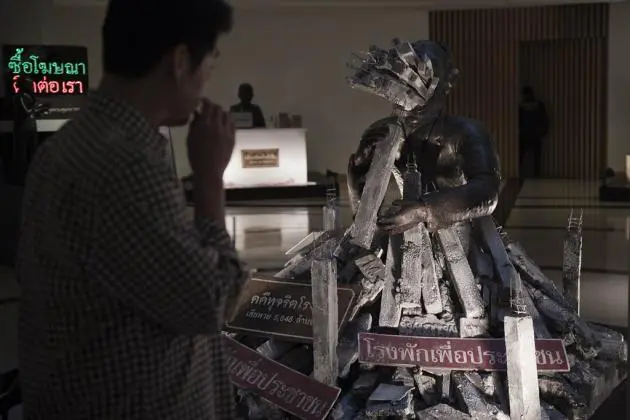
A bust of an unnamed man gobbling building pillars, captioned "the delicious meal of the police stations", dominates the room.
It references a scandal that saw the public coffers fleeced out of more than $160 million to construct nearly 400 police stations -- that were never built.
Anti-graft officials have charged Suthep Thaugsuban, who was deputy prime minister at the time the contract was awarded, with malfeasance over that case that saw one company win the bid to build the stations.
Suthep then went on to lead last year's movement against Yingluck, calling for her to be removed to excise corruption.
There is also a sculpture of three guffawing officials draped over a bright yellow Ferrari -- a long-running tax-dodging saga in which Thai customs officials helped smuggle luxury cars into the country without paying import duties.
The Thai junta has declared war on corruption, promising to slash the time it takes for graft cases to reach the courts.
Organisers hope the exhibition will also become a rallying cry to ordinary Thais wearied by graft -- and it has made an impact on the visitors so far.
"Each sculpture illustrates national cases of corruption which trouble my heart, because each one has caused tremendous damage," said 19-year-old Tatpitcha Khanumsee.
Another visitor, Anon Adhan, 30, praised the exhibition for its use of art to drive a "serious campaign".
"We don't want corruption. That's why I support this campaign, by visiting, taking photos and sharing on social media," he added.
