
Anti-coup group marches against 'dictatorship'


Play
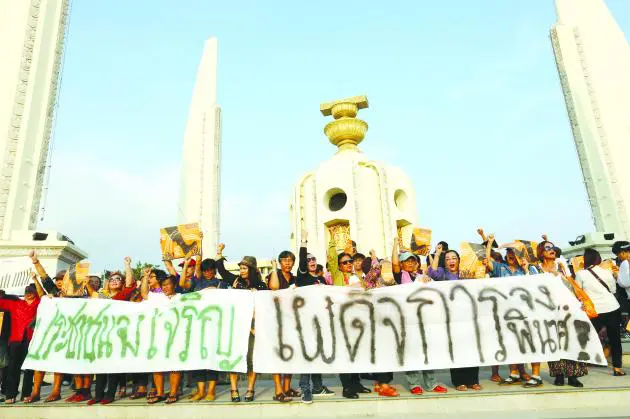
A LARGE group of demonstrators from the New Democracy Movement marched from Thammasat University to Democracy Monument yesterday evening, in a rally against dictatorship.
Yesterday’s march was part of the events held to mark the ninth anniversary of the military coup on September 19, 2006, which brought down the government of Thaksin Shinawatra following allegations of corruption and abuse of power.
The marching demonstrators, many of them university students, shouted “Down with dictatorship, long live democracy” and “NCPO get out”. They also displayed a banner that read “Return the power to the people”. The demonstrators remained at the monument until last night. A leader at the rally, Sirivich Serithiwat, said they would disperse voluntarily after 10pm.
Protest leaders read poems and played music at the monument. They were under close watch of police and military officers, some of whom recorded the rally on cameras.
More than 200 policemen were deployed around Democracy Monument, many of them directing the traffic at the roundabout. Some angry motorists honked at the protesters occupying three lanes of the road, and the students booed them.
When arriving at the monument, the protesters managed to climb over the traffic barriers put up by police around the monument. They then severely criticised the National Council for Peace and Order.
Government Spokesman Maj-General Sansern Kaewkamnerd yesterday said the NDM march appeared to be intentionally timed ahead of the prime minister’s trip to attend the United Nations’ general meeting this coming week.
“They anticipated some action by the authorities to make it look like violence was used against demonstrators. This is in concert with similar moves by people of the same group overseas,” Sansern said.
“They want to create a perception that this government is opposed by many people and that the local situation is still unsettled,” he added. “In fact, most people accept the government and the NCPO. And they know the government will stay only for a period to solve the country’s problems.”
A senior Metropolitan Police officer said that the march was against the newly-promulgated public gathering law and an NCPO order. He said police negotiated with the protesters in a bid to get them to disperse.
The protesters had earlier yesterday gathered at Thammasat University, where other events including panel discussions were held to mark the anniversary of the 2006 coup.
Prime Minister Prayut Chan-o-cha had instructed police to closely monitor the events and take necessary measures in case of violence, according to Royal Thai Police spokesman Lt-General Prawut Thavornsiri.
The NCPO is confident it can keep the NDM students under control, NCPO secretary-general General Chatchalerm Chalermsuk said.
The NDM held a discussion at Thammasat University entitled “Nine Years – Failure to Move On After September 19 Coup’’, before their march to Democracy Monument.
Chatchalerm said the NCPO allowed them to hold the discussion but declined permission for a rally. He said the students were familiar faces who had been arrested several times.
He said there was nothing to worry when asked if the junta were concerned about the timing of the protest, given it came ahead of Prayut’s trip to the United States for a United Nations general meeting later this month.
“Officials will not take a drastic approach and the situation will not escalate. We know this group of students well. We will resort to a soft approach, stressing negotiation. I believe most people understand that officials must enforce the law to keep peace and order,’’ he said.
He said the military and police could control the situation if the students were adamant about rallying.
The NDM distributed leaflets urging people to fight against what they labelled “dictatorship” and fight for democracy.
The organisers of the seminar were told they could not use the room they had booked earlier for the event and were forced to find another room.
Pichit Likitkijsomboon, a lecturer at Thammasat University’s Faculty of Economics, told the audience that the staging of two coups in nine years meant the country was trapped and it could not find a way back to becoming a democratic society.
He said countries which overcame conflicts between the old and new powers progressed but those which failed became underdeveloped countries such as those in Latin American.
“To become a developed country, we have to have an open society that allows people to freely express views, questions and thoughts,’ he said.
