
BYD Racco sharpens rivalry in Japan’s electric minivehicle market
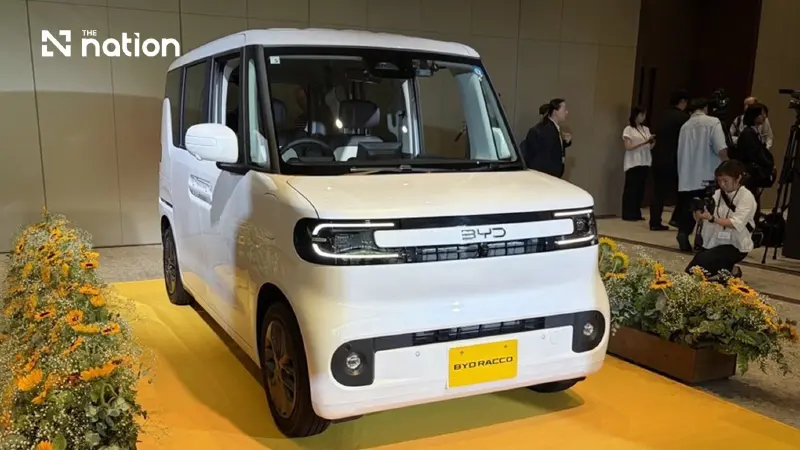


BYD is targeting annual Racco sales of 10,000 as more manufacturers enter a market constrained by high prices and dependence on government incentives.
- Chinese electric vehicle manufacturer BYD has entered Japan’s electric minivehicle market with the launch of its Racco model.
- The move intensifies competition in a niche segment currently led by Nissan's Sakura, with a Japanese automaker official stating the "battle between makers will certainly become fiercer."
- Rivalry in the market is expected to grow further, with a Japanese start-up and major manufacturer Suzuki Motor Corp. also anticipated to launch electric minivehicles.
- The competition is heavily focused on price, where government subsidies are crucial for electric models to challenge the far more popular petrol-powered minivehicles.
Low prices and day-to-day practicality have made minivehicles a major part of Japan’s automotive market, accounting for more than 30% of new vehicle sales.
Electric versions remain a niche, however, with only four passenger models currently available and each costing more than 2 million yen, putting them above their petrol-powered counterparts.
BYD Co. joined the limited field last week by launching the Racco in Japan.
The Chinese electric vehicle manufacturer is targeting annual sales of 10,000 units and wants the model to become “the new standard” for minivehicles.
“The battle between makers will certainly become fiercer,” an official at a Japanese automaker said.
Sales figures illustrate the gap between electric and petrol-powered models.
Nissan Motor Co.’s Sakura, which leads the electric minivehicle segment, sold about 10,000 units in fiscal 2025, which ended in March.
Honda Motor Co.’s N-Box, by contrast, recorded roughly 200,000 sales.
It was Japan’s top-selling petrol-powered minivehicle, according to the Japan Light Motor Vehicle and Motorcycle Association.
Government assistance can significantly reduce the price difference.
Japan provides subsidies of up to 580,000 yen for purchases of electric minivehicles, while additional local incentives allow buyers in Tokyo and certain other areas to acquire some models for less than 1 million yen.
Questions remain over whether the market can continue expanding once that financial support is withdrawn.
“Minivehicle buyers place a lot of weight on price. Competition will become far tougher once subsidies expire,” said Hikari Todoroki, a principal at KPMG Consulting Co.
The number of competitors is also expected to increase.
Further competition is anticipated from EMT Co., a Japanese start-up partly owned by China’s Chery Automobile Co., as well as Suzuki Motor Corp., a major Japanese minivehicle manufacturer.
An official at a Japanese automaker already selling electric minivehicles stressed that companies would be competing across the entire minivehicle market, rather than only against other electric models.
“Manufacturers must compete not only against rival electric models but against overall minivehicles on both performance and price.”

[Copyright The Jiji Press, Ltd.]
