
China deploys robotic dog for mountain transport and waste removal
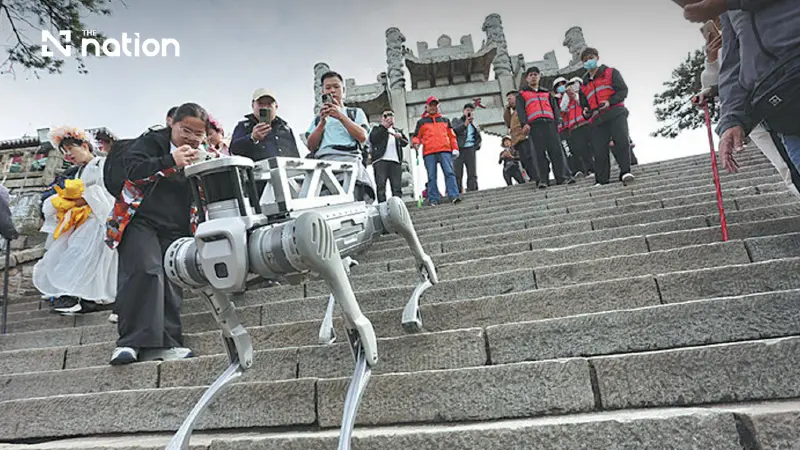


The four-legged machine takes on demanding mountain transport as Mount Tai broadens the use of artificial intelligence in site operations and tourism.
- A robotic dog has been deployed on China's Mount Tai to transport supplies uphill and carry waste downhill, assisting human porters.
- The robot is capable of carrying 30-45 kilograms, a load comparable to a human, and navigates steep terrain using cameras and LiDAR sensors.
- The goal of the deployment is to reduce physical strain on workers and improve efficiency in managing the mountain's significant annual waste.
- This initiative is part of the larger "Smart Mount Tai" project, which also utilizes other AI technologies like climbing exoskeletons for tourists.
A robotic dog has joined the workforce at Mount Tai in eastern China’s Shandong province, taking on some of the supply runs and waste removal traditionally handled by human porters.
It carries bottled water uphill and refuse back down the steep stone steps of one of China’s oldest pilgrimage routes.
The silver-grey unit is about one metre long and transports its cargo in a large nylon canvas bag secured to its back.
Moving at a steady pace among hikers, it normally carries between 30 and 45 kilograms on each journey, broadly matching the load transported by a porter.
Under stationary conditions, the robot can support up to 120 kilograms.
One battery provides four to six hours of operation, while rapid replacements enable it to remain in service throughout the day.
High-resolution cameras, LiDAR and several sensors allow the machine to identify obstacles and travel across inclines of up to 45 degrees.
Mount Tai’s difficult landscape has made porters essential to goods transport for centuries.
The same conditions have left waste collection heavily reliant on manual labour, with the scenic area generating about 24,000 tonnes of rubbish annually.
“The robotic dog is expected to significantly reduce physical strain while improving efficiency,” Wang Yunpeng, a manager at the scenic area, said.
Since entering service, the machine has also attracted the attention of visitors, who frequently pause to photograph it as it climbs.
Wang Liang, a tourist from Qingdao in Shandong province, posed beside the robot and expressed hope that further upgrades would enable it to provide greater support for tourism at Mount Tai.
The deployment forms part of the broader Smart Mount Tai initiative. Last year, the attraction introduced AI-powered climbing exoskeletons in one of the technology’s first large-scale applications in tourism.
Each wearable device weighs 1.8 kilograms and uses artificial-intelligence algorithms to reduce the physical effort required from climbers by more than 30 per cent.
A wider management system at Mount Tai connects AI with the Internet of Things, cloud computing and virtual and augmented reality.
Its functions include fire dispatch, crowd control and smart tourism services.
These developments also fall within China’s wider effort to bring AI into everyday life and major industries.
National guidelines issued last year set out the AI Plus Initiative, which targets extensive adoption by 2027 across technology, industry, consumption, social services, governance and global cooperation.
Similar systems have been introduced at other tourist destinations.
Mount Huangshan in Anhui province now uses climbing exoskeletons, cargo drones and AI travel assistants.
At West Lake, an iconic historic attraction in Hangzhou, Zhejiang province, tourism authorities have deployed an autonomous biomimetic robotic fish.
The device patrols the water, measures temperature and pH levels, detects invasive species and sends real-time ecological information to command centres.
Together, the projects show artificial intelligence moving out of research settings and into routine tourism operations across China.
Source: China Daily
