
Public health experts warn against co-payments in UC system


Play
USING co-payment methods in the Universal Coverage Healthcare Scheme (UC) would increase the burden on the poor and lead to disparity in the health system, public health experts have warned.
Despite this, the Thailand Development Research Institute (TDRI) reckons the co-payment method would help improve the health service under the UC scheme and benefit all UC beneficiaries, both rich and poor.
Former public health minister Mongkol Na Songkhla said he opposed co-payment methods to increase the UC budget because it would result in a wider disparity among beneficiaries and further burden the poor, who would have to pay more for medical services.
“Co-payment should not be implemented as many UC beneficiaries are poor and co-payment will push more financial pressure on them when they are most vulnerable,” Mongkol said.
He noted that even if the poor are exempt from extra charges; others will see that they are disadvantaged and it may also be considered class separation and social disparity.
“I disagree with all kinds of co-payment in the UC because it is supposed to be the fundamental health security to which everyone has equal access,” he said.
Nimit Tien-udom, a member of National Health Security Office and Aids Access Foundation director, echoed Mongkol’s view. He said he also disagreed with the idea of co-payment for universal coverage.
“This is the wrong way to solve the UC budget problem. The extra charge will increase the burden on the poor and some of them may be bankrupt if they have to cover large expenses that the scheme does not cover,” Nimit said.
Inequality among health security schemes is the real reason for the UC budget problem, he said, adding that reform is needed in health security.
“It would be unjust if the UC beneficiaries have to pay more to receive treatment under limited-fund healthcare scheme, while the Civil Servant Medical Benefit Scheme (CSMBS) beneficiaries can access an open-ended healthcare fund at no extra expense,” he said.
He suggested all three health schemes be managed under the same mechanism in order to average the budget to each scheme according to needs and “equalise” the health security system.
Mongkol also suggested that the UC management system should be reformed to reduce costs and save money.
“The clearest example of poor management of the UC scheme is the amount of people who have leftover medicine in their homes because the hospital gave them too much. If we adjust the UC management system, we can save up to 50 per cent of the budget,” he claimed.
On the other hand, Worawan Chandoevwit, a TDRI specialist on social security, insisted that the co-payment method would help to increase the fund for inpatients who need more subsidised money than outpatients and thus improve the quality of healthcare services.
Worawan pointed out that the problem the TDRI tried to emphasise was the budget for inpatients and outpatients did not suit the real need.
“The problem now is the fund for inpatients is insufficient, so the hospital may reduce the quality of treatment to save money but this will negatively affect the patients,” she said.
“Therefore, we suggested that more money from the outpatient budget be used to subsidise inpatients and let the money from co-payments be used for outpatients,” she explained.
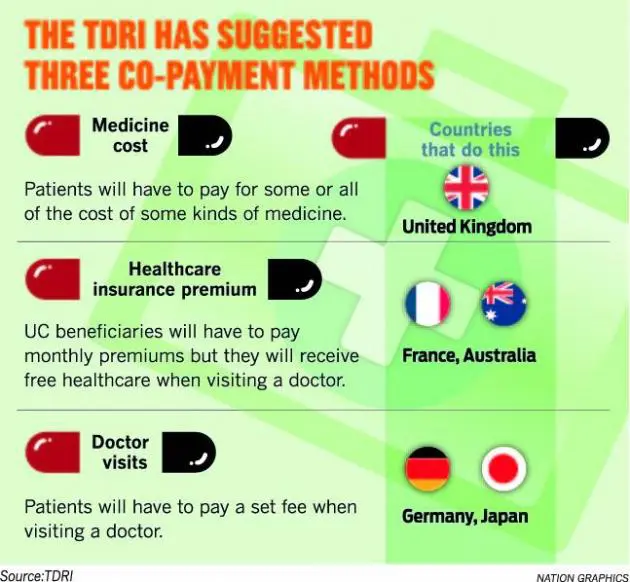
The TDRI suggested three co-payment methods: medicine cost, in which patients have to pay for some or all of the cost of some kinds of medicine; healthcare insurance premium, in which UC beneficiaries have to pay monthly premiums to receive free healthcare when visiting a doctor; and doctor visits, in which patients have to pay a fixed rate expense when visiting a doctor.
She said another co-payment suggestion presented by the TDRI would be to collect from outpatients who receive treatment and medicine for minor illnesses such as headache or cold, so those patients would think twice about wasting resources.
“This will also encourage them to take better care of their health so they don’t have to go to hospital with minor sickness and prompt medical staff to use up resources needed by patients with more severe conditions,” she said.
Prateep Dhanakijcharoen, acting secretary-general of the National Health Security Office (NHSO), said co-payment was inevitable.
“What we need to discuss is how the co-payment should be arranged. Should the co-payment take place upon medical visits or before medical needs arise?” he said.
If pre-co-payment method was chosen, it was very likely that specific taxes would be introduced for those purposes.
Prateep said the government needs to be brave enough to formulate such a policy, which would very likely affect the middle class.
He said middle-class citizens usually do not exercise their rights under the UC for minor illnesses and would embrace the collection of specific taxes for a co-payment system only when the government proves that the UC can really benefit them.
