
Public Gathering Act 'can only do so much to contain an angry mob'


Play
SPECIFIC measures related to the Public Gathering Act announced by the Royal Thai Police and the PM's Office Minister in recent weeks will affect organisers of public gatherings and people who join rallies.
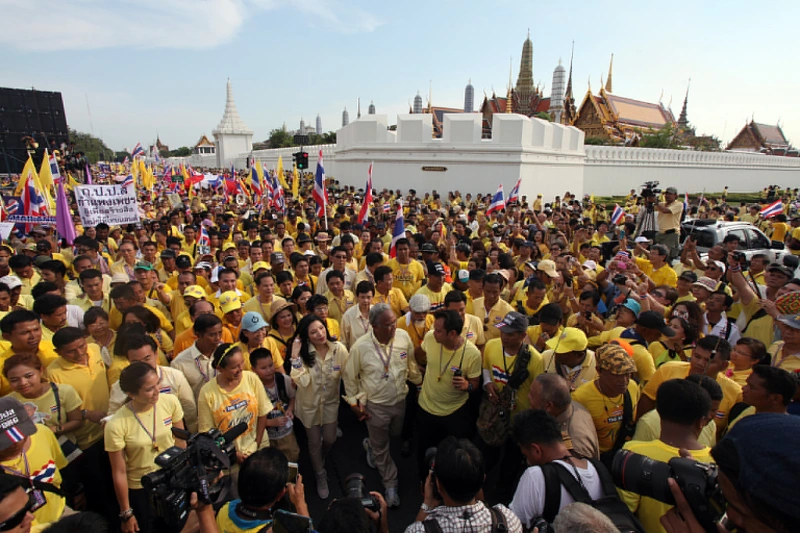
After more than a decade of political protests, Thais are very familiar with street rallies. Indeed, many times they have descended into days of civil strife and unrest.
Authorities say the new law, which took effect in August, aims to maintain security and prevent violence that might erupt from confrontations and conflicts between protesters and authorities, or rival political camps.
After the new measures were revealed, critics raised questions over whether they were restrictions of people’s rights – or measures to keep peace, order and national security, as claimed by officials.
The moves include a noise restriction during public rallies. Although the noise level that poses a health threat is over 85 decibels, authorities set the average noise limit at not more than 70 decibels within a period of 24 hours. When a large crowd gathers, critics wonder if demonstrators can hear what rally leaders say, even through loud-speakers.
The Act stipulates that people at public gatherings must not be armed, and they must be staged far from royal palaces, residences of royal guests, Parliament and courts.
Rallies must not block entrances or exits of state agencies, airports, public transport stations, hospitals and educational institutions. And they are prohibited from 6pm to 6am. No rally stage and loudspeaker system is allowed from midnight to 6am.
Sombat Boonngamanong, director and founder of the Mirror Foundation, who has had long experience in holding rallies, questioned the move to ban gatherings at strategic locations. He said holding rallies at such sites gives bargaining power to the people.
“We want state agencies to address our grievances quickly. We hold rallies because our petitions have fallen on deaf ears. State agencies ignore the plight of the public. That is why we hold rallies at now-banned locations,” he said.

However, Pol Maj General Sornkrit Kaewpaluek, commander of the Training Division, rejected criticism that the Act restricts people’s rights. He said holders of public gatherings must notify authorities in the area where a rally will be staged. This was not to seek permission but to inform officials about gatherings – when and where they will be held.
If officials think the gatherings are illegal, they can ban them. But rally organisers have the right to appeal such a ban, he said.
Sornkrit said the law stipulates that officials in charge of public gatherings must be well-trained and practice tolerance. Officials must strictly follow rules and regulations without exception.
“If everyone follows the law strictly, there will be compromise. This Act aims at keeping public safety. Other agencies involved in riot control must also undergo same training,’’ he said.
Last week, the PM’s Office announced what equipment can be used when officials seek to control a public gathering. The announcement said officials have the right to select 48 items of equipment that they believe do not pose threat to national security, public safety, public health, rights, liberty and human dignity.
They include anti-riot caps, bulletproof vests, ballistic shields, batons, handcuffs, toxic gas masks, teargas spray, mobile devices to jam frequencies, disposable teargas shooting devices, teargas guns, smoke hand-grenades, lights and sound hand-grenades, teargas-hand grenades, paint, high-pressure pumps, shotguns to fire rubber bullets or teargas, net shooting guns, electric shock equipment or tasers, high pressure water trucks, arms detection devices, metal barricades, cement barricades, barbed-wire, cranes to remove cement barricades and ten-wheel riot trucks.
These devices are intended to control crowds – not to assault protesters or cause injuries, officials claimed.
Sombat said although he agreed that demonstrators should not cover their faces and carry arms, he questioned if police could guarantee the safety of protesters in light of rival camps aiming to disrupt rallies and attack them.
“Protesters carry arms in self-defence against attacks from rivals. Large political rallies are prone to violence,’’ Sombat said.
He feared the law may not be effective in controlling rallies because there was a loophole, which is hard for authorities to deal with. That is when protesters are roused by their leaders to have the spirit to fight for a common goal – and stage a lengthy protest. “Peaceful protests can get out of hand if protesters turn into an angry mob. Protest leaders or police may not be able to cool them down. Once a large crowd shares angry feelings, this law may not be a solution,’’ he said.
