
Bill warns of jail for referendum ‘crimes’


Play
Wissanu says one of earlier charters or a mix could be used if people vote 'no'
THOSE who work for the failure of the upcoming referendum on the charter could face imprisonment for up to 10 years, according to the referendum bill written by National Legislative Assembly (NLA).
Article 62 of the bill partly stipulates that any one who causes disturbance, deceives, forces, or threatens voters in a bid to prevent them from exercising their right or to make them cast a particular vote in the referendum set to take place on August 7 would face imprisonment of 10 years or Bt200,000 fine. In addition, the court could also consider banning their electoral rights for a maximum of five years, too.
The bill would be taken up for the second and third readings at the NLA meeting today, said Jate Siratharanon, the assembly’s whip spokesman.
Meanwhile, amid questions being raised about the options for the country if the present charter draft bites the dust in the planned referendum in August, Deputy Prime Minister Wissanu Krea-ngam said the only recourse would be to revert to a recent charter or adopt a mixture of past ones. And the government would not organise a referendum because the process would delay a promised general election in 2017, he added.
Charter must be temporary
Scholars said any charter should only be a temporary one that could allow an election to take place. A permanent charter should be drafted after the next government takes power. Wissanu’s remark came in response to a call from politicians that the government make clear its plans for a new constitution, if the referendum outcome turned out to be negative.
Wissanu noted it was not appropriate to unveil charter alternatives now because they could distract voters. However, he said a backup constitution could possibly be one of the recent previous versions, or a new one written from the 1997, 2007, 2014, and the current charter drafts blended together.
“The government would reveal soon enough [about an alternative plan] because if the referendum outcome is negative, the [2014] interim charter will need amendment as to which constitution will be adopted,” he added.
Wissanu also said he wondered why a referendum should be held at all on the present charter draft. “Personally, I think there are some other ways that are cheaper and take less time, but we didn’t opt for them,” the deputy PM said, without saying what those ways were.
Concerning an additional referendum question to be posed by the NLA, Wissanu said that if legislators resolved to pose one, it would be sent for the Election Commission (EC) to process.
He said no matter how the result of the referendum turned out, nothing would be in vain because at least it revealed what people thought about the issues.
Abhisit Vejjajiva, former PM and leader of the Democrat Party, said yesterday the government should clarify to the people exactly what would happen if they did not accept the present constitution draft.
“The people have the right to know what would be the options before deciding on how to vote in the referendum,” he said.
‘No more referendums’
Gothom Arya, a constitution enthusiast and a human rights advocate from Mahidol University, gave the opinion it was not beyond his expectation that there would not be any more referendums if the present draft was rejected.
“However, I [believe] that any charter adopted after that should only be another interim one. The whole process should restart after an elected government takes office,” Gothom explained.
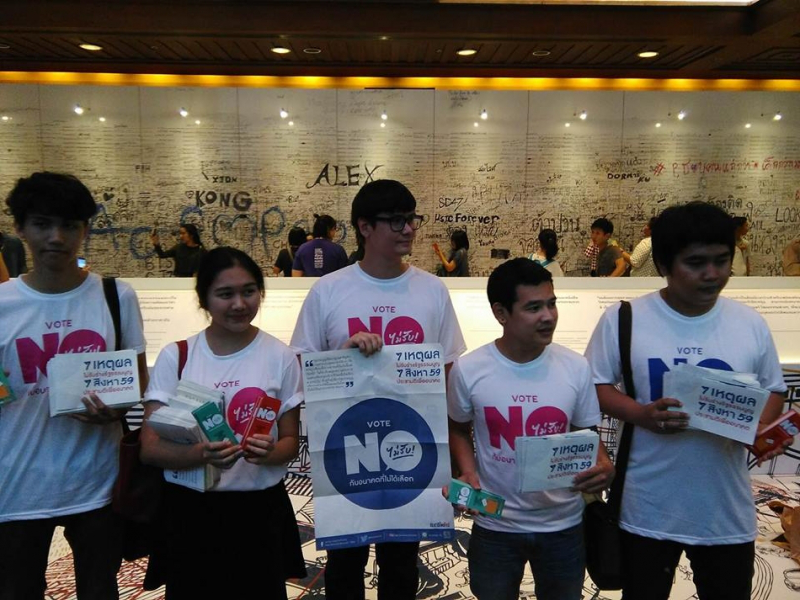
Yesterday, young activists of the New Democracy Movement showed up at the National Book Fair taking place at Queen Sirikit Convention Center to campaign against the charter draft, with the slogan “Vote No to the Unchosen future”.
