
Groups in the North successfully engage locals in reforestation


Play
UP IN THE NORTH, trees have returned to villages in Chiang Mai province thanks to a successful reforestation campaign.
The success at Ban Mae Sa Mai in Chiang Mai’s Mae Rim district can serve as a model for a campaign waged by the Plook Loei Group, or Plant It Now, which aims to do the same in Nan this weekend.
Suthathorn Chairuangsri, education director of the Forest Restoration Research Unit (FORRU) who led the campaign in Ban Mae Sa Mai, said the key to reforestation was to bring back the rich biodiversity of an ecosystem and this could be achieved by growing various kinds of ‘base vegetation’ on a local area’s natural environment.
Suthathorn said a successful reforestation campaign needed a good understanding in a local ecology, combined with intensive participation by locals.
“Our project area is on a mountain, which has an elevation of around 1,200 metres above sea level. The nature of the forest is hill evergreen forest, so we chose the native tree species that grows in this type of forest to re-grow in that area. This way we can preserve the originality of the ecosystem," she said.
“We also planted trees that are food for wild animals, and when the animals came back, they were bringing the seeds of many plant species with them and increase the biodiversity of the forest.”
She said the forest in Mae Sa Mai could evolve into a rich biodiverse forest, but it needed human care during the first two years. “Many reforestation efforts fail because trees are abandoned. Mostly, the areas for reforestation campaigns are usually open land, on which grass dominates. The grass competes with the young trees and causes the trees to die eventually,” she said.
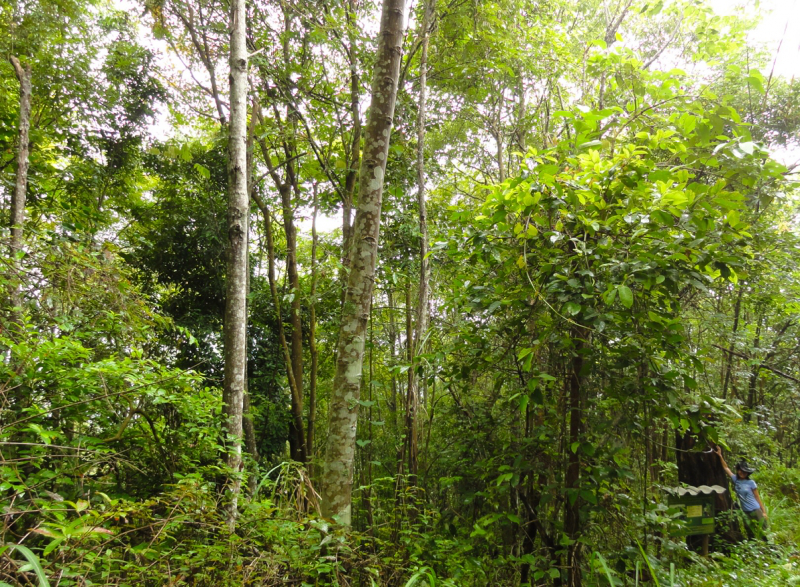
According to FORRU, Mae Sa Mai forest was planted in 2000, covering 137 rai of land. After 16 years, the plant species have increased to more than 90 species and many birds and rare wild animal have been sighted.
“Therefore, we have to keep getting rid of the weeds and fertilise the plants, if it is necessary, to ensure the survival of the trees. Then after two years, the trees will mature enough and we will only have to prevent a wildfire.”
The reforestation technique was also adopted by Somkiat Meetham, the Orphya Organisation director, who said his forestation project in Chiang Mai’s Mae Chaem district used native plant species alongside plants locals could use.
“Our main objective to re-grow the forest is to let the people live there and make a living from the forest by gathering forest products, so we encourage agro-forestry alongside forest preservation,” Somkiat said.
He said a solution to make reforestation sustainable was to let locals take part in the campaign so they develop a sense of belonging and will be willing to protect the forest. However, the forest must be suited to a community’s way of life.
“We have to let local people lead the campaign, because they can adjust the campaign to suit their lifestyle. They are also the main force to protect the forest as well,” he said.
Suthathorn also said locals were key to successful reforestation. “We are only the knowledge-provider but local people are the ones who live with the forest and protect the forest,” she said.
She suggested that area in Nan targeted for reforestation by Plook Loei Group was clear-cut land, so replanting the trees was essential but they had to be native trees that could survive in the elevated spot.
Fast-growing alien species such as wattle must be avoided because they would destroy the biodiversity, she said.
