
Govt denies cancelling coal-fired plant for Krabi


Academics urge long-term solutions to southern demand, including renewables
ACADEMICS HAVE said the decision to revisit and improve the environmental study on the Krabi coal-fired power plant is only a short-term solution and urged the government to pursue long-term options to satisfy the demand for power in the South.
Meanwhile, the government has emphasised that the country needs a new coal-fired power plant, while the decision to revisit the Environment and Health Impact Assessment (EHIA) study does not mean the cancellation of the project.
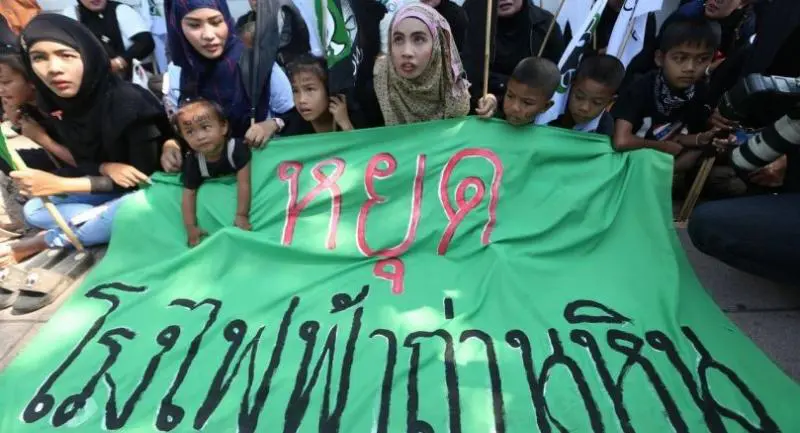
The government on Sunday reached an agreement with power-plant protesters and pledged to revisit the public-participation process in the EHIA study, ending demonstrations in Bangkok and prolonged protests over the past two years.
A former lecturer at Faculty of Science Silpakorn University and member of a tripartite committee on the issue, Renu Vejaratpimol, said that the promise amounted to progress, but in the long term authorities should consider other possibilities for power generation or the problem would not really be solved.
“I think that as the EHIA of the Krabi coal-fired power plant will be reset and restarted from the beginning, with the close inspection from a neutral joint committee, this coal-fired power plant project will not pass consideration. The location of the plant is wrong and … there will be too much of an impact on people and the environment,” Renu said.
“So, the government should consider other options for power development, because coal is not a good answer. Moreover, the tripartite panel has agreed that Krabi has potential to produce power from renewable |energy of up to 1,700 megawatts.”
She added that the government should give renewable energies a chance to provide power stability in the South.
Nevertheless, Renu said the government order to revisit the EHIA study was a good decision, as the previous EHIA report and public hearings on the project were incomplete and did not allow affected people to raise their concerns.
“The new EHIA study and public hearing should be closely monitored and regulated by a neutral joint committee, including all stakeholders, to make sure that all points of concern will be properly explored and everyone will have a chance to express themselves,” she said.
“It is very important to study the EHIA and conduct the public hearing properly according to the law, as the intention of the law is to protect and mitigate the impacts to people and the environment.”
Prasitchai Nu-nuan, leader of the Save Andaman from Coal Network, wrote on his Facebook page that the group had made an agreement with the government that the existing EHIA report would be revoked and a new report conducted under the surveillance of the neutral joint committee.
Prasitchai also said the new EHIA report would take about three to five years to complete and it was very likely that specialists would not approve the final report because the technology does not exist to entirely eliminate pollution from a coal-fired power plant.
Government Spokesperson Lt-General Sansern Kaewkamnerd said the order to revisit and improve the EHIA study would give a fresh start to the opposition.
“We have reached the conclusion that the southern region needs more power and there is a need to build a new power plant in the South. So we will start the public participation process for the project again,” Sansern said.
He also asked that the people should not confuse the words “set zero”, used by the opposition group, and “improve”, used by the authorities, as the implementation would remain the same.
Meanwhile, Deputy Prime Minister General Prawit Wongsuwan said the initial plan for project would still go ahead. The government delayed the project to ensure that public participation in the project was transparent, he added.
“Right now we have a problem that many people do not understand the energy issue and the environmental impact assessment of the previous EHIA report of the Krabi coal-fired power plant,” Prawit said.
“The prime minister renewed the EHIA process of the project to let people understand, but we do not abandon this project, because if we do not build this coal-fired power plant, we will face power shortages in the future.”
