
Dhammakaya devotees steal a march over DSI in social media war
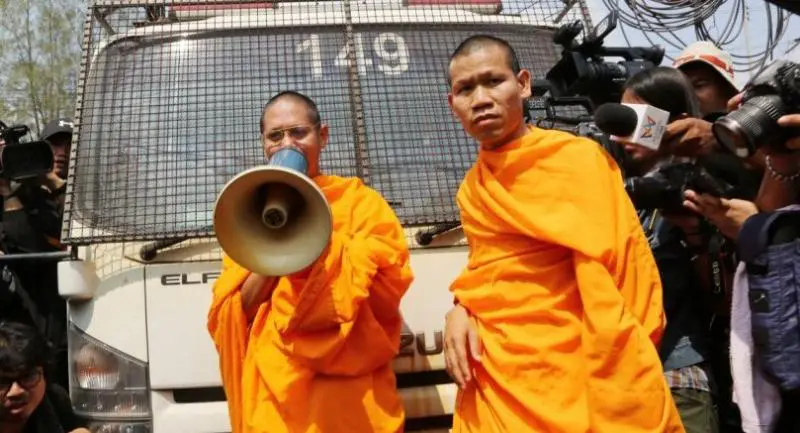


WHILE Dhammakaya Temple supporters are furious about biased reporting in the mainstream media regarding the ongoing stand-off with authorities, the temple has also used the media, notably social networks, to shape public opinion.
Its DMC television station, which was ordered closed recently, was a powerful medium for the temple to publicise its activities and teachings, reaching millions of followers through its satellite network. Since the closure of the station, the temple has turned to social media. Phra Sanitwong’s Facebook profile is the most active, with posts about Dhammakaya’s teachings and activities.
The monk operates multiple accounts, including one under his real name, Phra Sanitwong Charoenrattawong, as a spokesperson for the temple.
In addition to the monks, the temple’s lay followers are also using social media in a battle of information. The page “We love Dhammakaya” is among many pages posting about the temple and the stand-off with the authorities, notably the ongoing operation conducted by the Department of Special Investigation (DSI).
The newest page, under the name “Pitak Luang Por Duay Chewit” (protect the abbot with our lives), was launched recently in Thai, Chinese and English.
The temple, which has as many as 100 branches around the world, includes many non-Thai followers.
As the temple raid to arrest Phra Dhammachayo, the former abbot of the temple, was launched this past week, Facebook Live broadcasts by Dhammakaya monks and followers was used intensively to depict events on the ground.
The temple’s spokespeople have used social media to provide information about the temple, but also to assail authorities. Justice Minister Suwaphan Tanyuvardhana and his wife’s telephone numbers were shared widely on the temple’s social media networks, alongside threats against him and his family.
In addition to real information about the stand-off, false information and so-called fake news have also appeared on social networks, apparently intending to confuse perceptions of the situation.
It took the DSI days to realise that it had been left behind in the battle of information. Initially, junta supporters had used social media to defend the DSI and justify the operation against the Buddhist temple, while the DSI later took to Facebook to explain its operation and plans, as well as to identify misinformation in the public sphere. The department also uses Facebook Live to broadcast its operations and negotiations with monks and stream news conferences. But while the DSI uses English in its social media communications, its communications machine is far inferior to that of the temple.
The DSI spokespeople are also using Line to communicate with journalists to spread their messages.
Both sides have released “discourses” and “counter-discourses” attacking each other on social media. The temple has said the state is damaging Buddhism and bullying monks, while the government has said Phra Dhammachayo has no reason to run away unless he did something wrong.
