
Asean ministers meet to gauge economic impact of Russia-Ukraine war
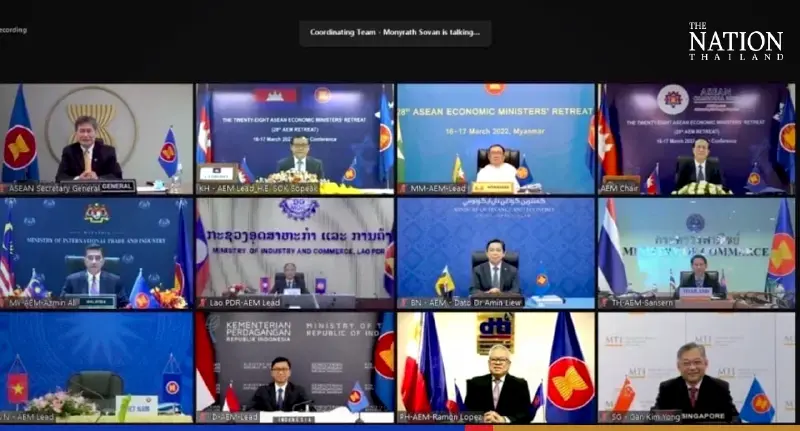


Economic ministers from Asean countries recently discussed measures that should be taken to curb the potential impact the ongoing Russia-Ukraine war will have on the region’s economy.
They also pushed for all 15 signatories of the Regional Comprehensive Economic Partnership (RCEP) agreement to ensure the pact is ratified and enforced as soon as possible, Vice Minister for Commerce Sansern Samalapa said on Friday.
RCEP, effective since January 1, is a free trade agreement between the Asia-Pacific nations of Australia, Brunei, Cambodia, China, Indonesia, Japan, South Korea, Laos, Malaysia, Myanmar, New Zealand, the Philippines, Singapore, Thailand and Vietnam. It is the largest trade bloc in history, accounting for about 30 per cent of the world's population or 2.2 billion people and 30 per cent of the global GDP valued at US$29.7 trillion.
The 28th Asean Economic Ministers (AEM) Retreat, chaired by Cambodia, was held online on Wednesday and attended by representatives of the 10 Association of Southeast Asian Nations members.

The AEM Retreat agreed that the Russia-Ukraine war would have a moderate impact on Asean, as the region relies on raw materials from both countries, including fuel, metals and steel, although direct trade is minimal.
They called on Russia and Ukraine to negotiate an end to the conflict soon to prevent a long-term impact on the global economy, especially Asean.
“The risk of interruption in the supply chain may slow down Asean’s economic recovery,” said Sansern, who represented Thailand at the meeting.
Thailand also proposed that Asean countries work together to curb the impact the war has on energy supplies in the region. The Russia-Ukraine war has resulted in a surge in global oil prices, and the rising cost of fuel has made consumer products more expensive.
During their meeting, the economic ministers also signed a memorandum of understanding specifying that Asean countries will not restrict the export of necessities until November 2024.
The ministers also discussed Asean’s readiness in becoming a digital society and the preparation of measures in response to the economic and social impacts of the Covid-19 pandemic.
Thailand’s trade with other Asean countries came in at $110.7 billion (3.6 trillion baht) last year, marking a 17.1 per cent increase year on year. Thai exports totalled $65 billion, compared to imports of $45.7 billion.
In January, Thai trade with Asean was valued at $9.3 billion (306.9 billion baht) – $5.2 billion in exports and $4.1 billion in imports.
