
Japan may counter China's influence


Play
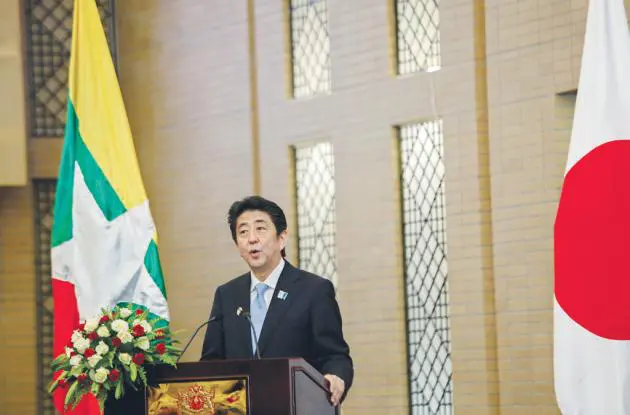
Japanese Prime Minister Shinzo Abe's visit to Myanmar, the first by a Japanese leader in 36 years, could counter China's strong influence in the Southeast Asian country, analysts said on Sunday.
But the welcome mat that is out for Japan now could be pulled away just as quickly if Japan’s largesse falls only on the already rich and powerful, others warn.
The visit, which included a meeting between Abe and President Thein Sein earlier on Sunday, highlights the quickly improving ties between the two countries since the end of military rule in Myanmar in 2011, they said.
During their summit in the capital Nay Pyi Taw, the leaders discussed the promise of Japanese technology and know-how in Myanmar to promote infrastructure development and sustainable growth.
Underlining Japan’s willingness to make serious inroads in Myanmar, Abe brought more than 100 representatives from about 40 Japanese firms with him, all seeking new ties with Myanmar government and business leaders.
That possible injection of a large number of Japanese companies into Myanmar’s economy is much welcomed from the top and from the grassroots.
“We will have economically better options in business partnerships,” Khun Tun Oo, chairman of the Shan Nationalities League for Democracy, an ethnic political party, told the 7Day News.
And Pyone Cho, a leader of the prominent ’88 Generation Students group, told the same newspaper it is time for Myanmar to choose “more credible” investors such as Japan.
Long a stronghold of China’s business interests, Myanmar’s opening to Japan could add strength to growing protests against existing Chinese investments in the country over lack of transparency, environmental concerns and adverse social impact.
Among the concerns of many in Myanmar is a $1-billion copper mine project in central Myanmar operated by China’s Wanbao Mining Ltd that has drawn continued opposition, even after a severe crackdown on protesters.
The Lapadaung Taung copper mine near Monywar in central Myanmar, operated by Myanmar Economic Holdings Ltd, the business wing of Myanmar’s army, and Wanbao Mining Ltd, a subsidiary of Chinese arms manufacturer China North Industries Group Corp, is particularly resented because of local land grabs and damage to the environment.And the mine did its reputation no good when a police crackdown on protesters last November left dozens of monks and villagers severely injured.
Other campaigns target China’s strategic twin pipelines carrying crude oil and natural gas across Myanmar to western China.
Perhaps even more damaging to China’s interests, in 2011, just months after Thein Sein became president, he suspended the $4-billion Myitsone dam project, bowing to strong public pressure against the massive dam planned for Myanmar’s symbolic Ayeyarwaddy River.
It would have inundated as many as 766 square kilometres of forested area, displaced thousands of people and submerged important historical and cultural sites.
Sun Yun, a China analyst at the International Crisis Group, wrote in the Journal of Current Southeast Asian Affairs last year that China has managed to overestimate its political and economic clout in Myanmar at the same time it has underestimated the anti-China sentiment among the people.
And it is this growing dissatisfaction with China that analysts say Japan can tap into with investments that bring job opportunities and increase the role of smaller and medium-size companies in the economy.
