
Poor, but benevolent


Play
Myanmar tops World Giving Index, thanks mainly to Buddhist teaching
Here is proof that generosity is not a virtue of only the wealthy: Despite stark differences in economic size, standard of living and per capita income, Myanmar shares first place with United States in the World Giving Index 2014.
The annual index is calculated by simply averaging responses to three central questions. The respondent has to answer whether any money has been donated to a charity, any voluntary work has been contributed to an organisation, and whether any help has been provided to a stranger, all in the past month.
According to Britain-based Charities Aid Foundation’s fifth annual ranking, the United States is the only country to rank in the top 10 for all three kinds of giving: Helping a stranger (1st), volunteering time (joint 5th) and donating money (9th).
Meanwhile, Myanmar has improved on its joint second place reported in 2013, with an increase from 58 per cent to 64 per cent in the World Giving Index. As highlighted previously, Myanmar’s lead ranking is mainly due to an extraordinarily high incidence of donating money. While 85 per cent of its population aged over 15 said last year that they had donated money, the ratio has risen to 91 per cent this year.
As of the third quarter of this year, the US economy is valued at US$17.6 trillion. That is 79 times higher than Myanmar's size of $221.5 billion.
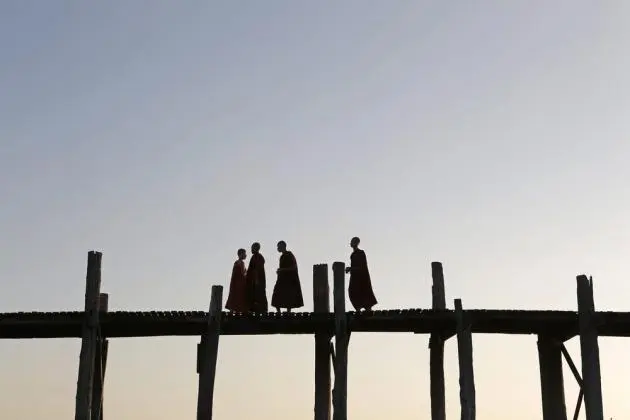
“Nine out of ten people within Myanmar follow the Theravada school of Buddhism under which the lives of the Sangha [ordained monks and nuns are supported by dana [charitable giving] by lay followers of the religion. This clearly translates into a strong culture of charity, with Myanmar ranked first for donating money and 13 percentage points ahead of the second-placed country. Sri Lanka, another country with a strong Theravada Buddhist community, also ranked within the top 10 of the World Giving Index, placing ninth,” the report said.
It is estimated that there are 500,000 monks in Myanmar, the highest proportion of monks to population of any Buddhist country.
“Indeed, the practice of charitable giving or dana is integral to religious observance amongst Theravada Buddhists, with it being one of the key paths to earning good merit. The position of Myanmar reminds us how important each country’s distinctive culture is in the predilection of its people to be charitable,” said the report.
In the top 20 chart, only Myanmar, Malaysia and Indonesia (13th) represented Southeast Asia.
Malaysia has experienced a significant improvement across all three ways of giving, resulting in a 26 percentage-point increase in its World Giving Index, moving up from 71st to seventh. This behavioural change is likely to reflect the humanitarian effort undertaken following Typhoon Haiyan in the neighbouring Philippine archipelago, and is in line with giving uplifts recorded following other natural disasters in China and Japan. It is encouraging that regardless of geography or culture, people universally appear to respond to those in need.
Ranked within the top 20 in the past four years, Thailand’s ranking this year dropped to the 21. In terms of donation, Thailand is ranked 3rd, behind Myanmar and Malta.
Among BRICS countries (Brazil, Russia, India and China), despite their expanding economies, only China has seen an increase in donating money to charity since last year, up from 10 per cent to 13 per cent. Though, all four countries have seen an increase in volunteering scores this year.
“Clearly, a prosperous economy does not guarantee higher levels of giving money,” the report noted.
