
Discussion on education law not yet over


Play
Nay Pyi Taw - Discussion on the National Education Law continued for two days as only seven points were agreed on Sunday despite the students' demand for a nine-point agreement which must include an amnesty to students participating in the protest march.
The four-party talks on the national education bill on Sunday were attended by Union Minister Aung Min of the Presidential Office, Union Minister Khin San Yi of the Education Ministry, officials of the Presidential Office and the Ministry of Education, Lower House MPs, Upper House MPs, intelligentsias including Dr Thein Lwin of the National Network for Educational Reform (NNER) and the student delegates of the NNER.
“The word “union” was hotly debated during the discussions. Reforming the educational system is quite difficult as the government side is against the wording,” Dr Thein Lwin of the NNER said after the meeting.
Nandar Sit Aung of the movement committee for democratic education noted that the protests will continue if students are not guaranteed of democratic education.
“We have given the government 30 days to meet our demands in case the talk is prolonged.”
Minister Aung Min urged students to stop the protest march.
“I will take responsibility for the students’ protest march to Popa only. It’s nothing to do with us if the students’ protest march is away from Popa. I’ll intervene personally in this matter because I want the discussions to agree on the remaining two points,” Aung Min said.
In a statement issued after the first-day meeting, Myat Nyarna Soe, the representative of the Upper House, said: “When the amendment bill is sent to parliament, we will handle it in line with the rules and regulations of the parliament,” Dr Myat Nyarna Soe, the representative of the Upper House.”
On the first day, Aung Min began the meeting with the promise that the agreement would be reached. The meeting went smooth in the morning session.
In the afternoon, three demands were agreed immediately. The process turned bumpy later, due to hot debates on the “union” issue.
The students demanded 9 points at the meeting, including;
(1) Joint statement after every talk
(2) Public announcement on matters related to the talk
(3) Equal right in the discussion
(4) Recognition to the currently-formed unions of students and teachers
(5) Permission to students and teachers’ participation in the law drafting
(6) Amnesty to those who took part in democratic education protest
(7) Discussions on by-laws and related laws acceptable to the students and the people within 30 days.
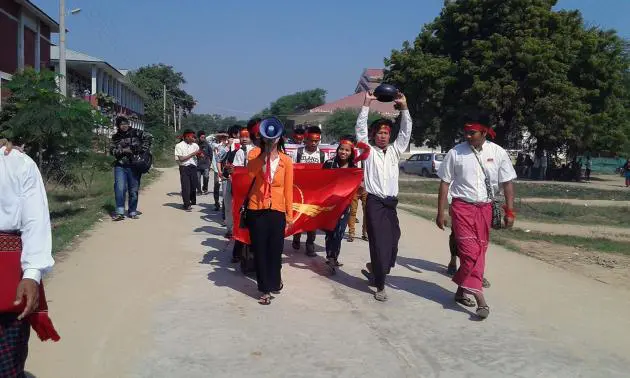
The discussion followed the march of some students from Mandalay to Yangon, a length of over 500km, in protest against the “centralised” law. Along the way, they have won supports from other students and villagers.
The students agreed to freeze the march as they started the discussion with the authorities. On Sunday, the students of Mandalay-based Yadanabon University staged a peaceful protest, to show their support to the talk.
