
A river runs through it


Play
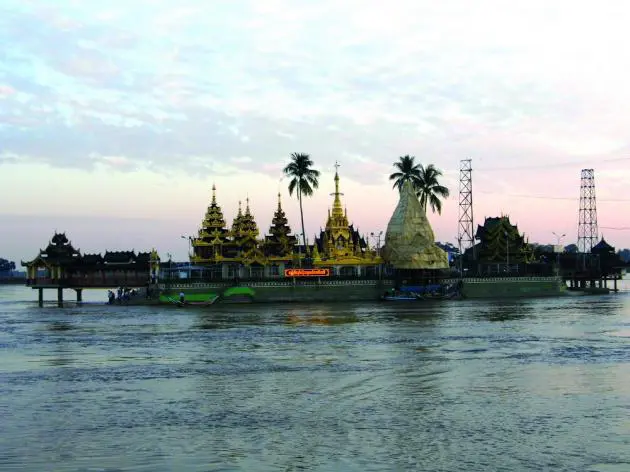
The Kyaik Hmaw Wun Pagoda (aka Kyauktan Yele Pagoda) makes for a perfect getaway from the hustle of Yangon if you don't have time to venture much further afield. The pagoda is situated on an islet right in the middle of a river in Kyauktan town, a 30-min
On arrival, visitors are greeted by religious fervor in the air only to be cajoled later into buying flowers from touts manning numerous flower and souvenir stalls on the pagoda grounds. Locals buy these ritualistic flowers as offerings to images of the Buddha. With flocks of seagulls fluttering overhead and big catfish infesting the river, it’s tempting to indulge in feeding the animals as a form of merit making.
Getting to the pagoda involves taking a short ferry ride (costing Ks300 or US$0.30 one way). It’s also possible to charter a ferry to the islet, which costs Ks 3,000 (US$3). Visitors love to feed the birds or throw popcorn at the fish after disembarking.
The statues of two ogre brothers stand guard over the entrance leading up to the pagoda's platforms. According to one historical account, Kyaik Hmaw Wun was built in the third century BC to house a collection of Buddha relics at the behest of King Bawgasena.
The pagoda is a real architectural marvel, whose uniqueness lies in the fact that the pagoda platform is right above the high-water mark meaning it always averts flooding at high tide. There’s also enough space for every visitor on the platform as the pagoda maintains a good balance in the number of people coming and leaving.
"During the Nargis, there was a great flood but the floodwater only reached the top end of the staircase. Part of the pagoda has never been submerged. Many believe this has something to do with the divine power of the pagoda and the vows [made by its builders]," said Zin May, a member of the pagoda’s management.
To the right of the entrance sits a statue of the Labamuni Buddha surrounded by two arahats – Maha Sivali and Maha Bakula. An exhibition illustrating the eight levels of Hell is on view right in front of the Labamuni statue to guide the visitors away from the sins.
Next to the exhibition zone, pilgrims are saying a prayer before the statues of Yele Bobogyi (the guardian spirit of Yele), U Shin Gyi (a Burmese Nat known as the Lord of the Sea), and Sarawati (the Hindu god of knowledge and wisdom) with offerings of bananas and coconuts placed nearby.
On the other side, the space opens up to the soothing vista of the Hmaw Wun river that has had people wondering for centuries how on earth the pagoda could be built in the middle of the current.
On the way back, one might want to take a jolly little side trip to Thanlyin, a small port town so steeped in history with religious monuments of historical significance such as the Kyaik khauk Pagoda and the remnants of a 17th-century Portuguese church.
