
Food prices rise in flood aftermath


Play
The price of rice has risen due to the worst flooding in in decades, which has claimed over 80 lives and affected over 300,000 people. At a press conference on Thursday, the Myanmar Rice Federation (MRF) said rice exports are being suspended until Septemb
The federation’s chairperson Chit Khine said: “People are afraid of rice shortages as 11 out of 14 states and regions experience flooding. That’s why we decided to stop the export of rice temporarily. Prices are rising fast due to huge purchases by charitable organisations and people.
“The federation is planning to open wholesale centres to prevent sudden increases. At present, we are delivering bags to Rakhine state and Mandalay and Magway regions. We are planning to send supplies systematically.”
Myanmar has around 15 million acres of paddy fields with more than a million acres inundated. From April 1 through July 17, Myanmar exported 397,607 tonnes of rice.
Deputy MRF chairman Aung Than Oo said that 10 wholesale centres will be opened in Mandalay city, Monywa and Shwebo in Sagaing Region, Pyay and Nattalin in Bago Region, Hinthada, Myaungmya and Kyaiklat in Ayeyawady Region. The association would also smooth the process for donors to purchase rice at Wartankone and Bayintnaung wholesale markets in Yangon. It also vowed to take action against profiteering.
“There is a lot goodwill with donors buying rice to supply refugees, but the problem is that they do not really know the going rate or where to buy rice in bulk. So they go to distributors and buy their entire stock, regardless of the cost. Then the distributors go to wholesalers and act similarly.
“So prices have rocketed. We will move to prevent this. The government is working on taking appropriate action under consumer protection laws,” Than Oo said
It is reported that in a flooded area, a sack of rice now costs between Ks60,000 to Ks100,000 (Bt1,709-Bt2,848), depending on the quality. Prices in Yangon remain unchanged at Ks17,500-Ks22,000, according to the association, which plans to ship rice through waterways to needy destinations to lower the transportation cost.
Due to the floods, domestic onion prices are also above export prices, discouraging exporters from exporting the commodity. The onions largely come from Pakokku, Magway, Seikphyu, Chauk and Shan State.
According to the Global New Light of Myanmar, as of Thursday the death toll nationwide was 88, including at least 55 in Rakhine State. The Rakhine floods have killed more than 4,650 cattle, displaced more than 85,400 people and destroyed 11,000 homes and more than 217,600 acres of farmland.
The Social Welfare, Relief and Resettlement Ministry said the floods, which began in June, had affected more than 330,000 people across Myanmar. The states of Chin and Rakhine, and the Sagaing and Magway regions in western and central Myanmar were declared disaster zones. Meanwhile, the water level was above danger levels in Ayeyawady Region.
In his monthly address last Thursday, President Thein Sein said the government had made arrangements for returning the flood-ravaged areas to normality as soon as possible. It is ready to assist farmers in ploughing their land and to provide them with seeds so they could grow rice.
“Floods and landslides have destroyed a lot of roads, train lines and bridges. But we are repairing them. Tractors and rice strains are ready for re-cultivation as soon as the waters subside. We also plan to reconstruct houses,” said Thein Sein, who was seen in Rakhine State on Thursday.
As the rivers in central and lower Myanmar swell, preventive and relief efforts are being made while dams and embankments are being watched, he added.
He also expressed thanks to those who had made donations, social organisations, monks, NGOs and diplomats for their generosity. International aid has poured in.
Opposition leader Aung San Suu Kyi urged people give the correct information on flood victims to help rehabilitation. The National League for Democracy is helping victims by cooperating with her Daw Khin Kyi Foundation, while collecting data on where and what help is urgently needed. Suu Kyi visited flood victims in Bago on August 3.
“It is a duty of all people to help flood victims,” said Suu Kyi. “We have saved enough rice in Ayeyawady Region. We will send bags to every affected area. It is encouraging that people are united when the country is facing a natural disaster. I ask people to continue their efforts.”
The Chin National Front and Chin Human Rights Organisation held an emergency meeting concerning natural disasters caused by climate change in Yangon last week. Attendees called for effective rehabilitation projects to be carried out by the national and the regional governments and allowing international foreign aid groups to operate in Myanmar.
They also urged Chin people living abroad to support natural disaster victims.
Aid efforts fail to meet need
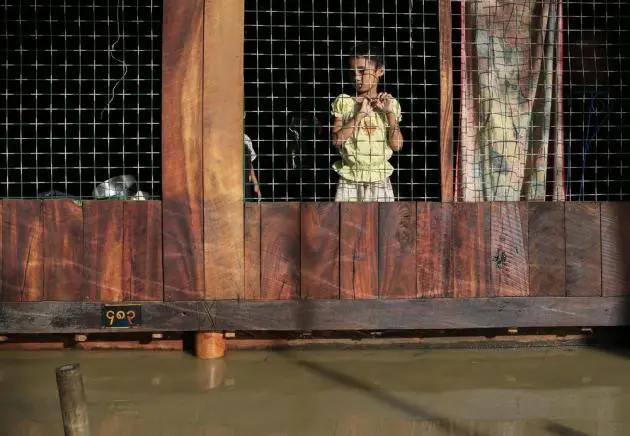
Flood-affected areas are now facing the aftermath of floods, including food and water shortages and rising commodity prices.
Water is selling for tens of thousands of kyats in Rakhine State’s Mrauk U. Water is currently being transported by boat and natural water sources are contaminated.
Water levels have receded across Sagaing Region but transport is still cut off in many areas.
“Though the floods have receded, we still can’t go home yet. Some of us are living with relatives while others are in schools and community halls. Some have caught the flu or scabies. Snake bites are also a danger. Many villages have been cut off during the two weeks of flooding,” said a Yaykyiwa villager, Shwebo Township.
In Maungdaw district, Rakhine state, Cyclone Komen has destroyed more than 1,700 houses, 130 schools and 29 monasteries. More than 280,000 sowed acres of farmland have been swamped, according to the land records department.
A female villager said: “Our farmland was flooded. Now we have no money to grow rice again. Last year we took a bank loan, now the bank says it can’t loan to us again without proof that we own the land.”
Kokang’s Myanmar Nationalities Democratic Alliance Army and the Ta’ang National Liberation Army have donated cash to help flood victims through the Sitagu Inter-national Buddhist Missionary Group led by Ashin Nyanissara.
“They transferred money to us through our bank. We accept donations from anybody. They transferred the money through the KBZ branch in Muse [northern Shan State],” said Sitagu’s Ashin Kaw Wida.
