
Laos' Sangthong district rolls out welcome mat for visitors


Play
VIENTIANE - Sangthong district, one of nine districts in Vientiane, is gearing up to attract tourists in a bid to further boost its economy after it was removed from the list of districts officially deemed to be poverty-stricken in 2014.
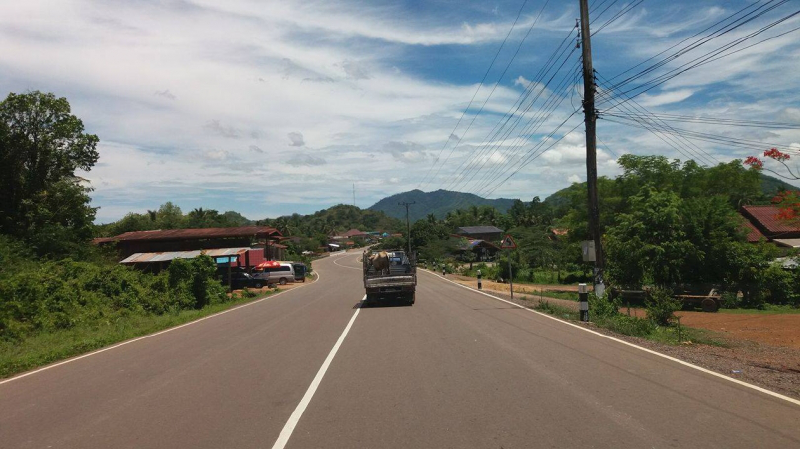
The district was doubly rewarded that year when a 60km paved road was completed, linking the remote and undeveloped area to central Vientiane.
This gave the district a huge boost by providing a fast connecting route to the economic opportunities offered by the commercial developments taking place in the capital. The new road also made Sangthong a more attractive prospect for developers and people looking for a new area to explore.
Located along the Mekong River and with a mountainous backdrop, the district is blessed with thick forest and rivers and offers a rural retreat on the outskirts of the increasingly built up capital.
Wanting to capitalise on their good fortune, district authorities are making plans to attract tourists by showing a different side of the country’s capital.
By doing so they are following the current socio-economic development plan adopted by the district’s 4th Party Congress in 2014, which placed a strong emphasis on tourism.
Head of the district’s Information, Culture and Tourism Office, Saveng Xanai, recently told Vientiane Times “Following the development plan agreed on at the congress, we are focusing on developing three particular tourist attractions. At present we are trying to decide which one we will embark on first.”
The first site under consideration is located along the Mekong River, where various leisure facilities would be offered.
The second area is along the Nam Sang river, which would attract people looking for stunning scenery and a rural idyll. It has been compared to the Nam Xong river in Vangvieng district, Vientiane province, and has many big trees.
The third area of interest is along the Nam Ton river. This location has waterfalls and is also the place where the President Souphanouvong spent 10 days after he and other leaders escaped from Phonkheng Jail where they were imprisoned during the Indochina War.
Saveng said “Don Kangkhong island, situated in the Mekong River, is also under consideration as a tourism site, but would be developed by the Vientiane authorities, who plan to build a resort, restaurants and other facilities.”
Following the development plan, the district also plans to use its agricultural strengths as a tourist attraction. There are various projects centred on the cultivation of organic rice and other crops, which would be of interest to visitors, Saveng added.
Deputy Head of the district’s Agriculture and Forestry Office, Somdeth Bouphakham, said recently “Our office is involved in the organic cultivation of rice and other crops. We are also promoting five locally-produced items under the ‘One District, One Product’ scheme, which we hope will be of interest to visitors.”
The production of organic rice involves 284 families who live in eight villages by the Nam Ton river. This year they hope to export 100 tonnes of rice to Europe and to grow and export more in the coming years.
The Republic of Korea is also running a project in which 10 families grow organic crops on an area of nearly one hectare in Pakthaep village. Families who live by the Mekong and Nam Sang rivers also grow crops on the riverbank and sell organically farmed vegetables at local markets.
The district also has four large cattle and goat farms, and a banana plantation. Several business operators are interested in setting up pig and fish farms, which could also become tourist attractions.
The district has 35 villages and more than 75,900 hectares of land, of which 29,900 hectares are agricultural land.
A recent statistics report issued by the Tourism Development Department of the Ministry of Information, Culture and Tourism showed that Laos’ tourism sector countrywide generated over US$725 million in 2015.
Tourism now ranks third in terms of income generation. The minerals sector tops the list and generated over US$1.292 billion in revenue for the government in 2015.
Second place was occupied by other industries combined, yielding over US$917 million, while electricity generation was fourth on the list with more than US$495 million, and agricultural products came in fifth with revenue of US$319 million.
The number of tourist arrivals in 2015 was over 4.6 million people. This was an increase of 13 percent compared to 2014, when some 4.1 million people visited Laos.
