
End of an era: Fidel Castro dead at age 90
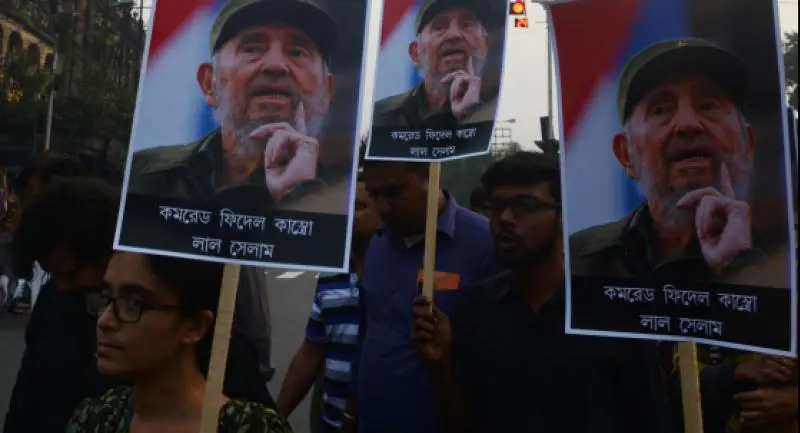


9 days of mourning decreed as world leaders salute revolutionary
Cuba’s historic revolutionary leader Fidel Castro died on Friday – yesterday Thailand time – aged 90, after defying the United States during a half-century of iron-fisted rule and surviving the eclipse of global
communism.
One of the world’s longest-serving rulers and modern history’s most singular characters, Castro defied 11 US administrations and hundreds of assassination attempts.
His younger brother, President Raul Castro, announced the news shortly after midday (Thai time) but gave no details.
Fidel Castro crushed opposition at home from the day he took power in 1959 to lead the communist Caribbean island through the Cold War. He stepped aside only in 2006 after intestinal surgery.
For backers of the revolution, Castro was a hero defending ordinary people against capitalist domination. For opponents, including thousands of Cubans in the US, he was a cruel tyrant.
Castro eventually lived to see the restoration of diplomatic ties with Washington last year.
“The commander in chief of the Cuban revolution died at 22:29 hours this evening,” the president announced on national television just after midnight Friday (0500 GMT Saturday).
“In compliance with Comrade Fidel’s expressed will, his remains will be cremated early in the morning” on Saturday, said Raul Castro, who took power after his elder brother Fidel was hospitalised in 2006.
The government yesterday decreed nine days of mourning.
From November 26 to December 4, “public activities and shows will cease, the national flag will fly at half mast on public buildings and military installations,” a statement said.
Castro’s ashes will be buried in the southeastern city of Santiago on December 4 after a four-day procession through the country, it added. Santiago was the scene of Castro’s ill-fated first revolution attempt in 1953.
‘Symbol of an era’
Castro’s death drew strong reactions from world leaders.
“The name of this distinguished statesman is rightly considered the symbol of an era in modern world history,” said Russian President Vladimir Putin in a telegram to Raul Castro.
Former Soviet leader Mikhail Gorbachev also hailed Castro for “strengthening” Cuba in the face of US pressure. He said the late leader left a “deep mark in the history of mankind.”
French President Francois Hollande said Castro “represented, for Cubans, pride in rejecting external domination.”
Venezuelan President Nicolas Maduro, Cuba’s main ally in the region, said on Twitter: “It is up to us to continue his legacy and carry his flag of independence.”
Indian Prime Minister Narendra Modi sent his “deepest condolences” to Cuba. “India mourns the loss of a great friend,” he wrote on Twitter.
In Havana, car washer Marco Antonio Diez, 20, said he was out at a party when the music stopped and he heard the news. “I went home and woke up everyone,” he said.
In the streets of Miami, home to the bulk of the US Cuban community, euphoric crowds waved flags and danced, banging on pots and drums.
The bearded, cigar-puffing leader, renowned for trademark army fatigues and hours-long public tirades, grabbed power in a January 1, 1959 revolution.
Living by the slogan “socialism or death,” he kept the faith to the end, even as the Cold War came and went.
He endured hundreds of assassination attempts, according to his aides, and the disastrous US-backed Bay of Pigs invasion attempt in 1961.
“If I am considered a myth, the United States deserves the credit,” he said in 1988.
Furious diatribes
Castro was at the centre of the Cuban Missile Crisis in 1962, as the world stood on the brink of nuclear war until the Soviet Union blinked in its bid to station strategic missiles on Cuban soil.
Well into his old age, Castro unleashed furious diatribes against Washington until he was slowed by surgery in July 2006.
An energetic symbol of defiance for developing countries and a driving force behind the Non-Aligned Movement, Castro proved even a small sovereign nation could thumb its nose at the world’s biggest superpower.
Born August 13, 1926 to a prosperous Spanish immigrant landowner and a Cuban mother of humble background, Castro was a quick learner and a keen baseball player. His political path was set when he formed a guerrilla opposition to the US-backed government of Fulgencio Batista, who took power in a 1952 coup.
In 1953 Castro led a small rebel force that attacked a major military base, the Moncada Barracks, in a bid to oust Batista. The drive failed. Castro was put on trial, and in a self-defence speech said he did not care if was convicted.
“History will absolve me,” he said.
