
Polish up your Tintinology


Play
An engaging biography of the troubled creator of Tintin re-emerges in a 20th-anniversary edition, just in time for Spielberg's big-screen homage
There is, admirably, no sales pitch for the new Steven Spielberg movie “The Adventures of Tintin: The Secret of the Unicorn” anywhere in this reissue of a much-admired 1991 biography of the cartoonist who conceived, raised, protected and ultimately despised Tintin. Surely the book is reappearing now to coincide with the film but, just as Hergé loathed exploitation, it avoids shilling for Hollywood.
And hopefully that is just as Spielberg would prefer. Enough that Harry Thompson took note 20 years ago of the deep influence the Tintin comics had on the great director of fantasy movies, as well as on Andy Warhol and, of course, generations of other cartoon artists.
Enough that critics are calling Spielberg’s “Tintin” his best film since the early days, when he was mining Hergé for all he was worth, from alien encounters to temples of doom. (Steven didn’t do as well with an discarded Hergé yarn about a man stuck living in an airport.)
Spielberg hasn’t yet tired of Indiana Jones, but it’s a safe bet he's in no hurry to get back to ET. Certain characters have a way of getting out of control due to their sheer popularity, and that was the case with Tintin. After 40 years of drawing the boy reporter, Hergé sketched Tintin holding a noose over his head. He’d had enough.
This is the part of the story that makes the book fascinating even for people who never really got acquainted with Tintin (such as North Americans like me). In Europe he was so well known and commercially successful that he ruined his creator’s life with endless bickering over the rights and the proceeds.
By the 1970s Hergé was vanishing for long periods, only to drag himself back to his Brussels studio and, on putting pen to paper, breaking out in crippling eczema rashes.
He would have recurrent nightmares that ended up depicted in the comic strips, exorcised as it were, with fans unaware of the origins of strange scenes and events. Hergé’s blinding white dreams of being trapped in a snow tunnel drove him to a psychoanalyst – and then became “Tintin in Tibet”.
Hergé, whose real name was Georges Remi, emerges as a quirky, not-altogether-sympathetic innovator who did his own share of borrowing to concoct Tintin, in 1929, for a comic strip in the right-wing Belgian newspaper where he worked as an illustrator. “Tintin in the Land of the Soviets”, the original serialised adventure, sent the paper's circulation soaring. The series were subsequently published in book form.
Thompson takes a fond, funny look at each of the Tintin stories in turn, from the Belgian Congo, America and Egypt to India, the moon and deep beneath the sea, and explains what was occurring at the time around the globe and in Hergé’s life. World War II ended what little admiration the cartoonist had for fascism, but post-war critics still hauled him over the coals for “collaborating” with the Germans.
In fact, all Hergé had done was decide to stay in Belgium and continue working. (The Nazis controlled the newspaper, but not Tintin.) The critics chose to forget that he’d ridiculed Hitler and Mussolini in 1939 with a dictator character called Musstler.
Hergé remained a keen satirist and promoted social reforms in his strips, but eventually the responsibility of rearing Tintin became too much for him, and he fell short of his goal of emulating Walt Disney and his Mickey Mouse empire. There were failed marriages, conflicts with his production team and ceaseless rows with publishers. That his life story still enthrals with charm and amusement is a credit to his fundamentally beneficent nature and the good heart of the late Harry Thompson.
In 2001, nearly two decades after Hergé died, the foundation that was set up in his name demanded that a Chinese publisher recall its translation of “Tintin in Tibet” because it had changed the title to “Tintin in China’s Tibet”. It was just another copyright dispute. The original title was restored.
Five years later, the Dalai Lama bestowed the Light of Truth Award on Tintin, ostensibly because that 1960 book had introduced so many people to his homeland’s landscape and culture.
Not so, alas, “Tintin in Thailand”, a 1999 parody credited to one “Bud E Weyser” that took the quiffed hero and his pals on a sex tour. Printed here for distribution in Belgium, it was promptly declared illegal by the Hergé Foundation but it is, of course, still for sale in Bangkok.
Swear like a sailor
Tintinologist, the Internet’s “oldest and largest English-language Tintin fan site”, lists every curse ever uttered by the young adventurer’s companion Captain Haddock, and much more. See www.Tintinologist.org.
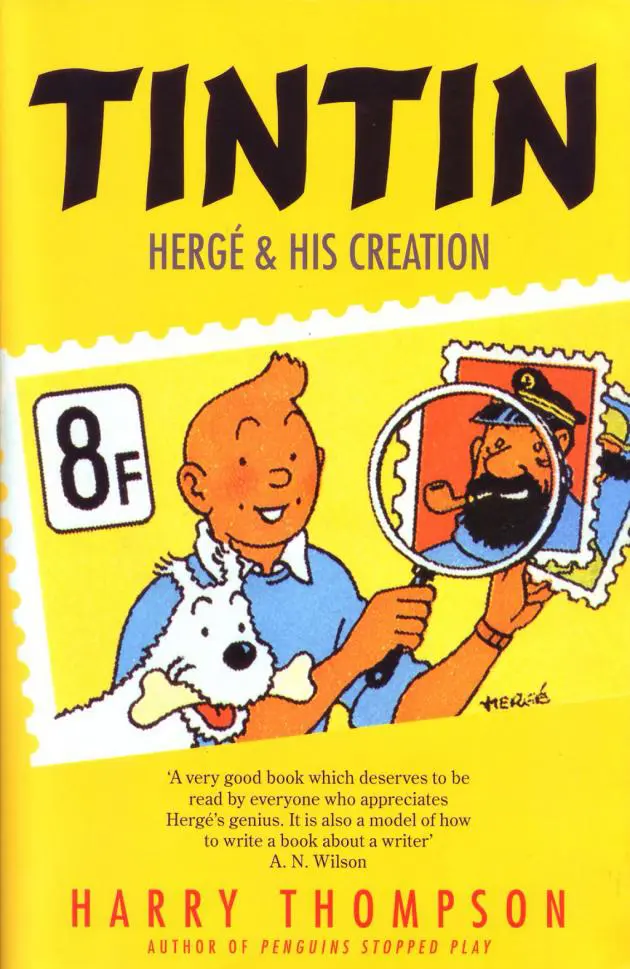
Tintin: Hergé and His Creation
By Harry Thompson
Published by John Murray, 2011
Available at Asia Books, Bt316
Reviewed by Paul Dorsey
