
Thanks for all the foithong


Good mates of ours for 500 years, the Portuguese enriched Siam's mealtimes and vocabulary
Simon de la Loubere, France’s ambassador to the court of King Narai of Ayutthaya, counted around 40 different ethnic groups living in the monarch’s good graces. There were Lao, Mon, Khmer, Burmese, Chinese, Japanese and Muslims, he noted, and also the tribe that the Siamese called farang.
The French had obviously joined that category by 1687, but that was late compared to the Portuguese, who made first contact with Ayutthaya in 1511, when Rama Thibodi II was on the throne.
Historian Charnvit Kasetsiri and his team re-counted the nationalities for a paper titled “Ethnic Groups in Ayutthaya”, which was presented at last month’s conference marking the 500th anniversary of Thai-Portuguese relations.
The historians determined, among other things, that the Portuguese eventually earned the names chaow borathet, chaow prathet, khaek muang farang patugun and farang losong portugate – losong deriving from Luso, their own name for themselves.
Like most of the Europeans who followed them, the Portuguese had two chief aims in opening up new territory – spreading Christianity and making a lot of money in trade.
Alfonso de Albuquerque seized spice-rich Goa on India’s western coast in 1510 and then turned his fleet against the booming Malay port of Malacca. Once that was secured amid much bloodshed, cooler trade negotiations began with lesser nodes of the Asian trade route – Siam, Pegu, Kedah and Pattani.
Duarte Fernandes was dispatched to Siam, which was known to be more open to foreign business (and more tolerant of the word of Jesus). By hook or by crook, the Portuguese built history’s first global empire, with outposts ringing the African shore and as far away as Indonesia and China.
Associate Professor Dr Chuleeporn Virunha of Silpakorn University told fellow conference participants that the Portuguese rounded up most of the spices they wanted in India, but they also coveted pepper from Malacca. European cooks were gasping for the stuff, with those in Venice willing to pay 100 times more than it cost the traders in Malacca.
Chuleeporn stressed, though, that Portuguese trade in Southeast Asia was not only commercial but cultural as well. They were the world’s best shipwrights, navigators and explorers in the 15th and 16th centuries. Ayutthaya welcomed their expertise in these and other undertakings.
Researchers found evidence of three different Portuguese ambassadors in Ayutthaya in just six years, each of them bringing new techniques for building city walls or digging canals, for drawing maps or forging cannon.
“What Ayutthaya had to offer in return was different from the Malay Peninsula,” said Rasi Burusrattanapan of the government’s Fine Arts Department. “We offered items from the forests, such as elephant tusks, animal hides and fragrant wood, as well as rice.”
Some of the Portuguese merchants and adventurers battled the Burmese alongside Ayutthaya’s troops. Others served the Siamese as pastors, state officials and translators.
All of them were cloistered in the Portuguese settlement on the south edge of the city. They were the first Europeans to be granted ownership of land in Siam – and possibly the last, as a group.
Covering 400,000 square metres, theirs was the third-largest community after those of the Chinese and Muslims. It had its own moat on three sides and about 100 houses, as well as shops, warehouses and churches.
As conference participants discovered during a visit to the archaeological dig site one morning, the remains of three churches can still be seen – a Jesuit one in the south, Franciscan in the centre, and Dominican to the north that retains remnants of crosses and other religious icons.
The Portuguese bestowed other legacies on Thailand, Associate Professor Dr Chatchawadee Saralamba of Thammasat University noted. One is a small vocabulary of words still used in daily life. “It’s hard to distinguish between what’s original Thai and what is Portuguese because we so commonly use the words,” she said.
“Most of the Portuguese words were borrowed for the things we didn’t have prior to their arrival, or else we created our own terms based on theirs.”
Share credit with the Portuguese for kradaat (paper), sabu (soap), pinto (the food carrier), kampado (comprador, a broker), baatluang (pastor), lah (yard, the distance measure), and laylung (discount sales).
“But, interestingly, we’ve seen no military-related words borrowed from the Portuguese,” Chatchawadee said.
Perhaps even more interestingly, according to the journal of the French envoy de la Loubere, the Siamese endured life without dessert until the arrival of the Portuguese. “Siamese previously only drank water after meals,” Chatchawadee explained.
Once the farang induced a fondness for sweets, “We borrowed or created words for all the Portuguese desserts”.
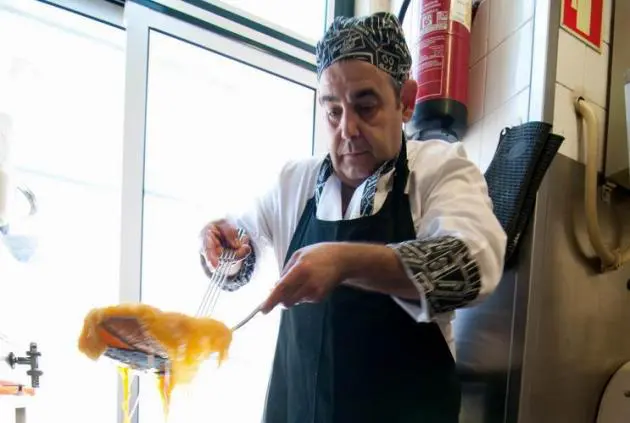
Most Thais today know that foithong is of Portuguese origin – fios de ovos, they call the delicate lacework of oil-fried eggs.
Fewer Thais realise that the same country gave them thongyod, the soft egg drops made with yolk and sugar, known in Portugal as ovos moles. Lookchoop is massapdes, a mung-bean mash mixed with sugar and moulded into miniature fruit and vegetables.
Kanom ping is broinhas, the cookie balls made with flour, coconut cream, sugar and egg. Sungaya is bolo de coco, or egg and coconut cream custard. Mogaeng is tigelada, a baked coconut pudding, and baabin is quenijade de coimbra, which is coconut bars made from glutinous rice flour and sliced coconut.
It’s commonly believed that these desserts were adapted for local palates by Marie Guimar de Pihna, the half-Portuguese, half-Japanese wife of the celebrated Greek adventurer Constantin Faulkon, who served in the Ayutthaya court as Chao Phya Vichayen.
Were relations with the Portuguese always so sweet and savoury? Not according to several accounts of an 18th-century Portuguese priest in Malacca who railed against Ayutthaya’s “cruel” King Naresuan.
The man now revered by Thais as Naresuan the Great was, the priest insisted, an enemy of God and all Christians, and should be got rid of.
Friends across the ages
The International Conference “The 500th Anniversary of Siam-Thailand Relations with Portugal and the West: 1511-2011” at Ayutthaya Rajabhat University was organised by the Foundation for the Promotion of Social Science and Humanities Textbooks Project, the Toyota Thailand Foundation and Toyota Motor (Thailand).
