
The past in person
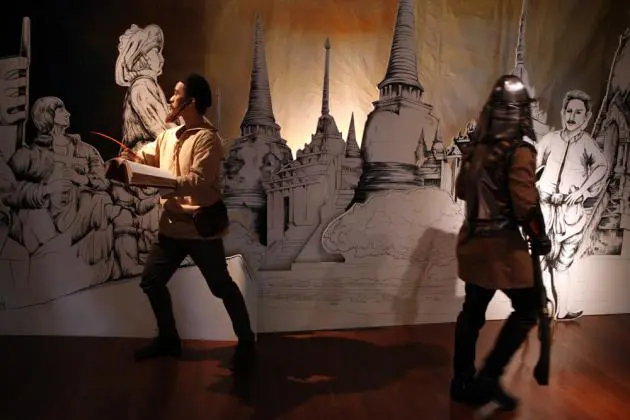


Some of Siam's original Portuguese visitors are 'reborn' in the flesh to tell the tale
Fernao Mendes Pinto is at Museum Siam, looking quite well despite being more than 500 years old. He visited the Kingdom of Ayutthaya when he was young.
“I arrived in Odia, the capital of Siam during the reign of King Chairacha Thirat,” he says, which would put it in the 1530s or 1540s. “Odia has two seasons – summer with lots of rain and winter. It looks like Venice with its canals and rivers. It’s a populous city with many beautiful temples.”
An actor portrays the famed Portuguese traveller and chronicler of Asia to help Thailand celebrate half a millennium of warm relations with Portugal. The exhibition at Museum Siam is called “Ola Siao – Five Centuries of Thai-Portuguese Relations: God, Greed and Gold – and the Ultimate Quest”.
Other costumed actors play other historical figures as the story of European gallantry – and greed – unfolds.
Mendes Pinto also referred to Ayutthaya as Sarnau in his memoir “Pilgrimage”. It was “wealthy and fertile”, he reported. You can see it on the old maps on view alongside Portuguese guns, costumes and paintings.
Domingos de Siexxas, a famed mercenary who joined Ayutthaya’s army in battling the Burmese, has his own swashbuckling tale to tell. He and his compatriots were “building Fort Pasir” in Tenasserim near the border when he was captured by Siamese troops while hunting for food.
“Seventeen of us were taken prisoners-of-war and sent to Ayutthaya, where I was detained for 20 years, but it wasn’t such a horrible experience. The Siamese king learned of our military skill, so he drafted us into his army. Many of us became sharpshooters for the army.”
Museum visitors also meet in person priests and courtiers and Alfonso de Albuquerque and Marie Guimar de Pinha, who helped establish relations between the countries, and their stories don’t stint on admissions of Portuguese avarice.
They came for spices and other precious commodities, and more often than not took what they wanted by force. Ayutthaya, an important node on the trade route, was amenable to the Europeans’ business proposals and tolerant of their Christian preaching, so there was no animosity.
The foreigners’ willingness to share their skills and knowledge ensured that Siamese rulers always welcomed them. As Marie Guimar de Pinha acknowledges, Thailand is today the only Asian country commemorating the great Portuguese “adventure” five centuries ago.
“Other Asian nations don’t have such a sweet, beautiful history with them,” she says, recalling the Portuguese attacks on Malacca and Goa, which became colonies.
In 1509 Afonso de Albuquerque became the second governor of Portuguese India and set about expanding the empire into Southeast Asia. He captured Goa, Hormuz, Malacca and around 30 other coastal cities for use as trade stations and naval bases.
Malacca fell in 1511 and Portugal maintained the city’s central role in regional trade while building commercial and diplomatic relations with neighbouring kingdoms Pegu, Siam, Pasai and Pattani and exploring the possibilities regarding China.
“I learned from my explorers that King Ramathibodi II was a powerful monarch,” the reincarnated Albuquerque says of Siam’s ruler. “Ayutthaya was also blessed with high-quality products like ivory, animal hides and rice. So I dispatched Duarte Fernandes as the first ambassador to the Siamese court, bearing tribute and a mission to cultivate friendship.”
Albuquerque approached Ramathibodi even before he’d secured Malacca, offering Siam trading privileges in the port that’s now part of Malaysia.
“Siam may not have had the spices we needed,” he says, “but we could not ignore Ayutthaya: It was our major trade station in the region.”
Siam replied in its own time, sending diplomats to Goa three years later and paying tribute to the viceroy of Portuguese India.
In Ayutthaya the Portuguese found not just friends but freedom. Marie Guimar de Pinha recounts her life there as being full of fun.
“I was born to a Portuguese father and a Japanese mother in the Portuguese Village,” she says, referring to the foreigners’ community south of the city’s walls.
“There were about 2,000 Portuguese living there, and everyone had the right to choose his own job. Many became mercenaries in the Siamese army and they earned the trust of the king – as his guards and sharpshooters.
“Ayutthaya was full of children of mixed blood, people like myself,” she recalls, but her life turned tragic when her Greek husband, Constantine Phaulkon, who served as King Narai’s prime minister, fell afoul of court intrigue and was executed.
“I found myself serving in the royal court as head of the kitchen, cooking for the royal family.”
As famous as Phaulkon is for his unprecedented (and never repeated) role in Thai politics,
Guimar is celebrated as Thao Thong Geepma, head of the royal kitchen and creator of the hybrid Siamese-Portuguese desserts still widely enjoyed today, such as thongyip and foithong.
Since few Thai know about this stage of the country’s history, the Portuguese characters dressed in period costume afford a wonderful chance to learn.
“The relationship with Portugal reflects Thailand’s open diplomacy from past to present,” says Museum Siam director Rames Promyen. “Our Kingdom has been welcoming foreign traders through generation after generation of great and far-sighted kings.”
NOT SO DISTANT
<< The free exhibition at Museum Siam continues through April 21, daily from 10am to 6pm.
<< Find out more at (02) 225 2777, extension 407, and www.MuseumSiam.com.
