
Classical cloth catches on


The long and useful life of pha khao ma still has a ways to go
You’re not likely to come across pha khao ma in the wardrobe of any Thai teenagers today, even though the multifunctional, chequered fabric is as useful as it was centuries ago – certainly more useful than a pair of Nikes, for example.
Tell that to the kids these days and they’ll say, “I’m not going to wear a loincloth!”
Navin Rawanchaikul can only smirk. The artist famed for his mixed-up, mixed-race take on life often wears a blazer made from jazzy pha khao ma cloth.
“I’ve always been fascinated by how a simple piece of cloth has such a strong connection to Thai life,” says Navin, 42. And he wanted tradition in his art, hence the garish jacket. “Thais respond to it better because they know the traditional context, whereas foreigners are fascinated by the colours and pattern, so it’s somehow become a trademark of my art.”
In 1997 Navin travelled around the North and Northeast recording video of the many ways the cloth is used in daily life. It’s a face towel, a hammock, a backpack and a blanket and is worn here there and everywhere on the body.
He took a batch of material to Tokyo for a gallery show and paraded round the trendy shopping districts in his wild pha khao ma outfits. Gallery visitors were given a sample and invited to send him photos of how they used it. “We received a lot of responses showing how it was adapted into their culture, both in traditional and modern ways.”
Since then Navin has handed out more than 50,000 swatches in numerous foreign locales.
And then in 2006, when he took part in the “Lost in the City” exhibition on Jim Thompson, he discovered that silk bearing pha khao ma patterns was one of the American silk tycoon’s best sellers.
“Jim Thompson was a pioneer in giving the loincloth some fresh and luxurious styling,” says Chutima Dumsuwan of Thai Silk Co. “He developed a loom and dyes for more consistent colouring.” She has a photograph taken around 1955 of Thompson inspecting pha khao ma silk at Baan Krua, the weaving community next to his Bangkok house.
“He designed several patterns himself that reflected his interest in Thai art and culture,” Chutima says. “He developed more than 100 patterns in silk with either fewer or larger stripes.”
Navin and Thai Silk ended up collaborating on merchandise made of pha khao ma cotton, beginning with Lost in the City handbags that were an instant hit among artsy people. Then in 2008 Navin and the Jim Thompson firm offered Lost on the Beach beanbags, hats, picnic mats, slippers and T-shirts, a playful yet practical collection that drew younger buyers with its vivid pop colours.
“We advertised in several magazines, and foreigners – particularly Japanese – loved the products,” says Chutima. “They came to the shop with the ad torn out of the magazine! We sold around 2,000 of the bags alone.”
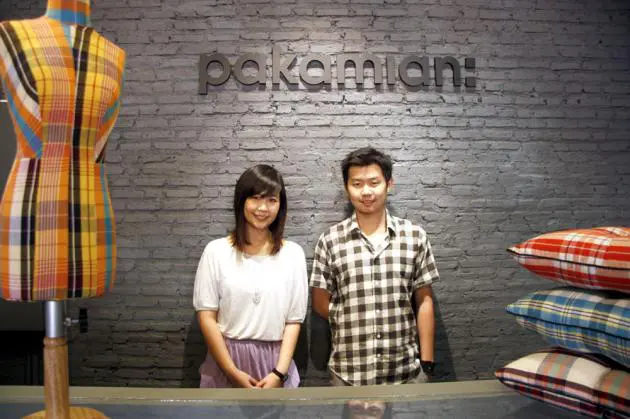
Over the past two years Nattawan Komolkittipong and her husband Krittin Taweepoljaroon have done their bit to revive the classic cloth, incorporating it into a variety of fashion accessories and furnishings under the brand name Pakamian.
Young people took to the Pakamian tote bags, clutches, pillows, scarves, wristwatches, notebooks and dolls they found at the couple’s online shop on Facebook, and now there’s an actual store in the Festival Walk community mall.
“Pha khao ma’s strong point is the classic check pattern, but it’s confined to a niche because of unattractive designs and limited colour choices,” says Nattawan, 30. “We add a modern twist to the old weaves, with vivid hues and various chessboard patterns to appeal to the younger generation.”
Nattawan’s family has run the Yingcharoen pha khao ma weaving factory in Ratchaburi for 40 years, so she knows her cloth. “In that 40 years in Ratchaburi only 10 pha khao ma factories have survived. They’re used to be 40,” she says.
“I never thought I’d be helping the family business, because it’s tough taking care of such a big factory with a hundred employees and distributing the fabric all over the country. But my husband and I visited the plant one day – he graduated in graphic design – and we realised how we could add value to what was there.”
To the already splendid qualities of pha khao ma – coolly porous, easily unwrinkled, dries in minutes – the couple added attractive new patterns for the 100-per-cent cotton varieties called Baan Rai, famed for the delicate but durable threads, and Chiang Mai with its stronger but softer yarn.
“The new colourful patterns appeal to young Thais,” says Nattawan, “but Europeans still go for the classic chequered style. They know it’s a simple piece of cloth that has a lot of cultural meaning in Thailand.”
CHEQUE IT OUT
<< You can find Navin’s pha khao ma creations in the store at Jim Thompson House on Kasemsan Soi 2 opposite the National Stadium. It’s open daily from 9 to 5. Call (02) 216 7368. The full line will be available soon, when Jim Thompson launches its online store.
<< Pakamian is at Festival Walk on Kaset-Nawamin Road and open on weekdays from 3 to 8 and weekends from noon to 8.30. Call (086) 344 5059 or see “Pakamian Thailand” on Facebook.
