
Artists take a stand


Play
Celebrities join Amnesty International to rally against the death penalty and push for freedom of expression
The rock musician Sting is busy raising awareness about oil pollution and human rights abuse in Nigeria for Amnesty International as part of his 2012 “Back to Bass” tour. Bob Dylan has given permission to a diverse group of artists to cover his 75 songs for “Chimes of Freedom”, an album that supports the non-government organisation’s human-rights cause.
In Thailand, Chulayuth Lochotinan, founder and conductor of the Bangkok Charity Orchestra, is set to perform “Toast to Freedom”, a commemorative song for Amnesty International, during a benefit concert on July 15 at the Siam Kempinski Hotel.
“I’ve been supporting Amnesty International’s work for eight years, ever since I was a student at Oxford University. In 2004, when I conducted the university orchestra at a charity concert, we presented the proceeds to Amnesty to help war victims in Sudan. When I returned home three years ago, I formed the Bangkok Charity Orchestra and have been raising funds to help orphans, poor children and the handicapped,” says Chulayuth.
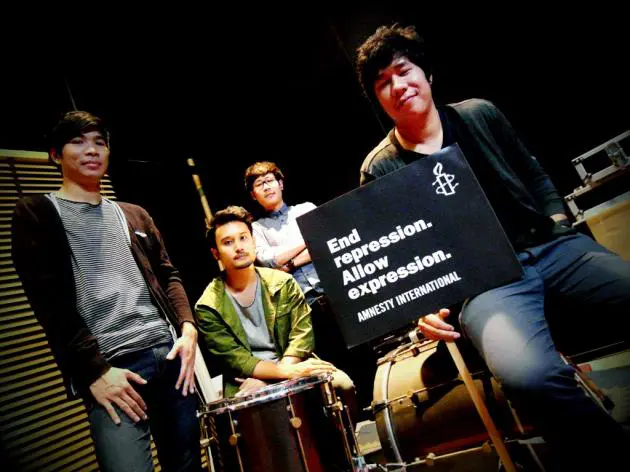
Chulayuth along with Carabao’s Kirati “Khiew” Promsaka Na Sakolnakorn, actor-musician Arak “Pe” Amornsupasiri, Apartment Khunpa’s Tul Vitoonkiet, the rock band Musketeers, Nitithorn “Ae” Thongtherakul, Nok Ratikaln, Pojanaj Pojanapithak, actress Pornchita “Benz” Na Songkhla, actress Boromwuti “Mick” Hiranyatithi, Thai PBS news anchor Chairat Thomya and Rachan Kanyarit are taking part in Amnesty International Thailand’s latest project “Artists for Amnesty”. Veteran singer and songwriter Su Boonlieng has been appointed as an ambassador of Amnesty International Thailand.
“We need to push for human rights to become part of Thai culture. All too often they are ignored because too many people simply don’t understand what human rights really mean. These artists will help to spread understanding,” says Parinya Boonridrerthaikul, executive director of Amnesty International Thailand.
Pe Arak, for example, is very involved with Amnesty International, taking part in last year’s 50th anniversary celebration at Hua Lampong railway station, where he talked about human rights and performed. “He is a good magnet that can draw people’s attention and make our goals more understandable,” Parinya says.
“Khiew Carabao is focusing his attention on our campaign to end the death penalty, while Benz is more interested in freedom of expression. Human rights are constantly raised in western culture; U2 speaks about it at their concerts,” she adds.
All 16 artists are expected to take part in Amnesty International Thailand’s two main annual events in October and in December. In October, there will be a three-day film festival that will touch on the process of judgement and the abolishment of the death penalty. December will feature a mini-concert.
Amnesty International has three main causes: ending the death penalty, promoting freedom of expression and exposing the misdeeds of transnational corporations.
According to the organisation’s journal, at the beginning of the 21st century, more than half the world’s countries had abolished the death penalty. This trend reflects the growing awareness that there are alternative punishments to the death penalty that are effective.
“Research conducted in many countries shows that the death penalty doesn’t reduce crime, because there are other factors to make people commit crimes,” says Parinya.
“Life is valuable,” says Khiew of the songs-for-life band Carabao, whose songs like songs like “Loong Khee Mao” address human-rights issues. “Why are we sentenced to death by other people?”
“The death penalty doesn’t reduce crimes,” concur fellow musicians the Musketeers. “We believe that our country will eventually abolish the death penalty.”
Thailand instituted a six-year moratorium on the use of the death penalty in the early 2000s, but went ahead with an execution in 2009.
“Human rights are our life and breath,” says singer-songwriter Nitithorn. “If we lack breath, we have no life and no rights.”
“We must have equality and respect each other’s rights,” asserts the singer-poet Tul.
“Human rights are very important,” points out Mick. “People are violated because they are undereducated or have no voice in the society.”
“Che Guevara said, ‘If you tremble with indignation at every injustice then you are a comrade of mine’,” says Rachan. “I say, ‘If you feel strongly about human rights, you are a comrade of mine’.”
“No matter who we are, we have equal rights,” says “Thailand’s Got Talent” judge Benz, who takes inspiration from Hai Khanjanthra, the grandmother whose land in Ubon Ratchathani was flooded when the government constructed the Huay La Ha reservoir. “She spent 30 years fighting and was finally compensated. Good for her!”
“For freedom of expression, we’re calling for the amending of such laws as the Insult Law, Computer Crime Act, the Emergency Decree and Martial Law, which is still imposed in the three southernmost provinces of Thailand and which violates human rights by allowing arbitrary arrest,” Parinya says. “The Computer Crime Act made sense when it was used to stop hacking but now it also implies to content, which means blocking free thought.”
“Our campaign against transnational corporations is primarily aimed at Shell in Nigeria, which has caused pollution. We want to see a clean up and payment of compensation to the victims.”
Freedom ring
_ The BCO Charity Concert is at 7.30pm on July 15 at the Siam Kempinski Hotel.
_ Tickets cost Bt500 and Bt800 (students Bt300) at Robinson School of Music on Sukhumvit Soi 31 and Robinson Piano in Siam Discovery Centre. Call (02) 259 9903 or e-mail reservation
@charityorchestra.org.
_ Proceeds will benefit the Ban Bang Khae Home for Older Persons.
