
The way we dressed


Learn how Siam's privileged ladies of the court contrived their enduring appeal
It always seems as though the women of old Siam dressed so beautifully, the rich silks and dainty cottons wrapped and draped luxuriously around the body. It’s a vision usually only glimpsed now at weddings and funerals – but thanks to Her Majesty the Queen, we’re seeing more of it.
The Culture Ministry, in tribute for the Queen’s birthday on August 12, declared her the Supreme Conservator of this uniquely Thai fashion.
“Her Majesty dresses beautifully and stylishly as a role model, promoting the traditional way of dressing even on her travels abroad,” notes textile expert Ajarn Paothong Thongchua. “She’s been preserving our tradition since she was a teenager.”
Paothing is one of the contributors to the exhibition “Pressing, Perfuming and Preserving: Caring for Textiles in the Inner Court” at the Queen Sirikit Museum of Textiles. It explains how Siamese women used to dye cloth with pigments made from plants, create perfume using flower extracts and manually work a teak pleating machine.
Preparing and taking care of clothes was a time-consuming process, says Paothong. “Cleaning and drying in the wind took two or three days alone. The natural perfuming of fabrics took a week, and pleating required yet another week.”
The traditional techniques are explained in Thai and English text alongside cute diagrams.
In the royal court, material for the clothing of the King’s wives, consorts, sisters and daughters had to be washed and ironed and then often glazed, pleated and perfumed. The ladies of the court occasionally even handled the labour themselves.
In the glazing process, printed or painted cotton clothes such as hip wraps were spread flat and “polished” to bring a shine to the fenugreek mucilage introduced during washing. It created a glossy finish when buffed with a smooth, rounded tool, usually a cowry shell but also agate, a glass bottle or even a small cannonball.
The women of the court were famed for their skill with perfume. “It was commonly said that their sweet fragrance lingered long after they’d left a room,” Paothong laughs.
Wraps for the hip, chest and shoulders were scented with fragrant smoke, fresh and dried flowers, or flower-scented water. Benzoin (also known as gum benjamin), agarwood, Myristica fragrans (nutmeg) and the musk of an Indian civet cat were among the many agents used.
The clothing items were stored in lidded wooden boxes to maintain the fragrance, with the wearer’s favourite flowers – such as salapee, Chinese rice flower, ylang-ylang and jasmine – placed inside as well, or, in their absence, scented cheesecloth.
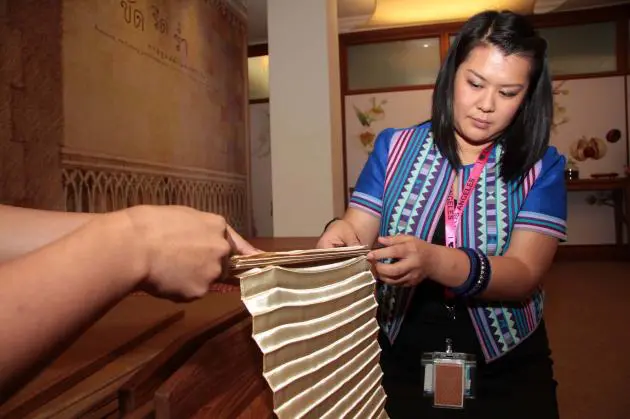
Clothing was also pressed and pleated using innovative tools. A wooden implement smoothed the creases and then shoulder cloths were pleated, both by hand and with a specially made press that required two operators, one on each side holding the material taut while folding it.
The fabric was next placed in a heavier wooden press to set the pleats, and then inserted into a raang chiip, a tool with bamboo teeth.
You can watch a video in which computer graphics explain how the cloth was donned. If visitors want to wear traditional costume, the museum staff will dress them as ladies of the court, using classical attire.
That includes the sabai shoulder cloth, the pleated jeep at the hip, and the chong kraben folded into trousers.
“Our aim is to preserve the tradition, so our staff is happy to demonstrate the correct way to wear the clothes,” says Thanpuying Oranuch Isarangkun Na Ayuthaya of the museum’s executive committee.
Woven into the fabric of life
