
A GREAT MAN'S FINAL DAYS
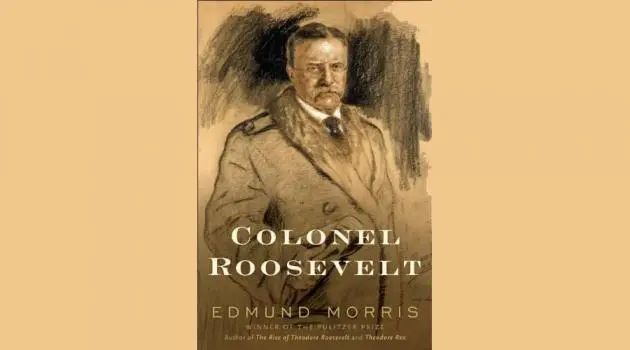


A 'colourful' historian finds more to celebrate in his biography of Teddy Roosevelt
Colonel Roosevelt
BY EDMUND MORRIS
PUBLISHED BY RANDOM HOUSE
Available at Amazon.com
If you ever want to appreciate the many reasons Theodore Roosevelt deserves to have his mug up on Mount Rushmore along with Washington, Jefferson and Lincoln, read Edmund Morris’ elegant biography. The combustion of an irresistible subject – the protean Roosevelt – and a passionate chronicler makes for great literature.
Morris won both the Pulitzer Prize and the National Book Prize in 1979 when he published “The Rise of Theodore Roosevelt”. One person who was most impressed by this scholarly yet vividly written first volume of a trilogy was Ronald Reagan, who appointed Morris as his official biographer.
Morris followed with “Theodore Rex”, about Roosevelt’s two presidential terms. As the last of three acts, he has now published “Colonel Roosevelt”, about the great man’s final days: his year-long African safari, his failed run to regain the presidency, and his gruelling 1914 jungle trek up an unexplored river in the Amazon, an ordeal which broke his health and led to his early death five years later.
Roosevelt was a voracious reader, compulsive letter-writer and prolific author whose collected works fill 24 volumes. He was a rancher, police commissioner, soldier, big-game hunter and, as president, fearless trust-buster, pioneer conservationist, early supporter of rights for blacks and women, builder of the Panama Canal and peacemaker between Russia and Japan, for which he won the Nobel Peace Prize. He was an exuberant, fun-loving man whose unflagging energy his country is unlikely to see again.
Morris’ accomplishment is to put you at Roosevelt’s side throughout his action-packed life. Like the late Barbara Tuchman, he is of the school of historians who believe that vigorous, graceful, imaginative, colour-packed prose only serves to enhance scholarly research (his notes and bibliography take up 150 pages). In this he is backed by Roosevelt the historian, who believed that “colour – authentic colour – was not an embellishment of the truth: it was truth”.
Roosevelt despised dry academic prose. Enhanced by his experiences on the frontier, his own American four-volume history “The Winning of the West” was praised by none other than Francis Parkman himself.
Roosevelt had his faults. He was ferocious in debate. Among the names he called his Republican rival Howard Taft were “flubdub”, “puzzlewit” and “fathead”. “Coward” was the kindest word he had for Woodrow Wilson for avoiding war with a truculent Germany. Privately he called Wilson “a skunk” and “a prize jackass”. In his own defence, Roosevelt said: “When you are dealing with politics you feel that you have your enemy in front of you and you must shake your fist at him and roar the Gospel of Righteousness in his deaf ear.”
Few Americans, let alone Wilson and Taft, could match his experience. As Morris writes: “Roosevelt had gone on four grand tours of Europe and the Middle East before he was 30, amassing an international circle of acquaintances that now extended from emperors down to his barefoot camaradas in Brazil.
He could converse in three languages and read in four ... He had killed a man in battle and just four months before, on the shore of a river unknown to any cartographer, confronted death itself.”
Later critics pinned the label of jingoistic war-lover on him. If so, he paid for it dearly. At the advent of World War I he urged all four of his sons into the front lines. Two were severely wounded and the youngest, Quentin, was killed over France in a dogfight. Roosevelt was heartbroken,
Yet even in his decline, Roosevelt radiated charisma. Sonya Levien, a young journalist colleague at Metropolitan Magazine, described him as radiant, original and irresistible. “I wonder how a man so thick-set, of rather abdominal contour, with eyes heavily spectacled, could have an air of magic and wild romance about him, could give one so stirring an impression of adventure and chivalry.”
Another journalist, Julian Street, of Colliers, offered this impression: “As the Colonel advanced to me he showed his hard, white teeth, wrinkled his red, weather-beaten face, and squinted his eyes half shut behind the heavy lenses of his spectacles, in suggestion, as it seemed to me, of a large, amiable lion which comes up purring gently as though to say, ‘You needn’t be afraid. I’ve just had luncheon.’”
Certainly there has never been a more popular ex-president. When Roosevelt returned from his African safari, having collected specimens for the American Museum of Natural History, and from a triumphant European tour where he conversed as an equal with crowned heads, he was welcomed by a flotilla of boats in New York harbour. A hysterical crowd stretching up Broadway screamed in adulation for “Teddy”. It’s difficult to imagine a similar level of mass frenzy nowadays. Giants like Theodore Roose-velt are rare, though needed now more than ever.
