
The girl from Saigon
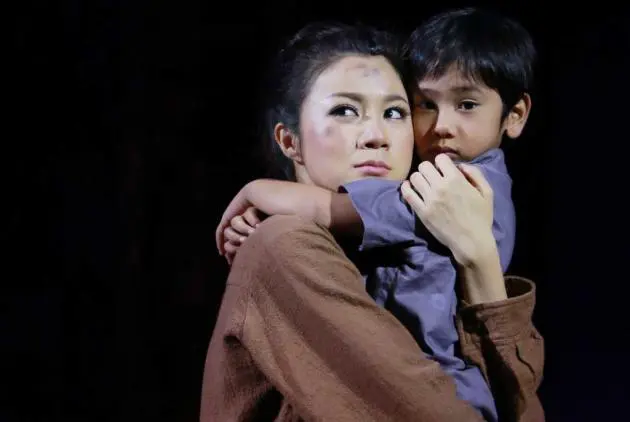


Praise-worthy performances lift an outdated musical that remains both sexist and racist
Stars were born on the stage of the Muangthai Rachadalai Theatre at the gala premiere of Cameron MacIntosh and Scenario’s Thai translation of “Miss Saigon”. They didn’t include the effects that made the landing and taking off of a helicopter realistic – something that drew loud applause in the late 1980s when the show was first staged but failed to work its magic in tech-savvy 2012.
Both Kanda Witthayanuparpyuen-yong and Suveera “Q Flure” Boonrod, already blessed with heavenly voices, immersed themselves in the characters of Kim and John so completely that the audience was totally engaged in their dramatic situations and empathised with them. By contrast, Napat “Gun The Star” Injaiuea’s portrayal of Chris was almost identical to that of his Khun Prem in “Si Phaendin”, except for a lighter hair colour.
Powerful crooner Chalatit “Ben” Tuntiwut had a ball as The Engineer, and so did we with his performance, but I wished his characterisation of this ultimate opportunist would have reminded me less of gay TV comedian Thongthong Mokjok.
Chorus members were at their full strength. However, the repetition of the sexy bar girls’ scenes, as the script required, reminded me that when the show was on Broadway, many male audience members – not all of them Vietnam veterans – gathered round the stage door to ask the Asian and Asian-American actresses out on a date.
Also commendable was the Thai translation, which managed to keep most of the original lyrics’ meaning, without sounding too literary. But when “LA” replaced “Bel Air” and “Hollywood” was substituted for “Fred Astaire”, the audience must have wondered whether
the producer was looking down on our knowledge of American culture.
Yet for me, the show brought to mind exactly the same thought as when I watched it for the first time in 1995 – that of the 1988 Tony Award-winning play “M. Butterfly” (1988) by Chinese American playwright David Henry Hwang. He based his drama on the true story of a French diplomat and his marriage to a Chinese woman, who turned out to be not only a man but a spy. The Frenchman is the one who commits hara-kiri at the end.
Having watched “M. Butterfly” in Thailand before “Miss Saigon” in the US, I found the latter as unbearably outdated in terms of the attitude of the masculine West versus the feminine East as Puccini’s “Madame Butterfly”, the opera which inspired both.
I was also reminded of former French cultural attache whose programming of “La fete” proved that he never looks down on the Thai audience’s sophistication. He and his wife, also French, adopted a Thai orphan. “When I’m with my daughter, people think I have a Thai wife,” he told me.
On the other side of the coin, I once asked Takonkiet Viravan in person why Scenario never considered bringing to Thailand “The Spring Awakening” – winner of a Tony Award for best musical — as his company was one of its producers on Broadway. His reply: “Thai people wouldn’t enjoy it.”
In fact, the Thai producer’s onstage declaration that “Miss Saigon” is one of his favourite musicals may explain his artistic choices in his previous works and also demonstrates his preference for eye-popping spectacle and emotional whirlwind, like Broadway of yesteryear. The bottom line is we’ll get to watch “The Phantom of the Opera” next year – it has already been to Singapore four times since the 1990s.
The world is changing every second and becoming ever more socially and culturally complex. If theatre is to perform its main task of holding a mirror up to life, theatre producers – commercial or not – must choose wisely what to offer their audience.
SINGING SPECTACULAR
“Miss Saigon” is at the Muangthai Rachadalai Theatre every Wednesday to Sunday. 7:30pm, plus 2pm on Saturday and 3pm on Sunday, until November 18.
It’s in Thai with English side titles at all performances.
Tickets are from Bt500 to Bt2,800 (students pay Bt800 for Bt1,800 tickets), at ThaiTicketMajor. For more details, visit www.MissSaigonThailand.com.
