
When learning |is a problem


Play
Thailand's most updated English news website, newspaper english, breaking news : The Nation
There are several reasons why children experience learning disabilities, among them a low IQ, abnormal function of the brain, mental and emotional state or other external factors such as the environment where the child grew up. The latter could include parental behaviour, the teacher’s style and method of teaching, as well the family, school and socio-economic conditions and values though, in most cases, a combination of several factors is the most likely cause.
Learning disorders affect a child’s reading, writing and mathematical ability. Children may be able to perform some of these tasks but their performance will be below average compared to other kids of their age. In Thailand, learning disorders are found in four to six per cent of school children, with symptoms appearing in grade 1. About 60 to 70 per cent of cases associated with attention deficit-hyperactivity disorder (ADHD), a condition that will be covered in greater detail in the health matters column on March 5.
Learning disorders can be categorised into three main groups:
1. Unable to read, have difficulty in reading and achieving low levels of reading. Children’s spelling will be inconsistent, they will struggle to read fluently, be slow to remember words and combination of words and unable to understand details of what has been read.
2. Unable to write or writing with errors. When compared to children of the same age, they lag 2 years behind.
3. Unable to perform mathematical calculations or able to perform very few mathematical calculations.
Parents and teachers should be aware of 4 main symptoms:
1. Difficulty in studies, such as failing in class, struggling to catch up with other peers in class, incomplete assignments, easily forgetting what has been read, errors in writing.
2. Behavioural problems such as not wanting to go to school, skipping school, being quiet and isolated from friends.
3. Emotional and adjustment problems such as depression, isolation, irritability, unable to socialise with friends.
4. Physical pain without known reasons such as headache, stomach-ache, nausea and dizziness.
Children with learning difficulties should be thoroughly assessed and a family health history should also be taken. A physical examination will cover testing of the nervous system and sensory function, an eye sight test, hearing test and a psychological test that will indicate a child’s emotions, behaviour, thoughts, intelligence, adjustment and social skills. Other tests include an IQ test and a skills test that measures the child’s reading, writing and mathematical skills.
A formal assessment will lead to correct treatment and assistance. Special needs assistance will enable children to study further depending on their capability. Working collaboratively in a team, comprising of specialists from the public health and education, forms an important foundation that will benefit the child and the family.
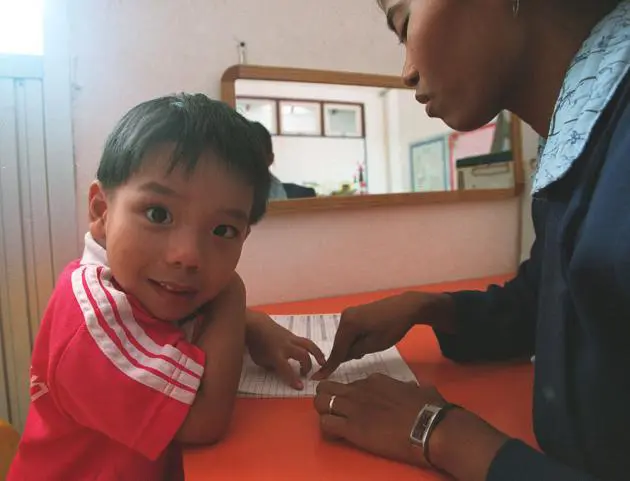
On the home front, parents, teachers or even older siblings can help by practising reading with the children, beginning at a level that they can read. For instance, a student in grade 5 could read books that are of grade 2 level.
It is also useful to change the teaching technique and style by using tools such as MP3, calculators, or computers.
In the classroom, the use other |teaching techniques should be applied where possible and include oral examinations, reading examination questions out loud to the students and allowing the student to use a computer during examinations.
Last not least, development and ability in other fields, such as sports, music and other activities must be encouraged. Since other areas of the brain are normal, a child with LD, if trained well, has the same abilities as other kids of their age. These children should be encouraged and taught to use language that will make them feel positive about themselves so that others can accept them.
This will make the child happy, proud and motivated to learn, eventually leading them to accept certain limitations they may have.
The Learning Disorder Centre at Samitivej Srinakarin Hospital is staffed |by physicians including a child and adolescent psychiatrist, clinical psychologists and experienced special needs teachers. Call (02) 378 9125.
