
It doesn't always run in the family


Play
Siriraj Hospital experts aim to reassure Thai women about BRCA and breast-cancer fears
The media and the medical profession have had nothing but praise for actress Angelina Jolie’s brave decision to undergo a preventive double mastectomy, as well as for her openness in explaining why in an editorial for the New York Times.
Perhaps unsurprisingly, the news has also created a wave of fear throughout the world, with many women worrying about developing cancer and wondering whether they should rush and be tested for the BRCA genetic mutation that can increase the chances of breast and ovarian cancer.
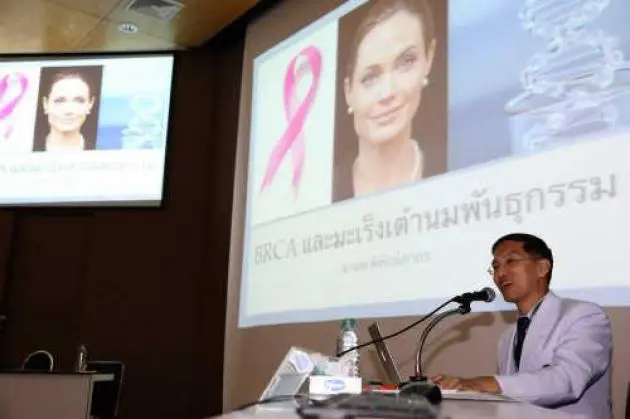
Siriraj Hospital’s medical faculty set out last Wednesday to allay those fears through the seminar “BRCA Testing with Awareness of Breast and Ovarian Cancers: Lesson learned from Angelina Jolie”. Eight specialists from the hospital, considered the best in the country, provided a wealth of information on how the genetic mutation is related to the cancers as well as the situation among Thais.
The first point the specialists made is that breast and ovarian cancers, as well as the mutations of the BRCA 1 and 2 gene, are found less among Thai or Asian people than Caucasians although breast cancer remains the most commonly diagnosed here, affecting 20 out of every 100,000 population
Most breast and ovarian cancers in Asia, they pointed out, are caused by several different factors, among them environmental exposure and lifestyle. The mutation on the BRCA 1 and 2 genes probably tops the list in genetic causes but is nonetheless represents a small percentage of cancers when compared to the other factors.
Genetic testing in Thailand is rarely carried out even though most medical schools have the equipment to check for the mutation. Siriraj is the only medical facility to provide the service in-house and to date has screened just 60 families, of which four tested positive. Results of the test on a blood sample take from four to six months and the cost is high – Bt50,000.
Asst Prof Dr Manop Pitahukpakorn of the Division of Medical Genetics, stresses screening should only be considered for individuals meeting one or more of the following criteria.
l At least two family members (from grandparent to grandchild, aunt, uncle, nephew, sibling or parents) having suffered from ovarian or breast cancers.
l Cancer diagnosed at a young age.
l A breast cancer diagnosis in a male of any age (very rare in Thailand).
l Having cancer in different places in the same organ, for example malignant tumours in both breasts or both kidneys.
l Showing specific types of symptom that require an expert’s diagnosis whether these might relate to the genetic mutation.
Even then, Dr Manop suggests long and careful consideration before opting for the test as well as thorough consultations with a doctor and genetic counsellor.
“Individuals need to be aware that they are likely to face other concerns on top of worrying about knowing whether they have the mutation gene,” says Dr Manop, adding that taking the test will affect their life. “If it’s positive, then the person is going to worry that will she will die young from cancer, even though a positive result doesn’t always mean that the cancer is already in their body.
“And if the result is negative, it doesn’t mean that you have zero chance of developing cancer as the major causes of both cancers are from other factors,” continues Dr Manop, adding that Siriraj has never performed a preventive mastectomy.
“Even with a good breast implant, a preventive mastectomy can lead to women having problems in their relationships as the removal changes the sensual feeling on their breast. Research has shown that a number of women regret their decisions,” says surgeon Asst Prof Dr Suebwong Chuthapisith.
For those at high risk of breast cancer, radiologist Dr Sirisopha Techawattanawanna suggests screening every six months, rotating the exam between MRI, digital mammograms, ultrasound with mammograms and ultrasound. The procedure will help the doctor detect even small cancers, as each type of equipment has a different specification.
The genetic mutation also affects the likelihood of ovarian cancer, which is hard to detect as its symptom overlap with other diseases, no screening is yet available and testing for tumour markers is no real indicator. Most patients presenting with the cancer are already at stage 2 or 3 of the disease.
Once again, this is a disease that is found less often in Thai woman and is caused by different factors, not only genetic. Having an ovary or both ovaries removed is no guarantee of avoiding cancer and a woman will simply go into menopause earlier while retaining a risk of peritoneal cancer after surgery.
And surgery isn’t the only answer: doctors point to other options like regular surveillance and chemoprevention involving such drugs such as tamoxifen and birth control pills.
That’s not to say women should rush to take these drugs.
Tamixofen, says Dr Pornpim Korphraepong, responds well to BRCA 2 gene only and the birth control pill has various side effects including headache and depression while increasing the risk of uterine cancer.
“We shouldn’t live in overwhelming fear of cancer. Getting a positive result for the BRCA1 mutation means the risk of developing breast cancer is 65 per cent and 45 per cent for ovarian cancer. Being alert, doing self-checks and learning more about the disease all help in diagnosing early stage cancer, which can be treated,” Dr Suebwong says.
But again, no one reading the media will have any doubts that Jolie made the right decision. The actress, whose mother died six years ago of ovarian cancer at the age 56, this weekend lost her aunt to breast cancer. She was 61.
