
The jeweller in the throne hall


Play
Galileo Chini did wonderful work for King Rama V. You should see what he made back home
COMMISSIONED by King Rama V to paint frescoes in the Ananta Samakhom Throne Hall between 1911 and 1913, Italian artist Galileo Chini blessed Siam with the ornate art nouveau that was then in favour in Europe. And Europeans were captivated as well by what Chini brought back with him from Siam.
Another commission awaited him in Salsomaggiore, in northern Italy, and Chini had his chance to unleash an Art Deco vision of East-meets-West cosmology on the walls and ceilings of the Thermae Berzieri, a vast spa complex. It is today considered one of the world’s most luxurious spring-water spas.
Architect Ugo Giusti began building the complex in 1912 but was interrupted by World War I. Chini revived the effort in 1919, and made it one of the most celebrated of all such structures.
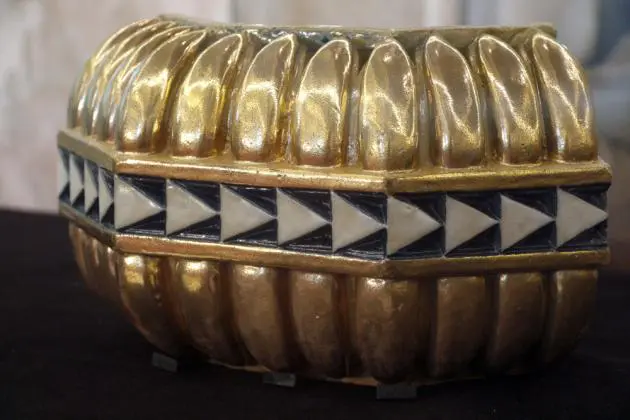
Now 26 Art Nouveau decorative sculptures from the Thermae Berzieri are on display in the exhibition “Galileo Chini: The Jewels of Decoration”, at Siam Paragon until next Sunday, as part of this year’s Italian Festival in Bangkok.
They date to the early 1920s, replacement pieces discovered by chance a few years ago in the spa’s basement. Most of the sculptures are of majolica and stoneware and adhere to the geometric stylistic features of the spa’s Art Deco enclosures.
Still in pristine condition, they were designed by Chini and realised by the craftsmen of Borgo San Lorenzo, a firm he founded in Florence with his cousin Chino. Chino’s grandson, Vieri Chini, was on hand for their Bangkok unveiling.
“Like most mosaic art, the spa building was complexly decorated with different materials – marble, glass, ceramic, wood and metal,” he said. “The oriental touch that Galileo Chini applied could be seen in some elements, in the red shading and the lion heads.”
Pilasters, keystones, architraves, balusters, roof tiles, umbrella stands and flowerpot holders show considerable refinement in the use of ceramic materials. The preciousness of the enamels in the multicoloured compositions in metallic gold reveals the value of such large production for the spa.
Polished metallic coating gleams on the pieces, and the enamel paints, mostly gold, blue, red, ochre and green, ensure a liveliness to match the elaborate patterns depicting antelopes, fish and cockchafers (May bugs) and the spirals, angles, cylinders, curls and amphorae.
“Galileo was the design director and my grandfather Chino was the technical director when they founded their ceramic factory,” Vieri Chini said. “The distinctive feature of our ceramic production is polychromatic turquoise and gold.
“Chini’s paintings after he returned from Thailand featured Siamese motifs and colours and reflected his fascination for this country. The dark feel of his earlier productions were overshadowed by vibrant hues or glittered with images of Siamese ladies, female dancers and riverside houses.”
Some of those paintings – “Sunset on the Chao Phraya”, “Celebration of the Last Day of the Chinese New Year” and “Mesu the Dancer” – are regarded among the best examples of the European orientalist genre.
King Chulalongkorn invited Chini to work in Siam after visiting the 1907 Venice Art Biennial, for which Chini had created a fresco in the main exhibition hall. Rama V asked him to spend 30 months decorating the then-new throne hall with allegorical frescoes.
It wasn’t the first time an Italian artist was beckoned to Thailand. In 1877 another Italian named Grassi was hired to design the neo-gothic Nives Thammapravat Temple at Bang Pa-In in Ayutthaya. DA Salvioti, a Venetian, in 1882 created a colourful mosaic for the pediment of the Chakri Maha Prasart Throne Hall.
And their countrymen Anibale Rigotti, Mario Tamagno and Ercole Manfredi, with engineer Carlo Allergi, were involved in designing the Ananta Samakhom Throne Hall, while the principal painters at the royal court were Cessare Ferro, Carol Rigole – and Chini.
NOT THAT GALILEO
“Galileo Chini: The Jewels of Decorations” continues until September 29 in the Lifestyle Hall on the second floor of Siam Paragon. Admission is free. Call (02) 610 8000.
