
Take me back to Wiang Kum Kam


The Lanna capital for three centuries, lost and found and lost again, is feeling festive
Wiang Kum Kam, the “forgotten” Lanna capital that rose from the floodwaters in the 1980s, was very nearly forgotten again after a flourish of initial interest. But the Yingluck Shinawatra government’s Bt88-million investment in the 13th-century archaeological site adjacent to municipal Chiang Mai has revived it anew.
It’s again being promoted as a cultural tourist attraction, but this time with more sustainable features, including a new Lanna-style cultural centre, improved landscaping and a festival of activities to draw the crowds.
Culture Minister Sontaya Kunplome says it’s part of a strategy realignment that covers the whole country. “The year-long development is focused on culture, tourism, the community, the green environment and connectivity,” he says. “The government aims to bring six million tourists to Chiang Mai next year and earn Bt200 million.”
Wiang Kum Kam vanished again after an initial effort by the Tourism Authority to put it on the map with a light-and-sound show faltered for lack of interest, and then the heavy flooding of 1994, 2005 and 2011 threatened it with the same historical fate it had always met.
The Culture Ministry’s Department of Fine Arts dug up remnants of the old city in 1984, around Wiang Kam Thom and Wat Chang Kham. The extent of the site proved surprising, and the dramatic back-story emerged of a new capital being built for the
Lanna Kingdom in celebration of King Mengrai’s victory over the mighty Mon of Hariphunchai (modern-day Lamphun).
Wiang Kum Kam survived for three centuries, but even after all that time, its leaders had to admit that the site had been poorly chosen. The river refused to relinquish its floodplain, repeatedly inundating the city to catastrophic effect. So in the 16th century, it was abandoned, and a new capital built on the opposite bank. They called it Chiang Mai.
When the Burmese overran Chiang Mai in 1558, recollection of the very existence of the former capital next door began to fade. Lanna people finally returned to the area another 200 years later, establishing a village called Chang Kham on the old site.
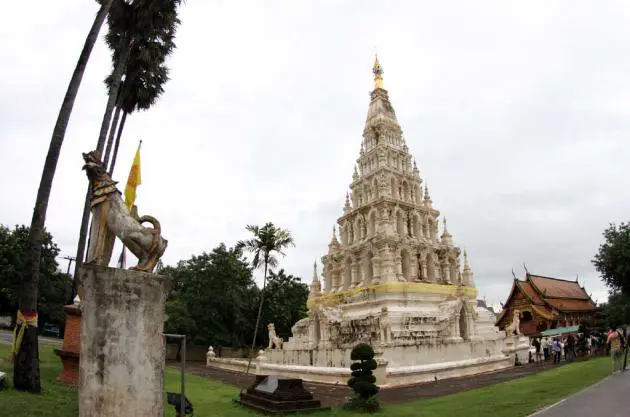
Over the course of three decades, the Fine Arts Department excavated and restored nearly 30 of the more than 40 temples at Wiang Kum Kam. These haunting edifices, spread out across a sea of well-tended lawns that tourists could visit one by one, on foot or in horse-drawn carriages, formed the basis of the Tourism Authority’s initial promotion. Sontaya was the authority’s governor at the time and hailed it as part of “Unseen Thailand”.
Even the light-and-sound theatrics of a decade ago seemed a distant memory when Wiang Kum Kam hosted the World Water Summit last May. Deputy Prime Minister Plodprasop Suraswadi, as chairman of the Water and Flood Management Commission, provided stage dramatics of his own, playing King Mengrai in a production about Siam’s historic methods for handling deluges.
And then the venerable old ruins fell silent again. The local community wondered what had happened. Unlike other key historical sites, like Sukhothai and Ayutthata, Wiang Kum Kam is part of a living community. These people, fearing they’d been abandoned yet again, started to demand development of a more sustainable kind.
“We should learn from the past. A decade ago they held events here and then left, leaving the community behind,” says Wat Chang Kam Abbot Weeradech Sontikako.
Fortunately the government recognised that more should be done – and that the involvement of the local community was essential. The Culture Minister and his former charges at the Tourism Authority, as well as Interior Ministry staff, set out plans in discussion with the monks, residents and area artists. Heritage again appears in be in good hands.
Professor Dr Apinan Poshyanonda, Deputy Permanent Secretary of the Culture Ministry, has led a team to the site to work with the citizens more than 10 times in the past four months.
“The new development is scoped to a 15-rai area that includes a Lanna-style cultural centre at Wat E-Khang and Wat Nan Chang,” Apinan says. The temple grounds have been refurbished so it can host a Wiang Kum Kam Festival, kicking off next month. The first phase, running from October to next April, is costing Bt54 million.
The cultural centre erected by the Fine Arts Department and Lanna Architect Association includes 30 old-style shophouses, a first-aid clinic, a car park and, of great relief to previous visitors, more comfortable toilets.
“It’s designed in the Lanna style, single storey and all wood,” says architect Adul Heranya. “The landscaping makes prominent use of plans that were common at the time, including sugar cane, which was Wiang Kum Kam’s trademark, and classical Lanna flowers like kasalong and maak muang.”
Colourful tung – the Lanna paper flags – adorn the buildings, over a courtyard designated for a typical Lanna market, known as a kad, with stalls selling northern dishes, handmade clothes and more. Paper kom loy ballons will fill the sky while visitors have a go at folk dances and building sand-mountains.
Once high tourism season ends in May, longer-term plans call for the opening of an information centre and the restoration of two more key temples, Wat Chang Kam and Wat Chedi Liam. That will cost another Bt34 million.
“We hope this current development will benefit the local community,” Abbot Weeradech says. “The people here can earn more from cultural tourism. Teamwork involving all the stakeholders will establish sustainable development.”
