
Soaring to success


Play
Australia's Lao-Isaan Oscar hopeful "The Rocket" lifts off the World Film Festival of Bangkok.
The 11th World Film Festival of Bangkok blasted off on Friday night with the Thai premiere of “The Rocket”, an Australian production in the Lao language that’s already picked up more than a dozen awards from festivals around the world.
Directed by Kim Mordaunt, the story is set in Laos though much of the filming took place in Thailand and most of the cast and crew are Thai.
“I’m very pleased to be presenting my film here at the World Film Festival of Bangkok. With the serious Thai presence in the movie, this festival has to be one of the most important,” Mordaunt says.
“Incredible as it may sound, Thailand makes more films than Australia so the crews here are good. However, having said that, the language gap did cause some problems and sometimes the Australian, Thai and Lao crew couldn’t understand each other.”
Mordaunt was able to overcome the linguistic glitches to produce a fine film that started its prize-winning journey in February when it was recognised by the Berlin International Film Festival jury for Best Debut Feature. It also won the Crystal Bear for Best Feature in the Generation Kplus section and went home with the Amnesty International Prize.
“The Rocket” also made a splash at New York’s Tribeca Film Festival in April winning the prize for Best Narrative Feature, the Audience award and Best Actor for young leading man Sitthiphon Disamoe.
Submitted as Australia’s entry to the Academy Awards for Best Foreign Language Film, “The Rocket” was initially slated to be shot entirely in Laos but budget constraints forced a revision of the plan with just 20 per cent of the action recorded in Thailand’s northeastern neighbour and the remainder here.
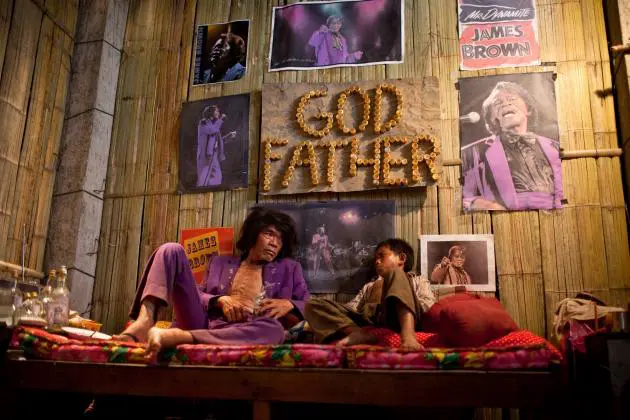
“The Rocket” tells the story of Ahlo (Sitthiphon), a youngster who seems to bring bad luck to everyone. When his family is forced to relocate due to the construction of a hydropower dam, Ahlo leads them and his two new friends – James Brown aficionado Purple (Thai comedian Thep Pho-ngam) and orphan girl Kia (young Lao actress Loungnam Kaosainam) – across the country in search of a new home. After a calamity-filled journey, Ahlo decides to join a bang fai (rocket) contest in hopes of winning enough money to buy land and build a new home.
Mordaunt describes his film as a “feel-good” movie that portrays the current situation in Laos.
“The Lao people are very brave. They are determined to move forward with their lives after decades of conflict and get away from the poverty that has dogged them for so long.”
Mordaunt and his producer Sylvia Wilczynski have a relationship with Laos that goes back 10 years to when they were both living and working in Southeast Asia. In 2007, they made the documentary “Bomb Harvest”, which follows an Australian bomb disposal specialist as he trains locals to detonate bombs while also trying to stop villagers, particularly children, from finding them and using them for scrap metal. The pair was in Laos during the a rocket festival and the idea for the movie was born.
The story was developed with the help of Lao-Australian Pauline Phayvanh Phoumindr who, Mordaunt says, helped to correct details about her people and culture and also translated the script into Lao.
“It’s a wonderful festival. The people send the rockets into the sky to ask for rain and sometimes their prayers are answered. There’s also a cathartic element related to the country’s long history of war. By shooting the rockets skyward, they are getting rid of the bad things and bringing the beneficial water to earth.
“When the family is evicted from their land because of the dam, it’s like the water is taking control of their lives but the Bang Fai festival gives the water back.”
The dam issue is such a sensitive issue in Laos that the authorities have chosen to ban the film.
“We got an invitation from the Luang Prabang Film Festival so we submitted the film to the Lao censors and they didn’t approve it,” Mordaunt says. “But they weren’t antagonistic about it. They probably didn’t want any more conflict about the issue. I think they know the film shows the beauty of the country and the courage and spirit of its people. It’s just too political at the moment,” he says.
In fact, the antagonist in the film is not the Lao authorities but the Australian company building the hydroelectric dam which, although promising to provide full compensation and new homes to the families forced to leave their land, fails to honour its pledge.
“Our film questions the integrity of a business that makes promises then reneges on those promises. This really is a global issue as figures show that 60 million people around the world have been relocated due to dam construction,” he says.
Despite the current ban on the film, Mordaunt’s submission of the script in his application to shoot in Laos won the approval of the government.
“I think from the script, they thought that the film was not going to be as political as it is. However, I do believe that Lao people will get to see the movie somehow,” he says.
“The Rocket” has done well on the Australian cinema circuit, earning A$250,000 (Bt7.5 million), which is high for a non-English language film. A release date of December 12 has been provisionally scheduled for its Thai release though this hasn’t been confirmed. If it doesn’t pan out, Mordaunt is hoping to screen it during the Oscar season in February.
He’s also hoping that the awards received from the major festivals are a good omen for the Oscars. Australian’s earlier hybrid submissions in the Foreign Language category have failed to come up with the statuette.
“There will have more stories to be like this because the world is getting smaller. You have big filmmaker Ang Lee making films in America with an American story. I think it’s the interesting that directors are trying to understand the planet rather than just their own countries,” he adds.
ONE MORE LAUNCH PLANNED
- “The Rocket” screens at 1pm on Sunday as part of the World Film Festival of Bangkok at SF World Cinema at CentralWorld.
- Tickets cost Bt120. A pack of five tickets is Bt500.
- For details, see www.SFCinema|City.com and www.WorldFilmBKK.com.
