
The beat goes on


Play
Learning a simple gesture like cardiopulmonary resuscitation can save lives
Every hour someone somewhere suddenly falls to the ground, the victim of a heart attack. Whether in the street, in the home or even in hospital, his or her survival will depend on whether someone nearby knows how to perform cardiopulmonary resuscitation, the emergency procedure that can restore blood flow to the heart and keep the victim alive until advanced medical care arrives.
People with proper training can boost the victim’s chances of making it through the attack by up to 29 per cent. But sadly those with that training are few and far between here in Thailand, where current figures put the number of individuals knowing how to perform CPR at less than 1 per cent of the population.
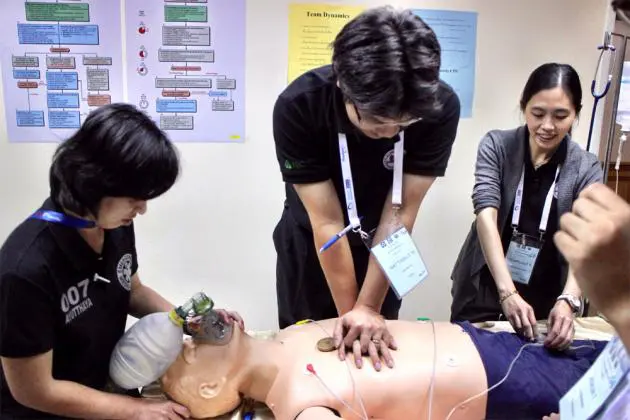
In a bid to save lives both in and out of hospital from sudden cardiac arrest or other life-threatening illnesses, the Thai Resuscitation Council (TRC) recently organised a series of both basic and advanced life support workshops in collaboration with the Police Hospital Institute Medical of Simulation and the American Heart Association.
The workshops were open to physicians, nurses, emergency medical technicians and paramedics and all the participants are fully expected to pass on their knowledge to others.
The training promises to improve their ability to help people during a medical emergency in line with international criteria.
“People whose hearts stop beating will have a chance to survive if someone properly compresses the centre of their chest for a full minute,” says the TRC’s Dr Sopon Krissanarungson.
Thomas G Calogrides Jr, a trainer from American Heart Association, stresses that medical workers need to have both basic CPR skills and knowledge of life-saving machines, such as the automated external defibrillator,
“Knowledge of basic life support is a must. Don’t forget that an AED or CPR alone may not be enough to save patients. Some patients also have underlying diseases, not just cardiac arrest,” Calogrides explains.
The workshops, which are now in their eighth year, cover three different curricula – basic life support, advanced cardiovascular life support and paediatric advanced life support – with medical workers learning more about how to diagnose patients’ symptoms and provide proper treatment.
As part of the recent workshops at the Police General Hospital in Bangkok, participants spread over different classrooms to practise stimulation and demonstrate how to save lives in different emergencies such as cardiac arrest and drowning.
“As a doctor working in the emergency department, it’s very important for me to learn how to save patients’ lives correctly. Knowledge about basic and advanced life support constantly evolves and I need to keep up to date,” says Dr Pimpak Prachasikchai, a paediatric cardiologist at Queen Sirikit National Institute of child health, adding that she shares this knowledge with the medical students under her supervision.
And indeed such basic and advanced life support gestures, provided they are timely, can and do save lives.
Chumphon Hospital, in the southern province of the same name, has been providing training in basic and advanced life support not just to medical workers but also to members of the public for the past three years. In 2012 alone, its medical staff who had followed the course successfully saved 11 lives while non-medical workers saved three.
“With proper training, ordinary people can help others who develop cardiac arrest or are in a life threatening condition,” Sopon says, adding that he would like to see more workshops organised for members of the public.
He points to the United States as an example that Thailand might like to follow. There, both medical workers and the public regularly learn how to perform CPR. Japan, he adds, has an excellent system, as all Japanese students are required to learn basic life support gestures.
Moreover, Japan has more than 400,000 AED devices in public facilities like airports and subways and the organisers of such major sports events as the 2013 Tokyo Marathon installed AED devices to ensure that if anything happened, life-saving equipment would be at hand.
The Federation Internationale de Football Association (Fifa) has also provided more than 300,000 AED devices to its members around the globe over the past five years.
But the Football Association of Thailand has just 60 AED devices.
“When compared with other developed countries such as Singapore and South Korea, life support training and devices in Thailand are way behind the norm,” says Sopon.
“We must continue to work on increasing public awareness of the need to have life-saving skills and equipment ready. Life is precious. Let’s save lives.”
