
Who flew first?


Play
A supporter of pilot Gustave Whitehead wants to bump off the Wright Brohters
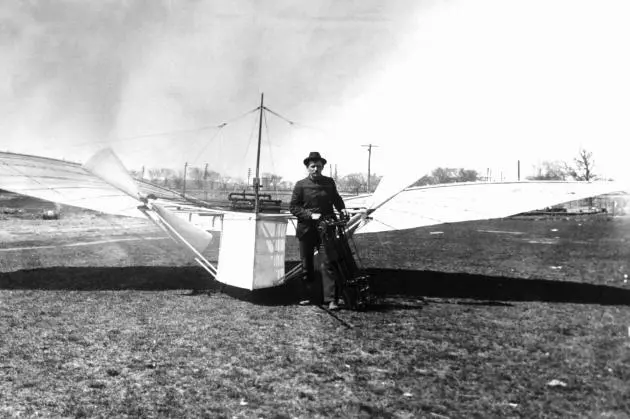
The world's first powered flight? Was it by the Wright Brothers? Or was it an obscure engineer who soared with a mad-looking, bird-like contraption over an Atlantic beach of the United States in 1901?
The tide of opinion seems to be shifting, thanks to a campaign by an aviation historian, John Brown, who argues that the honours should go to Gustave Whitehead, a German-born aviation pioneer who had emigrated to the United States.
The Wrights, who made their powered flight in December 1903, are still credited in most reference books and by most authorities.
But Brown believes that mounting evidence means that it’s just a matter of time before Wilbur and Orville Wright are bumped off their pedestal by Whitehead, who was born Gustav Albin Weisskopf in Bavaria, Germany on January 1, 1874.
An aircraft designer by profession, historian Brown was born in Australia and now lives in Germany.
In 2013 he opened a bitter dispute with historian colleagues, using as his weapons documents, eyewitness reports and photos.
After a 15-month search of 136 contemporary newspaper reports via archives and the Internet, he contends that Whitehead made the first powered flight on August 14, 1901 - more than two years before the Wrights.
At the time, neither the authorities nor academics paid much attention to aviation research since it did not seem to be leading anywhere, but the news media followed stories of eccentric inventors.
Brown says the clippings and other documents show Whitehead flew for a few hundred metres along a beach at Bridgeport, Connecticut.
Brown claims he has found 17 eyewitness accounts for Whitehead’s flight and in that sense he contends that the evidence is much better than that available for the Wright brothers. However, some of the pro-Whitehead witnesses were interviewed decades after the event.
Also there is no undisputed photo of Whitehead’s flight. Brown believes he has found one in a photo of a booth at an aircraft exhibition held in New York in 1906.
When the picture is greatly magnified there’s an image of something airborne that Brown claims is Whitehead’s No 21 aircraft.
However, experts such as Tom Crouch of the Air and Space Museum in Washington and Hans Holzer, aviation curator of the German museum of technology in Munich, aren’t convinced by the photo, considering it too blurry.
Brown believes he has cast enough doubt on the claim of the Wright brothers to be the first.
In a 1978 letter to historian Leonard Opdyke, Tom Crouch himself cast doubt on the Wrights’ claim: “Was the first flight of the Wrights on December 17, 1903 a stable flight? Probably not.”
Crouch has said since then that this quote has been misunderstood.
The photo of the first flight by the Wright brothers was seen as key evidence of their pioneering endeavour. The image appears on hundreds of thousands of US pilot’s licences as well as US stamps.
But now the Wright picture appears to Brown and some other historians as proof of the opposite – that the Wrights’ flying machine in that photo was never really able to fly.
At the time, none of the inventors celebrated their hops along beaches because they had their minds on building proper aircraft that could reliably take off, fly in any direction and land safely.
Whitehead died embittered in 1927 at 53, convinced he should have received the first-flight credit.
The issue has even caused controversy between US states. In 2013 Connecticut declared August 14 - the asserted day of Whitehead’s flight - an annual day of remembrance, sparking protests from officials of pro-Wright Ohio and North Carolina.
In March 2013 the British reference book, Jane’s All the World’s Aircraft, backed Brown’s claims that Whitehead made the first powered flight.
However, the community of aviation historians remains sharply divided on the issue, with most still believing that the Wright brothers deserve the laurels for the first historic flight.
