
History shrouded in golden nutmeg


Play
Celebrated artist Titarubi returns to Indonesia with a mystical take on history
After a long time away, acclaimed artist Titarubi is back home with a solo exhibition, “Discourse of the Past”, an investigation into Indonesian history.
Titarubi, whose work has been collected and exhibited throughout Asia and Europe, displays five pieces in the exhibition at the Philo Art Space in South Jakarta until April 18. They include sculptures, installations and a drawing series.
The 45-year-old says the exhibition had been planned for two years, but a technical problem with one of her pieces kept on postponing it. “The idea for the exhibition comes from consideration that it’s been a long time since I held a solo exhibition in Indonesia,” Titarubi says.
Another consideration was that the Philo is owned by noted philosopher Tommy F Awuy, who also served as curator for the show. “With Tommy’s philosophy background, I was hoping to attain a more specific, deeper perspective when we discussed the art,” Titarubi says. “I needed to be able to see with a different point of view or way of thinking from what I’ve been having until now.
She says the exhibition is a venture into Indonesia’s glorious but forgotten wealth and history, a main thread that pulls together the assembly of thousands of nutmegs in the sculpture titled “Hallucinogenic”.
“Hallucinogenic” presents a mysterious mystic shrouded in thousands of gold-plated nutmegs, holding a gold-plated book and a tree-branch staff with charred hands. The shrouded figure previously appeared in Titarubi’s 2013 work “Imago Mundi”, which was displayed among other pieces, by invitation, at Museum Van Loon in the Netherlands. That show reflected on the role the Van Loon family had in the Dutch East India Co.
“Imago Mundi” featured a large robe made of metal and gold-plated nutmeg. Nutmeg is a spice that comes from the Banda Islands in Maluku. Titarubi says that, in the 16th and 17th centuries, nutmeg was the most desired luxury in Europe – more valuable than gold – and attracted Europeans to the Nusantara archipelago.
The English and the Dutch engaged in prolonged battles to gain control of the nutmeg. Dutch East India Company governor-general Jan Pieterszoon Coen waged a bloody war to enforce a monopoly on the Banda spice trade, including the massacre and enslavement of the islands’ inhabitants in 1621.
After the killings the Banda Islands were run as plantation estates with slaves imported from Java and other Indonesian islands. The Dutch kept the price of nutmeg artificially high, intentionally burning full warehouses of nutmegs in Amsterdam.
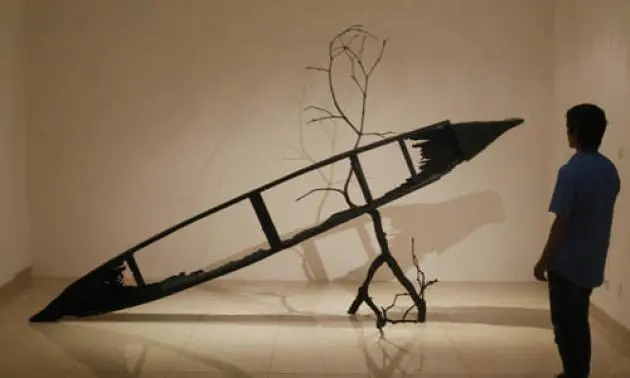
It was during her research into Indonesian spice history that Titarubi discovered the story of Keumalahayati, a 16th-century female admiral in the Aceh Sultanate. Keumalahayati’s powerful navy helped the sultanate become strong and control merchant shipping routes in the Malacca Strait. “Keumalahayati commanded great ships, but it is difficult to find a reference or document about what the ships looked like,” Titarubi says.
Her piece “Something Remains”, which is made of burned wood, reflects this piece of lost history. “Once we had the perfect ship, but now we no longer have it,” she says.
Curator Tommy believes Titarubi is revealing a chain of events in one of the most important periods in Indonesian history, as part of a massive effort to look into the past. “History is often interpreted by those with specific and scientific backgrounds. It would be quite a surprise if another party outside did their own interpretation of history,” says Tommy.
“I hope Titarubi’s historical narration through visual presentation can fulfil our curiosity, despite being one story among many other larger stories about the past. Narration can always return to the main actor, the human – as the subject, witness, and, more importantly, victim.”
