
Standing in for Sydney


Play
Bangkok shows its versatility as a film location, but "Trafficker" director Larry Smith says production companies need more incentives
He's the preferred cinematographer of such illustrious filmmakers as Stanley Kubrick and Nicolas Winding Refn and now British-born Australian Larry Smith is making his debut as a fully-fledged director, with the gritty crime thriller “Trafficker”.
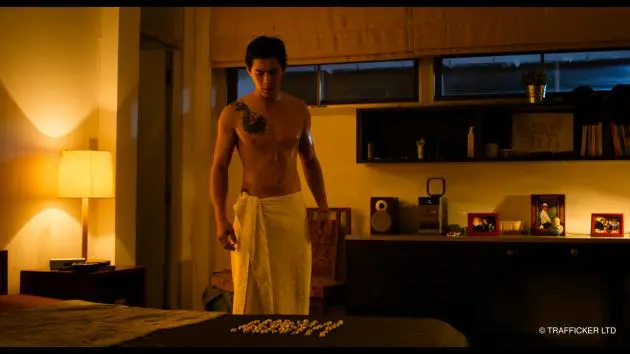
The film tells the story of Hao (Ratchanont “Guy” Suprakob), a young Vietnamese-Australian thug who botches a gangland assassination and runs into serious debt with the triads, forcing his younger brother Dahn (Jonathan Raggett) to embark on a harrowing drug run from Vietnam to pay off the mob bosses.
Filmed in Bangkok, it premiered at the Thailand International Film Destination Festival last Tuesday despite having been completed just two weeks earlier.
Written by Singaporean Ken Kwek (“The Blue Mansion”), it’s inspired by a true story from the 1980s. Other stars include British actress Amanda Donohoe plus Thai actors David Asavanond and Vithaya Parnsringam.
Smith, 56, started his filmmaking career as the gaffer on Stanley Kubrick’s “Barry Lyndon” and “The Shining”. He was the cinematographer on Kubrick’s last film “Eyes Wide Shut”. His other credits include Refn’s “Bronson” and the made-in-Bangkok “Only God Forgives”.
He’s wanted to direct for a while and says that combining his roles as director and cinematographer for “Trafficker” gave him total control over both location and the filming.
“The film is about far more than drugs and human trafficking,” he says. “It’s about survival, hardship, how we are as human beings.”
Smith has long been intrigued by stories of people who leave their homeland, either voluntarily or otherwise, and make their way to another country where they are unable to speak the language.
“Such migration, and particularly slavery, has been going on for centuries and shows no sign of abating. In the film, I ask how can it still be happening in the 21st century? Why are people so brutal with their own people? And what happens to this family, themselves victims of traffickers. It’s the moral undertone of the story,” he says.
Set in Vietnam, Australia and Singapore, “Trafficker” was shot mainly in Bangkok on a budget of about US$2 million (Bt63 million). Smith says he decided on Thailand rather than Australia after considering the potential problems regarding the workforce and labour union rules.
“It would be difficult to have made the film in Australia with that amount of money,” he says bluntly.
Smith says he went to Malaysia first to scout for locations, as he was keen on taking up that country’s current rebate scheme and tax incentives for foreign film productions. In the end though, he chose Thailand, as he knew from his experiences with “Only God Forgives” and shooting TV commercials here that he would find both the expertise and the crew.
“I also have a good understanding of the location so I don’t have much to worry about,” he says. The film was shot in 25 days last June with post-production completed at the beginning of April. He decided to premiere it in Thailand as he felt it would be a good opportunity for his Thai crew to see their work.
Smith cast Guy, a young actor who has starred in Poj Anon’s “Kao Rak Tee Kaolee” (“Sorry Saranghaeyo”) and TV dramas, as the lead character Hao. He was impressed by the work the young actor put in to perfecting his character. Vithaya and David have supporting roles.
While he’s pleased overall with shooting in Thailand, he notes that cultural differences obstructed the workflow.
“Thai people are always trying not to do anything wrong. They are afraid to complain and tell me when there’s a problem. I had to keep telling them that I needed to be told if there were any problems so we could fix them. It’s only a small thing but it tended to delay our shooting plans,” he says.
He adds, however, that his Thai crew never raised a fuss if they had to work extra hours, though he was careful never to overload them, shooting fewer hours on some days to make up for the extra time put in on others.
“Laughing at things is important on my set. I want to keep the mood positive and I really don’t want people to get nervous,” he says.
“When we were working with Stanley Kubrick, everyone was shaking with nervousness when he came on the set. I know he didn’t do it deliberately, it was just a case of being in the presence of a super director, but it’s a bad way to work.”
Smith is hoping that Thailand will follow Malaysia’s example and start offering foreign film productions tax incentives.
“The reason people come to shoot in Thailand is partly because you can offer sea, mountain, beach and jungle. There’s also a perception that it’s cheap but I can tell you that it isn’t,” Smith says, adding that the lack of incentives makes Thailand less competitive.
The Thai government, he points out, thinks that it is already offering an incentive through the relatively low cost of shooting in the Kingdom.
“If we are offered an incentive, the money we get back will in turn find its way to Thailand, in expenses if nothing else, as we will shoot for longer periods.”
