
Thailand showcases sword fighting, war drums and Thai Fight at 2026 IMF–World Bank meetings
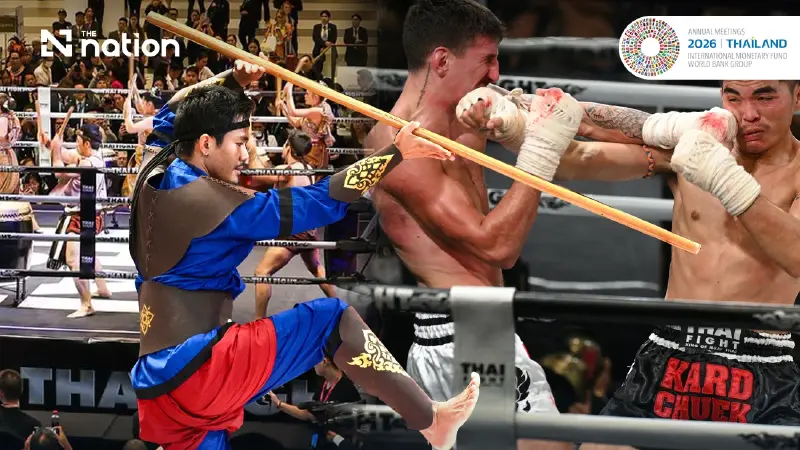


Sword displays, traditional drums and Thai Fight bouts introduce global finance delegates in Bangkok to Thailand’s martial arts and cultural traditions
- At the 2026 IMF-World Bank meetings in Bangkok, Thailand showcased its martial arts heritage as a form of cultural soft power for international delegates.
- The event featured a performance of krabi krabong (Thai sword fighting), combining traditional combat with contemporary staging to introduce the lesser-known art to a global audience.
- A war-drum performance, which blended traditional instruments with martial arts movements, served as an energetic opening for the Thai Fight programme.
- The "Thai Fight" segment presented the first full-scale, competitive Muay Thai bouts ever staged at an IMF-World Bank meeting, generating strong interest from attendees.
Thai sword fighting, war drums and competitive Muay Thai brought the country’s martial arts heritage to international delegates at the 2026 Annual Meetings of the International Monetary Fund (IMF) and World Bank Group in Bangkok. At the Queen Sirikit National Convention Center, performers combined traditional combat skills with contemporary staging, introducing audiences to cultural practices extending beyond the internationally familiar sport of Muay Thai.
Thailand’s return as host after 35 years provided a platform for both economic discussions and cultural exchange, with the performances presenting martial arts as part of the country’s soft power.

Traditional sword fighting meets contemporary performance
The Thai Sword Fighting Performance brought together the Phetch Jaras Saeng performance troupe and the Buddhaisawan Sword Fighting Institute in Kanchanaburi. Their collaboration combined Thai sword dance with krabi krabong, balancing the strength of combat with the grace of traditional movement.

Phet Phettong, a representative of Phetch Jaras Saeng, told Bangkok Biznews that the team wanted to build its performance around the roots of Thai self-defence and give krabi krabong a fresh presentation.
“We chose krabi krabong because we wanted to show the roots of our martial arts and culture. Most people are not very familiar with it. Some may see it simply as a basic subject taught in school,” Phet explained.
“But we want to show that krabi krabong is more than just the basics. It can be combined with an international approach and introduced to a much wider audience.
“Most foreign visitors at the event have only seen Muay Thai or boxing. Presenting this relatively rare art is therefore something very new for them.”
Phet highlighted the precise movements, beauty and grace within Thai fighting traditions as distinctive qualities rarely found elsewhere. She believed the performance could become another expression of Thai soft power and help international audiences see the country in a new light.
Jira Mesamarn, director of the Buddhaisawan Sword Fighting Institute, designed the fight sequences and sword-dance movements. A longstanding collaborator with Phetch Jaras Saeng, Jira explained that the performance had been developed to balance martial strength with the elegance of Thai dance, keeping audiences engaged.
Bangkok Biznews also described holographic elements within the production, alongside the combat choreography. The collaboration with the institute aimed to make the martial arts presentation accurate, exciting and entertaining.

Sword school reports a presence in 24 countries
For Jira, the performance offered an answer to a familiar question about the purpose of learning krabi krabong.
“Today provides the answer to why we study krabi krabong. People may know Muay Thai, but few realise that krabi krabong and Thai sword fighting are like an ‘undercurrent’ already recognised around the world,” Jira said.
“Our Buddhaisawan school now has teaching branches and dedicated gyms in 24 countries overseas.”
Jira explained that international students came for more than exercise or sword combat. They valued the art itself and wanted to carry forward the spirit of Thai culture, including the wai khru ritual of paying respect to teachers.
“Muay Thai without the wai khru is not Muay Thai, and the same applies to krabi krabong. From the moment students first pick up a sword, we teach them the dance movements, the wai khru and respect for their teachers, so they learn Thai culture at the same time,” Jira explained.

War drums open the Thai Fight programme
Phetch Jaras Saeng’s contribution continued into the evening, when its war-drum performance opened the Thai Fight programme.
Phet described a production built around exchanges of rhythmic solos, using traditional instruments including the taphon and poeng mang drums. Contemporary drumming techniques were combined with martial arts movements and Thai dance to create an energetic performance that held the audience’s attention from beginning to end.
Thai Fight then brought competitive Muay Thai bouts into the meetings venue. Bangkok Biznews reported strong interest from international delegates, with spectators gathering around the ring and cheering as the fighters competed.
The publication described the event as the first full-scale Muay Thai competition staged at an international IMF–World Bank meeting, featuring actual bouts rather than demonstrations of fighting techniques.
The programme gave Thailand another opportunity to introduce its culture through sport while hosting global economic and financial discussions. Across the sword, drum and boxing performances, traditional skills were presented through contemporary storytelling and performance design intended to connect with international audiences.


Source: Bangkokbiznews
