
Bullet to the heart


Play
The life of Thailand's last executioner is brought to the big screen
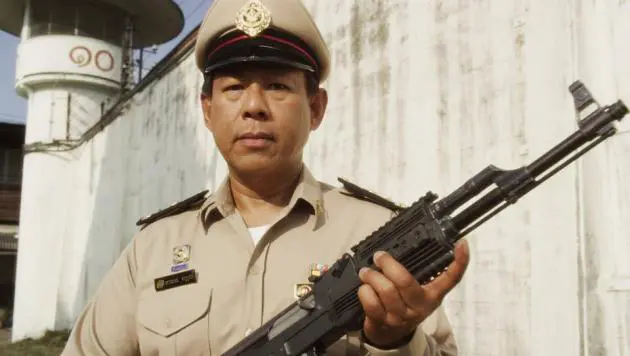
Is and executioner of condemned prisoners a murderer or simply a man doing his job? It’s a question Thai-Irish director Tom Waller attempts to answer in his new film “Phetchakhaad” (“The Last Executioner”), which tells the story of Chavoret Jaruboon, who served as Thailand’s executioner for almost two decades before the switch to death by lethal injection in 2003.
Throughout his 19-year career as executioner at Bang Khwang Central Prison, Chavoret put 55 prisoners to death by firing a bullet into their hearts.
“He did a job no one else wanted to do. I think he played a very important role in Thai history,” says Waller, who made his Thai directorial debut with 2011’s “Sop Mai Ngiab” (“Mindfulness and Murder”). Though the film didn’t make much of a dent at the box office, it was hailed by the critics and nominated for five Subhanahongsa Awards in 2012, including Best Film, director and screenplay, and won best supporting actor for Wannasak Sirilar’s performance as a mysterious monk.
Chavoret started his career as a guitarist, playing in a band at a bar for American soldiers during the early 1970s. Unable to support his family on his earnings, he took a job as a warden escorting prisoners on death row to their executions before eventually becoming the executioner.
Thailand adopted execution by gunfire in 1935 and employed 11 executioners over the following 68 years to end the lives of 319 prisoners. Of these, Chavoret held the highest tally at 55 lives.
“He took the job so he could support his family. The film reveals what he was thinking and shows his inner struggle with good and bad karma,” says actor Vithaya Parnsringarm, who plays the title role and spent many months reading everything he could find on the man and talking with Chavoret’s family.
“For me his job is not a sin. It’s important to look at the intention. He just pulled the trigger; he was not judging whether a criminal should be put to death or not,” Vithaya says,
Waller agrees. As a Roman Catholic, he understands why Chavoret, as a devout Buddhist, was in a state of permanent conflict.
Chavoret wrote his memoirs after retiring and it is on these that the film is based. He died of cancer in 2012 at the age of 64.
“It’s a thriller and I believe it will attract viewers of all ages, especially as the cast includes several well-known actors,” says the director who only used one superstar – hip-hop artist Way Thaitanium – in “Mindfulness”.
Also playing central roles in “Executioner” are Penpak Sirikul, who stars as Chavoret’s wife Tew, and David Asavanond who portrays the spirit in Chavoret’s mind as he struggles with the concepts of merit and sin. Veteran actor and director Pisarn Akaraseranee has a cameo role as the Justice Minister of Justice while Nirut Sirijanya stars as a TV show host who interviews Chavoret in the film.
Vithaya, whose role in “Mindfulness” shot him to fame and landed him a starring role in Nicolas Winding Refn’s “Only God Forgives”, is happy to be working with Waller again. The feeling, says the director, is mutual.
“His acting is stronger and better and he is truly convincing as Chavoret,” says Waller who prefers minimal but natural acting.
Vithaya adds that the natural acting is the strong point of Waller’s films.
“He only works on projects he likes and the audience benefits from that,” he says.
While the film in the Thai language, the script is in English. Rather than stick strictly to the translated screenplay, Waller prefers to improvise.
“I have to let them say their lines naturally so I work on the set with the actor,” Waller explains. And for a veteran actor like Seethao Saotong who has problems remembering his lines, the director explains the situation and lets him use his own dialogue.
“It works; his character provides the only comic relief in the movie,” he says.
Waller, who has lived in Thailand for more than 15 years, has worked on and produced several foreign films that have been made in Thailand, among them Isaac Florentine’s “Ninja: Shadow of a Tear”, Prachya Pinkaew’s “Elephant White” and “Soi Cowboy” by Thomas Clay.
“I’ve learned my filmmaking skills from world-class directors by watching and observing,” he says.
But despite his contacts, finding funding for “Executioner” has been hard, with several studios rejecting his pitch. He’s ended up financing it from his own pocket.
“Nobody wanted to invest so I spent the money I earned from my production jobs. That means I’ve had to do both jobs simultaneously. But I’m happy to be the director because it’s fun and I love working with a Thai cast and crew,” he says.
Waller, probably because he is foreign, brings a new element to the Thai movie treadmill, successfully presenting daily life in Thai society in a more attractive way than in domestic films. For example, a scene in “Executioner” shows Chavoret talking about his job while dining streetside rather than in a well-lit restaurant.
The Thai film industry has also enjoyed very mixed success with films based on true-crime cases, such as 1985’s “Naulchawee”, starring Sinjai Plengpanich as a nurse murdered by her physician boyfriend, and “Zee-Oui”, about a cannibalistic serial killer Chinese immigrant in Bangkok in the 1940s. And some proposed biopics haven’t made it to the screen due to objections by family members. These include Euthana Mukdasanit’s “2482 Nakthod Praharn”, about Field Marshal Plaek Phibunsongkhram and Parkpoom Wongpoom’s planned project on So Sethaputr, a political detainee who compiled a Thai-English dictionary while imprisoned at Bang Khwang and Tarutao island.
TAKING A BEAD
* “Phetchakhaad” (“The Last Executioner”) opens in cinemas on July 3. Find out more at Facebook.com/thelastexecutioner.
