
Fifty years the master of malt
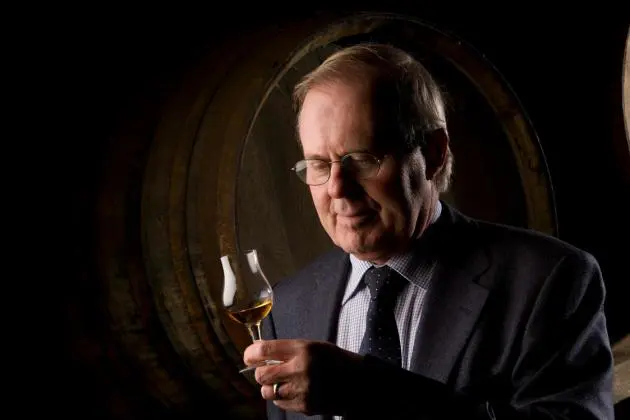


Meet David Stewart of William Grant & Sons, a recognised "Icon of Whisky"
Whiskey’s journey from mash to fine malt is long, but the path to becoming a master blender is much longer still. David Stewart, the award-winning malt master at William Grant & Sons Balvenie Distillery, has been “nosing and blending” for 50 years.
And, lucky for us, he’s still overseeing production in retirement.
Stewart started work at the Balvenie distillery when he was 17 years old, as a stock clerk. But one day the malt master, Hamish Robertson, dragged him into the sampling room and started teaching him the craft.
“I don’t know what he saw in me, but I must have been the most suitable choice at the time – because there was no one else to teach!” Stewart, now 69, laughs while greeting us at the distillery in old Dufftown, the self-described “whiskey capital of the world” in Banffshire. (Harry Potter’s school Hogwarts is supposedly nearby – or perhaps we’d already sampled too much.)
Hamish Robertson showed Stewart how to blend the samples, nose them and taste them. “Every day Hamish would bring some samples from the warehouse – sometimes aged for five or eight or 12 years in barrels of American or European oak or sherry casks. We looked at grain whiskies, old whiskies and whiskies from our competitors – we looked at everything. And I spent 12 years learning with Hamish.
“Luckily for me, Hamish decided to leave the company and went to the William Lawson distillery. I knew they were looking to bring in a replacement with more experience, and I was only 29, but I was the only one at the Balvenie who knew how to blend and nose whisky. So they said, ‘Well, carry on what you’re doing and let’s see how it turns out.’ Six months later I got the job as master blender for all the whiskies under William Grant & Sons.”
Stewart became the firm’s fifth “generation” of master blenders and one of just 12 malt masters in the entire Scotch-whisky trade. He is now also the industry’s longest-serving malt master, having applied his acute olfactory sensors to more than 400,000 casks in his career.
Among many achievements, Stewart in the 1980s played a key role in developing the technique of “finishing” single malt, one of the industry’s chief innovations over the last three decades. It refers to “double maturing” or “wood finishing”, with the nectar moved from a cask of a particular origin to another of a different origin.
Typically the first cask is American oak and has been used to mature bourbon. The second cask might have previously held fortified wine like sherry, port, Madeira or even Burgundy or Chardonnay. “The key is in the timing,” Stewart says. “You don’t want to keep the whisky in the second cask too long because it can become overpowering. We experimented a lot and, lucky for us, we now have a good collection of good whiskies to choose from.”
In 2010 he finally passed the master-blender baton to Brian Kinsman, a former chemist who’d apprenticed with him for almost a decade. “I had eight years to start looking for someone to replace me. It’s a long process, the training. We need to know more than just our own whisky – we need to know the whisky industry. William Grant & Sons whiskey has 25 different malts in it. We need to know all the different characteristics.
“Brian is ideal for the job and does it very well. As for me, I was very lucky that, after my retirement, the company was keen to keep me on.”
The industry he came to know so well hailed Stewart as an “Icon of Whisky” in 2009. It was an honour to add to the Lifetime Achievement Awards he’d earned from Malt Advocate in 2007 and the International Wine and Spirit Competition in 2005 and to the Grand Prix of Gastronomy from the British Academy of Gastronomes, also presented in 2005.
