
Money moves in Shaolin


Play
The centre of China's ancient martial-arts culture is under threat as capitalism takes hold
In the ancient mountain fastness of Shaolin Temple, behind the closed doors of a Buddhist sanctum, Abbot Shi Yongxin holds court from a lacquered wooden chair carved with dragons.
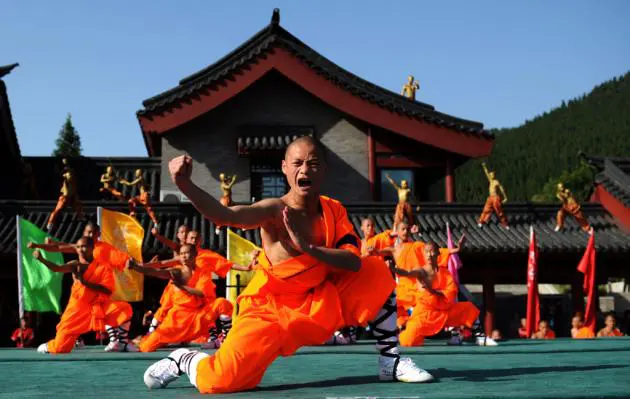
At his left hand, a trio of warrior monks stands attentively, 1,500 years worth of secret skills and kung-fu technique trained into their loose limbs.
There is something of the snake and tiger in their poise and posture, of the crane and the monkey in the way they move.
Amid the trappings of the past in the ornate receiving room, the abbot and his followers seem like throwbacks to China’s age of legend, remnants of a bygone era.
The spell is broken by an electronic jingle.
Shi, the 30th spiritual leader of the ancient order, pulls a smartphone out of his robes. He flips it open briefly to scan the screen, grunts and quickly makes the handset disappear again.
The 21st century has come to the famed temple at the heart of kung fu, bringing with it a new wave of foreign interest, and a growing debate domestically about what this means for the culturally iconic Chan Buddhist institution.
“We pursue a peaceful and simple life,” Shi says. “Our ultimate goal is to achieve the enlightenment of Buddha and to help others achieve enlightenment.”
But enlightenment isn’t always free at Shaolin Temple, not that this matters to a new breed of acolyte prepared to pay for the kung fu wisdom the order offers.
They are chief executives of multimillion-dollar companies, foreign businesspeople and motivated professionals willing to fork out about $800 (Bt25,000) a month to learn and live at Shaolin. While this phenomenon is part of a business model that is helping secure Shaolin’s future, some believe it is also part of a malaise that jeopardises its ties to the past.
Every day, thousands of tourists throng the temple grounds, once a quiet retreat for 13 famous warrior monks who, legend has it, took down a despotic warlord and his army during the Tang Dynasty (AD 618-907).
In their time, much of the mystery surrounding Shaolin pertained to the arcane, the closely guarded mental and physical abilities that approach the mystical in the telling. These days the temple is still cloaked in secrecy, but that relates largely to a veil of corporate confidentiality maintained by a separate business entity.
CTS Songshan Shaolin Culture Tourism Company, which collects an admission fee of 100 yuan (Bt500) a person to enter the scenic park that people making the pilgrimage to the temple must pass through, declined to provide visitor numbers or annual revenue.
Grizzled masters endure the daily invasion with stoic expressions. Shaven-headed novice monks talk loudly on smartphones, or sell incense and trinkets, or access the Wi-Fi now available in the ancient buildings.
Shaolin medical books are sold on Taobao, China’s e-commerce equivalent of Amazon, and Buddhist disciples can now avoid the trek up Songshan mountain by paying to study at Shaolin by correspondence on the Internet.
Since 2010, the temple has had an online social media presence on Sina Weibo, and boasts more than 150,000 followers. There is also a gaming app being developed to teach users kung fu on their mobile phones.
Shi, one of the first Chinese monks to gain an MBA, says Shaolin’s business interests have been set up to support and preserve its 1,500-year-old culture.
“We have entered a commercialised society ... so people tend to evaluate things from the angle of commercialisation,” Shi says. “But you need to look at what is behind the business practice. Some people do business so they can survive, and some do it to seek fortune. Shaolin Temple just wants to survive, to practise Buddhism.”
In March, executives from US tech giants Google and Apple joined the ranks of prominent global businesspeople to have received Shi’s wisdom.
Members of the China Entrepreneurs Club, a group that consists of 46 leaders of the country’s top private companies, also spoke with the abbot in a closed-door session this year at a conference themed “self cultivation of entrepreneurs”.
And they are not the only ones to flock here. In a shaded courtyard, kung fu masters flow through fighting forms with a sinuous, otherworldly grace.
A group of students look on as the shaven-headed monks demonstrate the basic stances of wushu, the backbone of Shaolin’s fighting style, made famous worldwide by the moviemakers of Hong Kong and Hollywood.
These eager pupils are African, American and European. And while some have made the pilgrimage to Shaolin seeking the fabled martial prowess that will stop an enemy’s heart with a single blow, just as many say they have come looking for a professional edge.
Wang Yumin, dean of Shaolin’s Foreign Affairs Office, says that since January last year about 800 foreigners have come to live and train at the temple for periods ranging from a few days to more than 12 months.
Many are funnelled in from the more than 40 “Shaolin cultural centres” dotted across Europe, the US and a host of other countries.
Wang believes foreign students are specifically and increasingly seeking the “legitimacy” that he says Shaolin Temple offers.
Abbot Shi generally shies away from talking about the commercial successes of Shaolin and why he has taken the order down a path that has led to financial sustainability.
But reading between the lines, when he opens up about his own journey to enlightenment, reveals much about the man and his mission.
Born in Anhui province, the son of a train driver, Shi arrived at Shaolin Temple in 1981 when he was 16 years old. He found the place in disrepair. The monks, he says, “didn’t have enough to eat”.
“At that time, Shaolin didn’t have so many visitors. The temple buildings were in poor condition, and more than 30 monks lived off 1.9 hectares of farmland. The conditions were harsh, and life was tough.”
Starting in 1987, Shi was able to help steer the future course of the order. In 1999 he became the abbot, and his reform agenda picked up pace.
“For 1,500 years, our belief, our way of practising Buddhism has not changed,” he says. “But our daily work has changed. Historically, monks lived off farming. Now they mainly work by serving tourists. We used to deal with farmlands, but now we deal with people, which is not that easy.”
Shi Yanbo, 25, is part of the new generation of novice monks at Shaolin. He believes going back to the old ways makes no sense.
“Tourists are a test of our xiuxing (journey to enlightenment) because we have to make sure that our heart won’t be affected by the noisy environment,” he says.
“We have to accept it and remain calm and treat visitors with joyful hearts. Shaolin belongs to the world now, and develops with the world. We cannot do farming; otherwise, people would be unable to visit us. All our traditional thoughts and beliefs have been maintained and carried on for generations. Our life may be different, but what we practise is of the heart, and the heart remains unchanged.”
The abbot says the temple’s growing connectivity with the modern world is about survival, and about spreading the benefits of Shaolin wushu to those who are seeking it, globally.
He hints that the kung fu wisdom he shares with executives is not just about people wanting to do better in business, but also about people who have done well in business, wanting something better.
“I tell businesspeople how to behave in a good way, how to do things well,” Shi says. “They need to be more confident, improve themselves, keep a normal heart toward things and believe that you reap what you sow.”
