
China frets over a fading tradition


Play
Though demand remains high for calligraphy brush-pens, few young people are interested in how they're made
In the workshop of the Wangyipin Brush Pen Store in Huzhou, 29-year-old Shi Wangli sifts through goat fur in water with an ox-horn comb to select appropriate strands to make a traditional Chinese brush pen.
Her hands are immersed in water for at least eight hours a day, summer and winter. The selection of the hairs is one of the most important steps of making a quality brush pen, and the work she does cannot be performed by a machine.
Shi is the youngest brush-pen technician in Huzhou. These days few young people are willing to undertake such a difficult job.
Xu Jianfeng, general manager of the store, is worried the thousand-year-old techniques for making the Huzhou brush pens used in calligraphy will be lost. “If the Huzhou brush pen dies, an important part of Chinese culture will die with it,” he says.
Located in the north of Zhejiang province, Huzhou has been a hub for brush pens for thousands of years. In ancient China an excellent Huzhou brush was representative of social status and was the aspiration of all men of letters.
In Chinese history brush pens served as an essential tool for cultural inheritance. However, amid modernisation, they were replaced first by nib pens, then ballpoint pens and finally keyboards.
Zhu Yanlin of the Huzhou Economic and Information Commission says the key reason the art of making the pens is in danger is not because fewer people use them these days.
“It’s very hard learning to make brush pens because the techniques are complicated and the working conditions are poor. The profits are low, too, so the income is lower than average.”
Shi would not reveal how much she earns making brush pens, only that she earns much less than her peers. “There are few people my age choosing this job. If I had a daughter I wouldn’t let her learn this because it’s so hard.”
Zhu says Huzhou had fewer than 10 brush-pen technicians under 40 in 2008. “I believe the number is much lower now. Most of them have already passed the age of retirement, but they stay in their positions because, without them, the factories would have no one to make brush pens!”
There are 128 separate procedures involved – and all must be done by hand.
Xu says the 271-year-old firm Wang-yipin, with about 60 technicians, is the largest brush-pen manufacturer in Huzhou. “There are a lot more that have only two or three technicians, most of whom have reached their 60s or even 70s. The problem is more severe for them,” he says.
According to official statistics, 102 companies and 187 family workshops make brush pens in Huzhou, employing a total of 1,500 people and collectively producing 10.3 million pens a year.
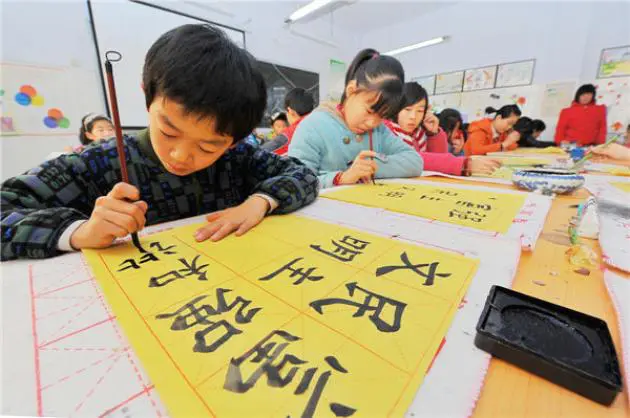
In January 2013 the Ministry of Education required elementary and middle schools to offer calligraphy classes to save the tradition. That brought many orders for pens, but Xu says the increase in orders is bittersweet. “We don’t have enough people to make the pens.”
Wangyipin is capable of producing 300,000 pens a year. “Actually we don’t lack orders at all,” Xu says. “Our productivity is much lower than the total demand. What we lack are skilled technicians.” The Huzhou government has issued preferential policies and set aside funds to revitalise the industry, but young people are still not attracted. As early as 2009 Huzhou issued stimulus plans to encourage young people to learn the art.
For apprentices under the age of 30 in key positions, the government grants subsidies for three consecutive years. “Their value can’t be properly reflected because the added value is low, and this problem cannot be solved by the companies,” Xu said.
He believes pen-making should not be viewed as just a type of traditional manufacturing, but should be regarded as a craft that represents Chinese culture.
“People should get to know the meanings and thoughts behind the techniques,” he says. “If all of society considered our workers respectable technicians rather than just somebody working on an assembly line, maybe the conditions would become better.”
