
Highballing into New Year
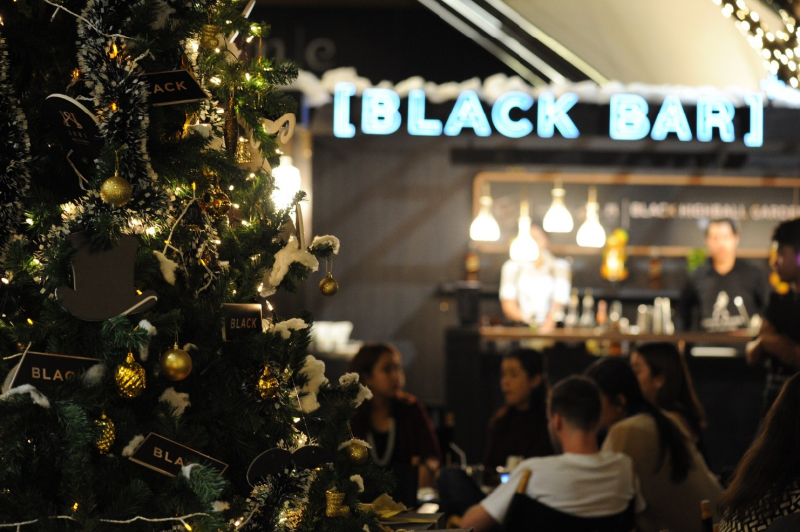


Johnnie Walker is cultivating whisky tastes in the Black Highball Garden at Groove
WITH FESTIVE booze oases popping up around Bangkok for the holidays, fans of whisky have their very own Black Highball Garden at Groove until January 4, courtesy of Johnnie Walker Black Label and three top restaurants.
Regarded as the simplest and most refreshing way to combine whisky and soda, a highball can actually be any drink served in a highball glass. What the word “highball” means exactly is lost to history, along with much of the terminology involving cocktails and bars in general.
Witnesses at the creation obviously forgot how these things started. One might safely deduce that they were inebriated at the time.
In lieu of chronicled fact, we have the belief shared by some “whisky experts” (and there’s a ripe scholarship) that the highball originated in St Louis, Missouri, in the latter half of the 19th century, when that Mississippi River city was still the American frontier. On the railroad, a ball hoisted to the top of a pole at the station was the signal for the train’s engineer to speed up – “highball it”.
The term was adopted for an alcoholic drink that could be made fast – such as splashing
water or soda into whiskey – and maybe get you drunk fast. You don’t hear the word “highball” a lot these days, although the pros in the bars and restaurants certainly know it.
An alternative origin saga has the highball arriving in the US in 1894 with the compliments of touring English actor EJ Ratcliffe, and indeed initially the most common recipe used Scotch whisky and carbonated water – the famed Scotch and soda of the United Kingdom.
Diageo Moet Hennessy (Thailand) prefers the version where bars at golf links in Britain served highballs in the late 19th century, “ball” referring to any “whisky drink served in a
high glass”. Of course these three competing theories could converge conspiratorially – maybe Ratcliffe was a golfer who’d played at St Andrew’s in Scotland and had a gig in St Louis!
In the 1950s the Japanese, recovering from a nasty war, gave the highball another surge in popularity as the younger generation embraced what had formerly been seen as an old codger’s drink. It was lighter and nowhere near as intense an experience as sipping malt whisky.
Mixing whisky with other beverages has raised the highball to new levels of popularity in Japan, almost matching that of beer. Home-distilled
whiskies like haiboru meets shochu (another distilled beverage) in the Chuhai, and tea is used for the Oolong Highball. You can even by ready-to-drink highballs in cans at convenience stores!
Johnnie Walker Black Label has its own signature highballs. The Black Highball is Johnnie Black, club soda and a shard of orange. The Ginger Black is slightly sweet with ginger ale in place of club soda.
Some of the varieties currently available at the Black Highball Garden – accompanied by food from the intriguingly named restaurants Hyde & Seek Peek-a-Boo, 1881 by Water Library and Tales of Gold Mine – have a decidedly wintry accent, like the Black Forest Highball, made with red gluehwein (mulled wine), tropical fruit and pine flavour.
Then there’s Belly Wash Dirt, with cream de cacao, lime juice and dark chocolate.
These drinks cost between Bt220 and Bt250. The dishes from the three eateries run from Bt180 to Bt450.
For your added amusement, there’s live acoustic music nightly and, today and on December 24 and 30. DIY Bar sessions with 2014 World Class Thailand champion Ronnaporn “Nueng” Kanivichaporn. For every drink purchased, Nueng will give you a personal tutorial on the construction of a highball.
BELLY WASH DIRT?
The Black Highball Garden is on the ground level of Groove at CentralWorld Plaza through January 4 and open daily from 6pm to midnight.
Find out more at www.Facebook.com/JohnnieWalkerTH.
