
Dharma and Drama greet Thai opera


Play
'The Silent Prince' earns standing ovations in Prague and deep in Wagner territory
IT WAS to be a bold voyage into uncharted waters. The indomitable Sissy Thammer, long-time director of an adventurous youth festival in Bayreuth, Germany, had invited me to give “The Silent Prince” its European premiere at the festival – during the annual pilgrimage to Bayreuth for the granddaddy of all epic opera cycles.
Richard Wagner’s 15-hour, four-evening Ring Cycle is the reigning world champion of music drama, and the Bayreuth Festival is an icon.
And a year ago I announced that “The Silent Prince”, “Mahajanaka” and “Bhuridat: The Dragon Lord” would form part of an even bigger cycle – “Dasjati: Ten Lives of the Buddha”, a modern recreation of the central literature of Buddhism. If finished, it would be the “biggest” opera of all time, with 10 complete works, eclipsing Wagner’s four.
To perform this work in Bayreuth in a small theatre at the same time “The Ring” was playing is the height of cheek. At the festival’s opening ceremony I said, “I am like a mouse that’s been asked to play in a house of cats.”
The Bangkok Metropolitan Administration, one of our troupe’s chief sponsors, had withdrawn its support, however, leaving 70 of Thailand’s finest young artists stranded in Europe. A member of the German press had got wind of this and smelled a human-interest story that could have given Bangkok, and Thailand, a black eye.
Suddenly I had to deal with a crippling financial shortfall as well as running the rehearsals and arranging the logistics at a large international festival. I literally didn’t know whether, in a few days’ time, our kids would have enough money to buy food.
I was determined that Thailand’s first entry into continental European opera would be a supernova, not a bomb. It was important that none of the young artists panic. It was equally important that I stave off a looming storm in the press because, instead of being a PR success for Thailand, there was a risk that Thailand would look like a cesspool of heartless bureaucracy.
I started calling my friends – starting with journalists who I knew really wanted this to succeed. And within a few days a miracle was happening. One journalist went to his ATM every day for three days and drew out his daily maximum to contribute to us. The parents of one of the chorus members canvassed relatives and raised Bt500,000. Another friend matched that, no questions asked. Still another immediately floated a loan of more than Bt1 million. And there were many smaller gifts from people who cared deeply about the project.
Karma had defused our crisis – not, I fear, my personal karma, which is laden with earthbound attachments, but the karma pertaining to the work itself, for what work of art could come with greater positive karma that the teachings of Buddha? In three days our story had changed from one of perfidy and defeat to one of heroic sacrifice and global encouragement – support had come from three continents.
Buoyed by the love of our friends, I told the cast and crew, “Let’s not worry about the fact that we may face a firestorm when we return. Let’s really show the Europeans that we have something new, something exciting to say – that we are a new trailblazer in a field that was born in Europe, but now belongs equally to Asia.”
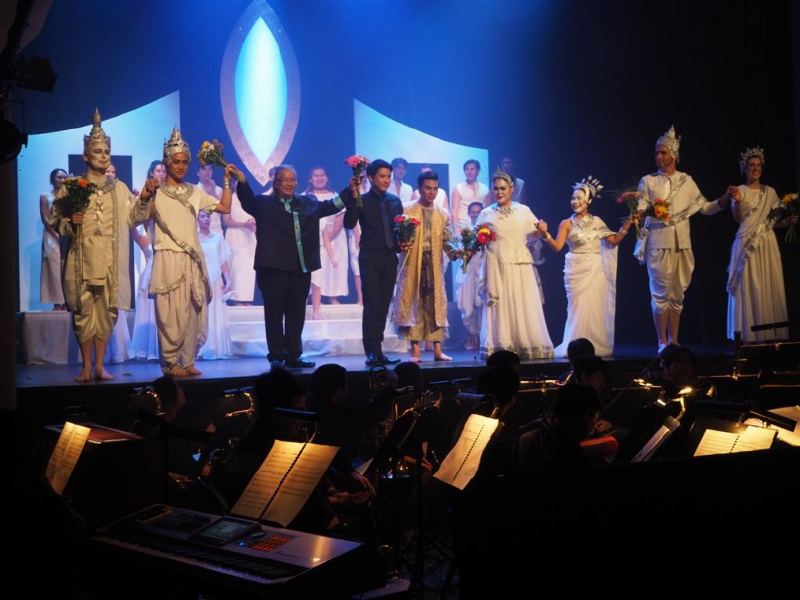
There were two performances of “The Silent Prince” in Bayreuth. The first night, the audience was small and didn’t quite know what to expect, but at the end there was a thunderous and protracted standing ovation. The second night the theatre was crammed, in part because that night was a break in the Wagner, so many Wagnerians were able to come.
The media reviewers were thrilled.
“The composer truly knows his craft,” the Nordbayerischer Kurier said. “This is a joyful and technically very accomplished syncretism. The stylistic collage conflates highly coloristic and saturated melodic lines with simple rhythms in the manner of the refined musical worlds of Franz Schreker (Vienna 1920), Leonard Bernstein and Steven Sondheim.
“Western tonalities are overlaid with Southeast Asian melodies. But, rather than creating a confused chaos of sound, Sucharitkul has fashioned an exciting score in which – and this is what is so modern about it – East and West are united in harmony yet with their differences clearly audible – partaking fully in the spirit of this festival. A massive round of applause for both an opera that is both scenically alien – yet musically accessible – whose music soars high and even as its ethics plumb depths of profundity.”
To be compared to both Schreker and Bernstein in a single sentence was very exciting for me. For decades repressed because of the Nazis, Schreker was second only to Richard Strauss in European fame, and now he is coming back again. Connoisseurs know about his operatic treasure trove that has yet to be unleashed on the modern world.
Though Bayreuth is a centre of Wagnerian pilgrimage, our next stop, Prague, has even more operatic history. Prague is the city that received Mozart’s music and made it into a triumph after Vienna’s lukewarm response.
Hidden from view during the Soviet era, Prague is now exciting and sophisticated, a place where cab drivers can speak the language of music, philosophy and art. Our kids felt liberated in this town, which welcomed them with open arms.
With the main theatres all closed for the August holidays, the first Thai opera in Czechia – the Czech Republic’s official short name as of May – opened in a theatre-cum-jazz bar in downtown Prague with wild Art Deco wall sculptures.
It turned out to be a wonderful venue. The audience could really get up close to the singers and see every nuance, and in which every colour of the orchestra was pinpointed and vibrant. Ryan Attig, our genius Thai-American lighting expert, was able to work magic with the extra lights available. We earned another long standing ovation.
The next day Opera Plus, Czechia’s leading classical-music magazine, captured my exact intent when it described the production as “based on traditional Southeast Asian aesthetics, but subtly adapted to the |comprehensibility of a western |audience”.
