
Peking opera hits new heights
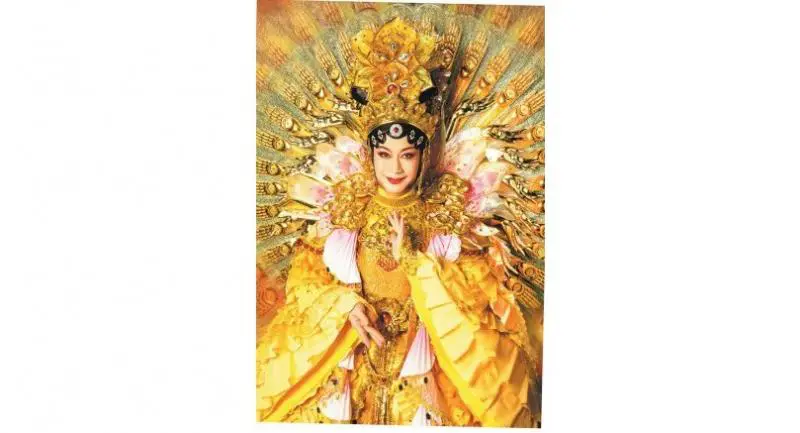


Wu Rujun aimed to master one tradition and ended up as servant to another
Was it chance or was it fate? Wu Rujun was just four years old and what delighted him most were his Shaolin training classes. But any possibility that he might one day become a Shaolin master was shattered one day when he badly sprained his ankle during training.
Instead, another calling that in fact seemed a much more natural choice for him came into view – Peking Opera.
Rujun was born in Nanjing in Jiangsu province, to a family with solid ties to opera, his father being a renowned jinghu, a player of the two-stringed fiddle that accompanies opera actors, and his mother a celebrated singer.
Yet the thought of passing on their artistry to their son barely crossed their minds, Wu says, until a friend visited the family, recognised the boy’s talent and suggested to his parents that they teach him. Wu began to learn the jinghu from his father when he was nine.
“Jinghu is too difficult for a child,” says the actor, now 53, who has spent half of his life in Japan. “It’s different from the piano, each of whose keys has a specific pitch. The jinghu’s two strings are like wire ropes – you have to use various techniques and varying intensity to make it sound pleasant.”
With time and practice he drew more praise and eventually the boy who hoped to be a Shaolin master ended up a servant to |the national treasure that is Peking Opera.
In six years of study at the National Academy of Chinese he pressed on with the jinghu and finally graduated with excellence in all subjects. His beautiful falsetto – which contributed to his later success in playing a dan (female character) – also appeared in this period.
Yet Wu’s career got under way at a troubled time for traditional arts, when popular culture from abroad was luring people to other forms of entertainment. In fact, Wu says, in the 1980s there were frequently more performers than there were audience members.
Many of his colleagues got out of the profession, but Wu was determined to make something of his craft. He blended the sound of the jinghu with more popular musical elements and created “jinghu light”, which brought the instrument out of its supporting role into the spotlight.
“Cultural heritage needs innovation,” Wu says. “Artists must share responsibility for spreading their country’s traditional culture and popularising it by being aware of related fields of art and music elsewhere.”
For Wu, national boundaries do not exist in the arts. Peking opera is a masculine art form, but he learned from Japanese culture to add more sentiment to his theatrical works, he says, and created “New Peking Opera”.
In Wu’s version, the key traditional elements are kept, but stylistic changes are made. For example, it highlights melody with thematic music that suits different roles, and actors don makeup and garments that are closer to modern life.
Current trends are also reflected in the presentation, and the stage design features more illumination and the choreography more dance movements than is the case with the traditional version.
Wu migrated to Japan in 1989 with his Japanese wife, and in 2000 he founded the Japan Peking Opera Theatre in Tokyo.
“After arriving in Japan I found people only had limited knowledge of Peking opera, mainly about fight sequences, and few knew about the music, which is obviously hard to understand.
“Japanese audiences are well mannered and everyone applauds at the appropriate time, but at first the applause was out of courtesy rather than being a genuine show of appreciation.”
In the intervening years Wu has created more than a dozen New Peking Opera productions and presented many Chinese traditional female figures to Japanese audiences. Every year nearly 50 of his shows are staged in Japan.
Just as the accolades of those who witnessed Wu’s performances as a boy pushed him to greater things, the applause he receives today continues to inspire him.
“Some audience members tie red flowers around their wrists, and when they applaud it looks like a sea of flowers. It really moves me and I really appreciate their love and support.”
The concepts of peace and benevolence in traditional Chinese culture run through his works, he says. Recently Wu brought his new opera “Philanthropic Guanyin” back to his hometown of Nanjing and gave Chinese audiences a fresh taste of the magnificence of their traditional treasure.
The play is reckoned to be the first of its kind depicting the process of enlightenment of the bodhisattva of compassion, which is portrayed as the female figure Guanyin in Chinese Buddhism.
It debuted at the Nanjing Culture and Art Centre on January 22 before moving to Beijing’s Chang’an Grand Theatre last month. It will tour Japan in September as a tribute of the 45th anniversary of China-Japan diplomatic relations.
Though Japan is very much home for Wu these days, he’s still passionate about the growth of Peking opera in China. Apart from presenting his works to Chinese audiences, he has also set up a studio in conjunction with Beijing Opera Troupe of Nanjing to cultivate prospective talent.
“My idea is to make use of my artistic performances to draw the people of my own country and of Japan closer to each other so that they understand each other better.”
