
Angels wait to guide her
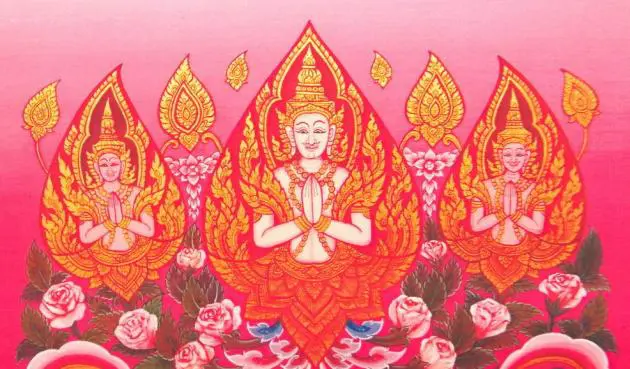


The artists adorning Princess Bejaratana's crematorium draw inspiration from faith and childhood memories
There were roses in the garden of the house in Brighton, England, where Her Royal Highness Princess Bejaratana grew up. She helped to tend them and always had fresh-cut stems indoors.
And roses will attend her rebirth.
Inspired by the childhood anecdote mentioned in “Duang Kaew Heng Phramongkutklao” – Vinita Diteeyont’s biography of the late Princess – skilled illustrators from the College of Fine Arts at the Culture Ministry’s Bunditpatanasilpa Institute have painted tall panels of roses that will surround the furnace at her cremation on April 9.
The rose panels will adorn one of a series of chaak bang phloeng – moveable folding partitions – to be placed at each entryway of the crematorium erected at Sanam Luang. Each chaak bang phloeng features four folding panels, so the painters have prepared 16 works of decorative art in all.
Foremost among the illustrations are depictions of four guardian angels, ready to guide the Princess’ spirit to Dawadungsa, the level of Heaven above Mount Meru in the Brahmin system adopted in Thailand.
Princess Bejaratana, who died last year at age 85, was the only child of King Vajiravudh (Rama VI) and his consort Queen Suvadhana. She was a first cousin of His Majesty King Bhumibol.
Air Vice Marshal Arvuth Ngoenchuklin, the former director-general of the Fine Arts Department who designed Princess Bejaratana’s crematorium, has said the panel illustrations reference the royal vihara at Wat Phra Prathom Chedi in Nakhon Pathom, whose murals by Phya Anusart “Chan” Chitrakara represent the “Rama VI style”.
Bunditpatanasilpa Professor Sanan Rattana, who did the preliminary sketches, pointed out that double chaak bang phloeng will bisect the space inside the entrance twice.
“On the outer panels, angels stand on a platform with hands in the wai gesture,” he says. “The murals of King Rama VI’s reign blended traditional Thai art and Western and lighting and composition, so the angels look more realistic and human.
“The angels’ chong kraben [hip wrap] shows the exquisite theatrical style that interested Rama VI so much, and there are many flowers, with falling rose blooms as the backdrop.”
Along the bottom of the panels are kanok, the classical scroll design, forming a lotus-like poom khao bin structure. This is homage to the Chulamanee Chedi in Heaven. Princess Bejaratana was a devout Buddhist, always making merit and living by the Buddha’s precepts. In fact she studied the dharma under Supreme Patriarch Somdej Phra Nanasangvara.
Sakorn Sopa, Viroj Klommanop, Boonnai Saheang and Sanan Rattana painted the celestial beings, while Nares Bhuchong executed the 32 frames of roses, having learned of the Princess’ fondness for the English rose.
Nares imagined beautiful blossoms of pink and orange in the garden of Heaven. “We decided on this right from the beginning and never changed our minds,” he says. “There are pink roses because the Princess was born on Tuesday, whose colour is pink, and we have orange roses because that was her favourite colour.”
Nares shares her admiration for the rose. “The way each petal forms is fascinating, each one so unique and refined in the nuances.”
He has 13 people on his production team, including former and present students of the institute, and says all were proud to participate. This is the third time the Bunditpatanasilpa Institute has helped decorate a royal crematorium, having also worked on those built for Their Royal Highnesses the Princess Mother and Princess Galyani Vadhana.
In other imagery on the partitions, angels fly on clouds, rendered in various sizes to create depth. Beneath them are poom khao bin roses formed into the shape of more angels. All of these messengers of the gods are waiting to guide the deceased to her earned place in Heaven.
On the reverse of the inner panels, placed closest to the furnace, are more falling rose blossoms. It’s a sad sight, and one that mourners will be spared.
For the farewell
The main pavilion, crematorium and other structures at Sanam Luang will be open to the public from April 11 to 17.
Mourners’ paper flowers for the cremation fire – dokmai chandra – will be collected at three pavilions at Sanam Luang, another opposite the grounds, and a fifth at the Chang Pier, and can also be deposited at 46 Bangkok temples that are holding funerals services in honour of the Princess.
There will be classical Ramakien, shadow play and puppet performances on different stages around the grounds from 7pm on April 9 until dawn the following day. Also performing will be the Public Relations Department and Chulalongkorn University bands and Santirat Institute of Business Administration choir.
The Princess’ ashes will be taken to the Dusit Maha Prasart Throne Hall on the morning after the cremation and a permanent place for them there will be ceremoniously designated on April 12.
Nakhon Pathom’s Sanam Chandra Palace, built by King Rama VI, will host a permanent exhibition in honour of the Princess.
