
When animation turns hard
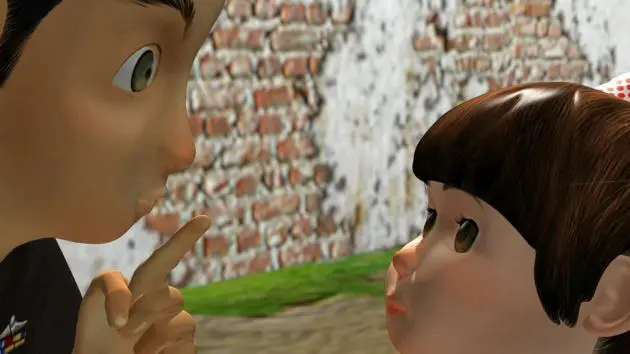


Cartoons take on challenging subjects in amnesty international's contest to stop violence and torture
WITH CONFLICTS raging from Thailand and the Ukraine to Egypt and elsewhere, Amnesty International is turning it attention to stopping violence and ending torture.
To get its message out in Thailand, Amnesty International enlisted the help of animators, putting out a call last October for entries in the first Stop Violence and Torture Animation Contest.
The finalists screened last week at Bangkok’s Lido cinema, with animator Dusaya Opap announced as the winner for “Nei”, about a little girl who witnesses a crime perpetuated by the police.
Organised by Amnesty International and Sputnik Tales Studio, the contest was on theme “direct wrongdoings by government officers” and was open to participants of all ages. The response was healthy though several entries were later disqualified for being off topic, not surprising in a country where such “official” wrongdoings are rarely brought out into the open.
“Our topic is related to the infliction of violence and torture that causes physical or mental pain or suffering, such as that used in obtaining information or a confession by a government official,” explains Parinya Boonridrethaikul, executive director of Amnesty International Thailand.
“While the Thai entrants understood the concept of violence, they misunderstood that it had to be perpetrated by a government officer and instead submitted shorts relating to the abuse of women or kids.”
Five finalists were selected from those entries which met all the criteria and the creators were invited to take part in a workshop then complete their idea within a month and within a budget of Bt10,000.
While none of the resulting five works can be called flawless, the animations are creative in the way they transform tough and serious issues into compulsive viewing.
“Animation is easy to understand, it’s appealing and helps to carry a serious message to people of all ages including children,” Parinya adds.
Rutt Jumapnule, production manager of the Sputnik Tales Studio, says that even though he has been involved in a variety of animation contests, this one was very special and he learned a lot.
“Usually we set each animation contest so that it targets a certain age group. This was the first to be opened to all ages. It was exciting to see such a variety of idea and approaches,” he says.
Sputnik Tales describes itself as a social enterprise that works with organisations in initiating social issue animation workshops, contests and festivals.
“I see the animation as something like a discourse by stand-up comedian Udom ‘Nose’ Taepanich. It allows us to seriously criticise an issue but in a way that tones down the comments while attracting different groups to listen to the message,” Rutt says.
The five finalists ranged from a team of college freshman to professional animators.
“Goat in a Sketchbook”, for example, depicted a goat escaping from being painted black by a manipulative paintbrush.
“Judge” and “Watch”, meanwhile, looked at police torturing individuals to accept responsibility for crimes they hadn’t committed and “The Smith” presented a man who unknowingly becomes involved in the torturing of prostitutes.
The winning submission “Nei” looks at police intimidation though the eyes of the little girl who happens to witness the police attempting to frame the man for dealing in meth. Rather than showing fear, she informs on them to other officers before two men in uniform tell her to stay quiet.
The short ends with her graduation picture and reveals that the little girl grew up to become an attorney.
“I like the idea that even though she couldn’t do anything at the time, the incident inspired the girl to do something as a adult to help build a better society,” Parinya says.
Noting that the topic was complex as well as one with which are local animators are not familiar, animator Kompinn Khemkumnerd, best known for his feature “Khan Kluay”, sees the contest as being of benefit to animators in terms of developing their creativity. He adds that “hard” topics in animation are not uncommon, citing the Hiroshima Animation Film Festival as a prime example.
In Thailand, most animations and shorts revolve around social issues but ones that concern the individual rather than social responsibility.
“Even though those contestants followed the topic issued by the Amnest International, they have different ideas about torture problems and this is reflected through their works. So if we have more contests on hard topics like this, people’s attitudes to unfamiliar problems and the way in which they react will gradually change,” he says.
JUDGE
AND JURY
- You can watch the five finalist animated shorts and vote on them for the popular award until February 25.
- One view on YouTube is equal to one point; one “like” on Facebook equals three points and one “share” on Facebook totals five points.
- For more details, check Facebook.com/AmnestyThailand or search on YouTube for the Sputnik Tales Studio channel.
