
Xi unveils four-pillar global AI governance plan with training and technology support for developing countries
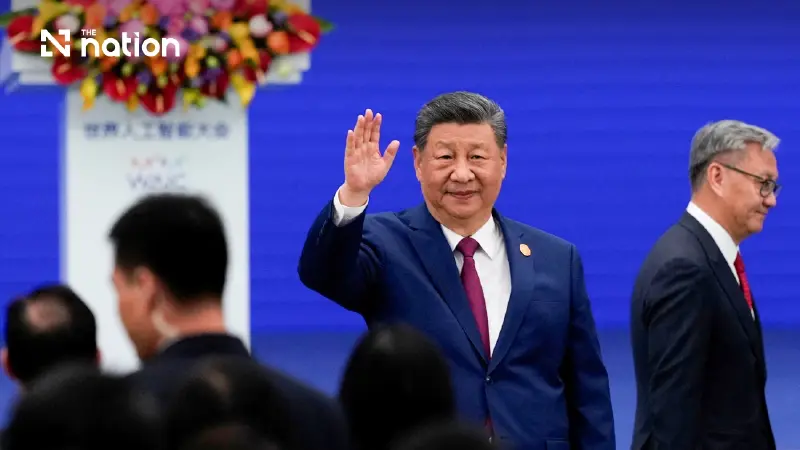


Chinese President Xi Jinping has outlined four principles for global artificial-intelligence governance as Beijing seeks a larger role in setting international standards for the rapidly developing technology
- Promote openness and shared benefits by supporting open-source systems and sharing AI knowledge and tools to make the technology more accessible and drive global economic growth.
- Ensure safety and human control by keeping AI development subject to human oversight, supported by laws, regulations, and risk assessment systems to prevent loss of control.
- Foster inclusion and mutual learning, arguing that AI should respect cultural and linguistic diversity and allow countries to develop systems suited to their own conditions.
- Advocate for solidarity and international governance with a central role for the United Nations in developing rules and ensuring greater participation from developing nations (the Global South).
Addressing the opening of the World Artificial Intelligence Conference 2026 and a high-level meeting on global AI governance in Shanghai, Xi called for a human-centred approach that would make artificial intelligence more widely accessible and prevent its benefits from becoming concentrated in a small number of countries or corporations.
The conference, held from July 17–20 under the theme “Intelligent Partners, Co-create the Future”, brought together more than 1,100 companies, more than 3,000 exhibits and over 300 products described as world premieres.
Xi argued that AI should increasingly be treated as a global public good capable of supporting economic development, improving traditional industries and narrowing technological inequality.
He also presented the technology as a transformative force comparable with the steam engine and electricity, which reshaped production, economies and everyday life.
However, he warned that the concentration of AI resources, computing power and technical expertise could create a new form of historical inequality and widen the divide between developed and developing economies.
Four principles for global AI governance
Xi’s first proposal centred on openness and shared benefits.
He called for stronger support for open-source systems and the wider sharing of AI knowledge, models and tools to reduce the cost of accessing the technology.
Under this approach, AI would serve as a new engine of global economic growth and help modernise manufacturing, industry and services.
The second principle focused on safety and human control.
Xi said AI development should remain subject to human oversight and be supported by laws, regulations, risk assessments, early-warning mechanisms and emergency-response systems.
The aim, he said, should be to prevent autonomous systems from operating beyond meaningful human control.
China also used the speech to oppose what it sees as the excessive expansion of national-security concerns, technological barriers and supply-chain restrictions that could limit other countries’ ability to develop AI.
The third pillar called for inclusion and mutual learning.
Xi argued that AI should not weaken linguistic, cultural or civilisational diversity, but should instead help improve understanding between societies.
Countries should also be able to develop systems suited to their own economic, social and cultural conditions rather than being forced into a single model.
The fourth principle advocated solidarity and international governance.
Xi backed a central role for the United Nations in developing rules based on international consensus and called for greater participation by countries in the Global South, many of which face shortages of financing, skilled workers, infrastructure and computing capacity.
China expands ‘AI Plus’ strategy
Xi also highlighted China’s “AI Plus” policy, which seeks to apply artificial intelligence across industry, agriculture, healthcare, education, transport and public services.
Information released before the conference indicated that China’s AI-related industries were worth more than one trillion yuan in 2025.
The sector was expected to grow by more than 30% in 2026, while the adoption rate of AI in major Chinese industries had already exceeded 80%, according to the report.
Xi nevertheless stressed that rapid technological development must be matched by ethical and safety safeguards.
He compared AI to a powerful horse that can travel quickly but still requires a rider to control its direction.
Training offer for developing economies
China also announced several measures intended to translate its governance proposals into practical cooperation.
Over the next five years, Beijing plans to provide 5,000 places in AI training courses and specialist seminars for personnel from developing countries.
It also plans to establish international AI application cooperation centres involving ASEAN, the Arab League, the African Union, the Community of Latin American and Caribbean States, the Shanghai Cooperation Organisation and BRICS.
Another initiative will expand the use of China’s MAZU intelligent meteorological early-warning system to 30 countries.
The system is intended to support the monitoring of severe weather, improve disaster warnings and reduce losses of life and property.
China seeks greater role in setting AI rules
The proposals form part of China’s broader effort to move beyond its role as a developer and manufacturer of technology and become a leading voice in setting international AI standards.
Beijing is placing particular emphasis on cooperation with developing countries, many of which are seeking lower-cost technologies and alternatives to systems controlled by a small number of providers.
Before the conference opened, 29 countries had joined the World AI Cooperation Organisation, or WAICO, which China views as a platform for increasing the influence of the Global South in AI governance.
The initiative comes amid intensifying competition between China and the United States over advanced chips, large language models, open-source systems, safety standards and control of technology supply chains.
Xi concluded that AI development should not become a solo performance by a single country, but a coordinated international effort in which technological progress benefits humanity more broadly rather than reinforcing monopolies or economic inequality.
