
Anutin calls for people-first AI governance on global stage
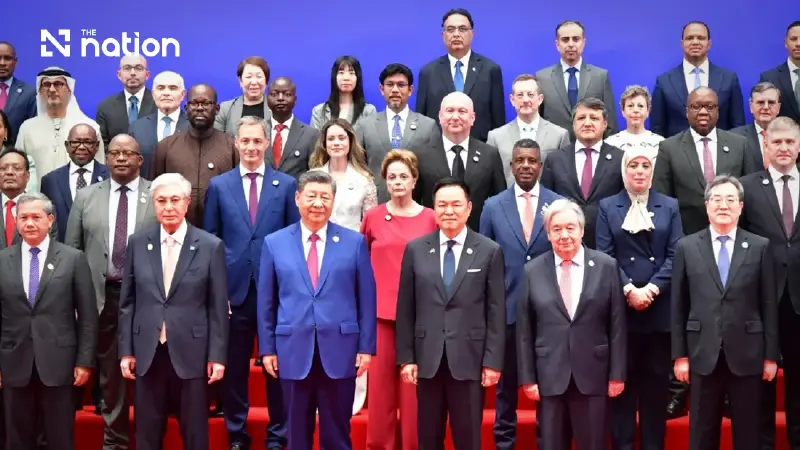


Thailand’s Prime Minister Anutin Charnvirakul proposes protection, potential and prosperity as three AI governance pillars at WAIC 2026 in Shanghai.
- Prime Minister Anutin proposed a global AI governance framework based on three core principles: protecting people's rights and safety, unlocking human potential through responsible innovation, and ensuring shared prosperity.
- He stressed that AI should be a platform for global cooperation to establish common rules and narrow divides, rather than becoming another arena for geopolitical competition.
- Anutin argued that good governance must balance technological progress with safeguards against risks like misinformation and algorithmic bias, creating "trusted progress" that benefits all nations.
Prime Minister Anutin Charnvirakul has outlined three principles for global artificial intelligence governance, calling for AI to protect people, unlock human potential and deliver shared prosperity without leaving anyone behind.
Anutin, who also serves as interior minister, stressed that AI should not become another arena for geopolitical competition. Instead, it should bring countries together to narrow divides, expand common ground and establish rules that support responsible innovation.
He delivered the address at the opening ceremony of the 2026 World Artificial Intelligence Conference (WAIC) at the Shanghai World Reception Hall in Shanghai on Friday (July 17), under the theme “AI Partnership for a Brighter Future”.
Chinese President Xi Jinping attended the event alongside leaders and senior representatives from several countries, international organisations, business and academia.

Global cooperation must shape AI’s future
The Prime Minister described AI as part of a major technological transformation reshaping almost every aspect of people’s lives.
Whether that progress ultimately benefits humanity, he argued, will depend on countries working together to determine the direction, responsibilities and rules governing the development and use of AI.
Anutin praised China for initiating the conference and promoting international cooperation on AI governance. He also welcomed its initiative to establish the World Artificial Intelligence Cooperation Organization and its support for the inaugural United Nations Global Dialogue on AI Governance.
Such efforts could help build an open and inclusive multilateral system centred on a shared objective: creating an AI future that leaves no one behind, he noted.
The Prime Minister proposed that global AI governance should be built around three principles: protection, potential and prosperity.
Protection: safeguarding people
AI must serve humanity while respecting human rights, privacy and human dignity, Anutin emphasised.
Governments and international organisations must also address risks arising from algorithmic bias, hate speech and the misuse of AI to generate fake news, misinformation and deliberately distorted content.
Further harm could arise when the technology falls into the hands of those seeking to exploit legal loopholes or evade accountability. The international community must therefore work together to minimise these risks and prevent damaging or unintended consequences.
Anutin pointed to UNESCO’s Recommendation on the Ethics of Artificial Intelligence as an important foundation for translating ethical principles into safeguards that are practical, enforceable and verifiable.
AI could also be deployed to tackle transnational crime, online scams, cyber fraud and human trafficking.
Thailand has worked with the United Nations Office on Drugs and Crime and partner countries to develop SHIELD, a platform supporting cross-border information-sharing on online crime and human trafficking.
The Prime Minister welcomed China’s interest in joining the initiative, describing it as evidence that AI governance involves more than drafting rules. It must also provide practical mechanisms through which countries can work together effectively.

Potential: enabling responsible innovation
Good AI governance should not become an obstacle to technological progress, Anutin argued.
Every country needs trustworthy institutions, a skilled population, strong digital infrastructure and predictable regulations to encourage innovation while maintaining public confidence.
A well-designed governance system should give researchers, businesses and public agencies room to develop useful technology while ensuring that innovation remains responsible, transparent and worthy of public trust.

Prosperity: ensuring benefits are shared
The true measure of progress in AI should be its contribution to human well-being and prosperity, the Prime Minister noted.
AI should support the Sustainable Development Goals, improve education, healthcare and public services, and create opportunities for small businesses and communities in every country.
Developing nations should be able to help shape and build the future of AI rather than remain merely users of technology created elsewhere, he added.
Thailand is ready to contribute through its AI Governance Practice Centre, which will operate as a practical sandbox where government agencies, businesses and academic institutions can apply international AI governance principles and turn them into workable guidelines.
“Our choice today is not between innovation and regulation. It is to work together to create ‘trusted progress’ so that every country and every sector can share the benefits,” Anutin emphasised.
“AI must not become another factor in geopolitical competition. It should be a platform for global cooperation that narrows differences, broadens common ground and encourages rules that make responsible innovation possible.
“That is how AI can create a safe and prosperous future that leaves no one behind,” he concluded.
