
Laos Launches Historic Gold Festival as Nation Eyes Asian Precious Metals Dominance
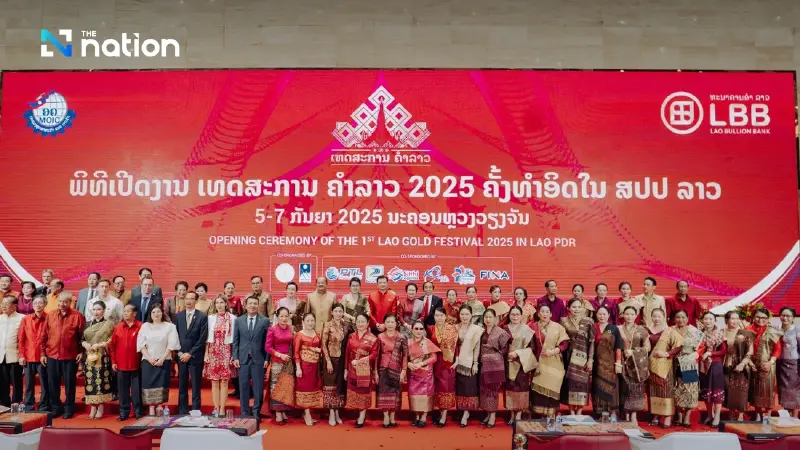


First-ever Lao Gold Festival showcases 40-50 years of craftsmanship as Bullion Bank targets 100,000 accounts and regional expansion
- Laos has launched its inaugural Gold Festival to showcase local craftsmanship and attract international buyers as part of its strategy to become a leading precious metals hub in Asia.
- A key part of the plan is a new US$180 million gold refinery that will allow Laos to control its entire value chain and produce higher purity (99.9%) gold than regional competitors.
- The recently established Lao Bullion Bank is central to the initiative, successfully attracting significant gold deposits to formalize the market and help stabilize the national currency.
- The nation aims to leverage competitive advantages, including cheaper energy, lower labor costs, and direct access to raw materials, to build regional partnerships and serve markets like Thailand's jewelry industry.
Laos recently unveiled its inaugural Gold Festival, marking a pivotal moment in the landlocked nation's ambitious drive to establish itself as Southeast Asia's premier precious metals hub whilst showcasing decades of indigenous craftsmanship to the global market.
The three-day festival (September 5-7) at Lao International Convention Centre brings together over 50 major domestic gold retailers alongside silk merchants and handicraft artisans, attracting over thousand international visitors from more than 10 countries including Thailand, Malaysia, Singapore, Indonesia, Turkey, Poland, Germany, and UAE and welcomed a total of 30,000 visitors across all three days

Four-Decade Industry Seeks Global Recognition
The Lao government strictly controls the country's gold market, which is supplied with about 40 tonnes annually from its gold mines, and driven by a combined annual demand of about 18 tonnes.
Despite this substantial production capacity, the industry has largely operated without unified international exposure.

"Laotian people are high-quality gold craftsmen, but the problem is the lack of opportunities or platforms to showcase their work," said Dr Chanthone Sittixay, CEO of Lao Bullion Bank (LBB), the festival's primary sponsor. "We organised this event to provide a stage for displaying Laotian gold products. This is what we expected."
Dr Chanthone revealed that his institution has committed to funding the festival for its first five years, jointly investing 30 million baht (approximately US$850,000) in this year's event alone, before transitioning oversight to the Lao Gold Association or government authorities.

Bullion Bank Charts Aggressive Growth Path
Eight months after its 3rd December 2024 launch, the bullion bank allows both individuals and legal entities to deposit their gold and use other financial services offered by the bank, enhancing its role as a central institution in the gold market.
The bank has achieved remarkable early traction, accumulating over 4,000 accounts and more than one tonne of gold deposits.
Following the 5 September launch of its LBB+ mobile application, over 5,000 additional downloads were recorded overnight, reinforcing confidence in reaching the year-end target of 10,000 accounts and two tonnes of gold deposits.
"We expect our account numbers this year to exceed our target," Dr Chanthone confirmed, outlining ambitious expansion plans targeting 30,000 accounts and 10 tonnes by 2026, ultimately reaching 100,000 accounts within three years.
The bank offers competitive 2% annual interest rates on gold deposits, complemented by capital gains from global spot gold price fluctuations. With gold prices surging 32% since the bank's inception—from US$2,700 to over US$3,000 per ounce—early investors have achieved substantial returns.

Multi-Billion Dollar Refinery Investment
Once its refinery – which has a capacity of up to 150 tonnes a year – is completed in end-June, the bank anticipates onboarding gold miners as a new customer segment.
The 5 billion baht (US$180 million) refinery project, owned by Lao government and LBB, represents a transformative investment in domestic value-added processing.
"Previously, we had to send gold abroad for refining, primarily to Singapore," Dr Chanthone explained. "Having our own refinery means we can control the entire value chain from extraction to finished products, significantly reducing costs whilst maintaining our 99.9% purity standards—higher than Thailand's 96.5%."
The facility, expected to achieve payback within five years, positions Laos to serve regional markets with 20 years of proven gold reserves supporting operations.

Regional Integration Strategy
The Singapore Bullion Market Association (SBMA) joined the Singapore Bullion Market Association (SBMA) as a Foreign Associate Member on June 4, 2025.
This official recognition followed a Memorandum of Understanding (MOU) signed in October 2024. The move highlights the growing international recognition of Laos' precious metals potential.

Dr Chanthone emphasised the festival's role beyond mere product showcase: "This event demonstrates our capabilities and opens opportunities for regional cooperation. ASEAN collaboration is essential—it's not a question of whether we should cooperate, but rather something we must do."
The CEO noted particular synergy with Thailand's jewelry industry, where high electricity costs, expensive labour, and premium raw material prices create opportunities for Lao partnerships.
"Thailand wants to export gold jewelry to various countries, but faces cost constraints. Laos offers cheaper electricity—from green energy sources—lower labour costs, and direct access to raw materials from our mines,” he stated.

Currency Stabilisation Ambitions
Beyond commercial objectives, LBB serves broader economic stabilization goals for the Lao kip.
"Drawing gold into the banking system is equivalent to drawing foreign reserves into the system, because gold is technically called 'near cash' and 99.99% gold is a settlement asset for international transactions," Dr Chanthone explained.
More than 540 mineral deposits of gold, copper, zinc, lead and other minerals have been identified, explored and mined across Laos, providing substantial foundation for the nation's precious metals sector development.
The initiative aligns with Laos aims to become Asia's gold hub by 2030, leveraging vast reserves to boost financial stability and economic growth.

Market Demographics and International Expansion
Current LBB customers are 98% Laotian, with the remaining 2% comprising foreign residents—90% of whom are Thai nationals. The bank initially restricts services to Lao citizens and foreign residents holding work permits and residential visas, though international expansion is planned pending enhanced cybersecurity infrastructure development.
With approximately 3 million mobile phone subscribers nationwide, the bank's 100,000-account target represents roughly 3.3% market penetration—ambitious yet achievable given the cultural affinity for gold investment across Southeast Asia.
"Through this Gold Festival, people will better understand Laos' gold industry and LBB's identity, principles, and services," Dr Chanthone concluded, reflecting on the event's strategic importance for positioning Laos within the global precious metals landscape.
