
Nattapon declares success in GBC meeting, noting Cambodia agreed to withdraw weapons
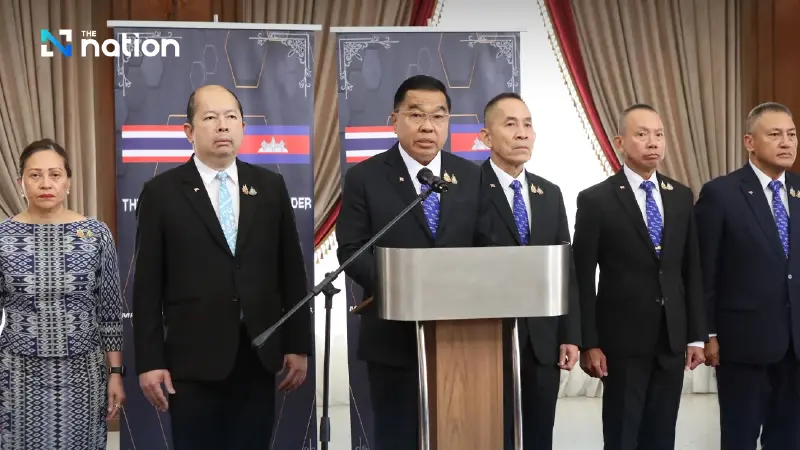


Thailand hails progress as Cambodia agrees to withdraw weapons, clear mines and curb scam gangs under new border peace plan reached at GBC meeting.
- Following a successful General Border Committee (GBC) meeting, Cambodia agreed to Thailand's key condition of withdrawing heavy war weapons from the border.
- To ensure implementation, an Interim Observation Team (IOT) will be established to monitor the weapons pullout, and a joint action plan will be finalized.
- The agreement also includes breakthroughs in other areas, such as a new procedure for joint landmine clearance and the formation of a joint task force to suppress online scam gangs.
- Both nations also agreed to conduct a joint survey and install temporary markers to manage disputed border villages in Sa Kaeo province.
Defence Minister Gen Nattapon Nakpanich has declared the General Border Committee (GBC) meeting in Malaysia a success, saying Cambodia agreed to Thailand’s key conditions — particularly the withdrawal of heavy war weapons from the border.
Cambodia accepts Thailand’s four peace conditions
Nattapon held a press conference after attending the GBC meeting in Kuala Lumpur with his Cambodian counterpart, Deputy Prime Minister and Defence Minister Gen Tea Seiha.
He said the Thai side had insisted on four key conditions for peace, all of which Cambodia agreed to. These conditions include:
- Withdrawal of heavy war weapons from the border.
- Clearance of landmines.
- Suppression of online scam gangs.
- Management of border villages in Sa Kaeo province.
Nattapon said the Thai delegation successfully persuaded Cambodia to accept the conditions, and both sides agreed on detailed measures to ensure concrete implementation.
Observation team to monitor weapons pullout
On the issue of weapons withdrawal, both sides agreed on a Terms of Reference (TOR) for the establishment of an Interim Observation Team (IOT) to monitor the process.
“The two sides have already signed the TOR, and the IOT will monitor the progress of the weapons pullout,” Nattapon said, adding that a timeframe and specific targets were also agreed upon.
He said the Second Army Area Commander and the Commander of Cambodia’s Fourth Military Region have been assigned to implement the joint action plan, and both will meet on Saturday to finalise operational steps.

Nattapon stressed that the withdrawal of weapons was necessary to protect Thai villagers living along the border.
He explained that Cambodian troops had deployed BM-21 multiple rocket launchers, which have wide destructive ranges and could threaten houses, shops, schools, and hospitals in nearby Thai areas.
Breakthrough in mine clearance cooperation
Nattapon said both sides had also reached agreement on a Standard Operating Procedure (SOP) for landmine clearance, covering both disputed and non-disputed zones.
He said coordination teams from both countries could now begin clearance operations immediately, marking a major step forward.
Previously, the Thailand Mine Action Centre (TMAC) had faced difficulties carrying out operations because Cambodian troops frequently obstructed its activities near the border.
“This is the first time Cambodia has seriously agreed to discuss mine clearance in detail,” Nattapon said.
Joint taskforce to tackle online scam gangs
On cybercrime cooperation, Nattapon said this was the first time Cambodia had agreed to actively support Thailand in cracking down on online scam networks.
He revealed that police forces from both countries would set up a joint taskforce within two weeks to begin coordinated suppression operations.
Nattapon said many gang members had previously moved freely between the two countries, using various routes. The new agreement includes the exchange of information, evidence, and witness testimonies, as well as witness protection measures and faster coordination for arrests.
Agreement to jointly survey Sa Kaeo border
Regarding the disputed areas at Ban Nong Chan and Ban Nong Ya Kaeo in Sa Kaeo, both sides agreed to conduct a joint survey between boundary pillars No. 42 to 47 and install temporary border markers.
“These temporary pillars will support the adjustment of land occupation on both sides,” Nattapon said, stressing that the markers were for survey purposes only and would not affect Thailand’s rights under international law.
He also confirmed that Thailand would begin constructing a border fence along clearly demarcated areas within Thailand’s sovereign territory.
