
Thailand and Vietnam enter new era by linking supply chains to counter global geopolitics
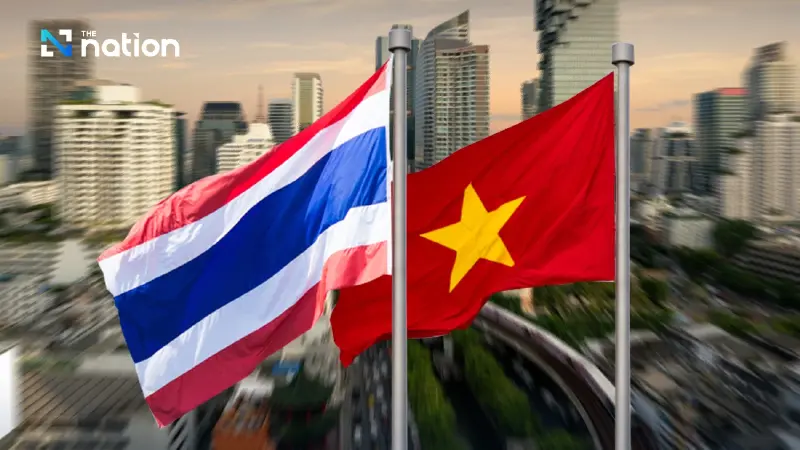


Thailand and Vietnam are entering a new era of cooperation, with closer supply-chain links, sustainable growth strategies and a push to become a stronger Asean production base.
Sanan Angubolkul, president of the Thailand-Vietnam Friendship Association, said the first official visit to Thailand by To Lam, General Secretary of the Central Committee of the Communist Party of Viet Nam and President of the Socialist Republic of Viet Nam, from May 27-29, 2026, marked a signal of transition into a “new era” in Thai-Vietnamese relations across politics, the economy, trade and people-to-people cooperation.
The visit carries significance on several levels, especially as Thailand is the first Asean country chosen by To Lam for an official visit after assuming Vietnam’s highest leadership role. This reflects Hanoi’s recognition of Thailand as an important strategic partner in the region.
The visit also coincides with the 50th anniversary of the establishment of diplomatic relations between Thailand and Vietnam, covering the period from 1976 to 2026. It is therefore seen as a joint effort to set a new blueprint for cooperation over the next half-century.
It also reinforces continuity in government-level cooperation after Thailand formed a new administration, ensuring that existing cooperation in the economy, security, digital development and people-to-people ties continues with stability.

Upgrading CSP to turn competitors into complementary partners
Sanan said the key highlight of the visit was the elevation of Thailand-Vietnam relations to a Comprehensive Strategic Partnership (CSP), the highest level of diplomatic relations.
He said the upgrade would transform economic cooperation between Thailand and Vietnam from being viewed as overlapping competitors into fully complementary partners.
The two countries aim to push bilateral trade to US$25 billion in the years ahead. The new form of cooperation will shift from competing to attract foreign direct investment to a “One Plus One” model that combines the strengths of both countries.
Thailand has advantages in capital, logistics systems and research and development, while Vietnam has strengths in labour and benefits from free trade agreements with European and US markets. Together, these strengths will help both countries attract more global investment into the region.
At the same time, the economic and trade structures of both countries are shifting towards future industries. These include advanced electronic components, electric vehicles, digital technology, renewable energy and green industries, rather than relying mainly on traditional agricultural or textile products.
The public and private sectors of both countries are also preparing to establish joint support mechanisms, such as the Thailand-Vietnam Business Forum, to serve as a platform for business matching and to reduce non-tariff barriers in a concrete way.
More than 300 senior business executives are taking part in activities during the visit.
Pushing the “Three Connects” to link regional supply chains
Sanan said one of the key strategies being accelerated by the Thai and Vietnamese governments is the “Three Connects” strategy. This will serve as an important mechanism to close economic gaps and strengthen the supply chains of both countries amid global economic and geopolitical volatility.
The first area is Connect Supply Chains, or linking supply chains. This aims to resolve bottlenecks in raw materials and energy that have previously disrupted production systems.
One important approach is to integrate industries that support one another. For example, Thailand could produce automotive parts or intermediate chemicals for assembly in Vietnam before the finished products are exported to Europe and the United States through Vietnam’s FTA network. This would make the production systems of the two countries more closely integrated.
The second area is Connect Local Economies, or linking local economies and SMEs, to spread economic opportunities from major cities to regional areas.
This strategy would encourage business matching between provinces in Thailand and Vietnam, especially between Thailand’s Northeast and Vietnam’s central and northern provinces through the R8 and R12 economic routes that pass through Laos. This would help SMEs access new markets more easily while also supporting tourism and border economies.
The third area is Connect Sustainable Growth Strategies, or linking sustainable growth strategies, to respond to environmental trade barriers from Western countries, such as the European Union’s Carbon Border Adjustment Mechanism (CBAM).
Thailand and Vietnam are therefore preparing to connect Thailand’s BCG economy model with Vietnam’s net-zero strategy and green transition. This would be done through joint investment in clean energy, low-carbon technology and smart agriculture, helping upgrade the supply chains of both countries so they can compete sustainably under new global environmental standards.
Sanan said that as the global economy faces pressure from trade wars, geopolitical conflict and the energy transition, Thai-Vietnamese cooperation in this new era would no longer be merely diplomatic.
Instead, it would become an economic strategic partnership with an important role in elevating Asean into a new global production base and supply-chain hub.
